Bush rats fight back
November 10, 2009
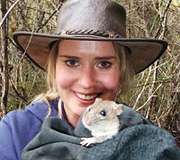
(PhysOrg.com) -- Sydney's native bush rats were unintended victims of a campaign to exterminate foreign black rats during a plague epidemic in 1900, according to new research by scientists who plan to reintroduce the native rats into bushland around Sydney's harbourside suburbs.
The Sydney epidemic of 1900-1905 claimed more than 163 lives and was part of a plague pandemic affecting dozens of countries between 1850 and 1912.
In a bid to limit panic and the mounting death toll, the NSW Government offered six pence - four dollars in today's economy - as bounty for the body of every rat delivered to a purpose-built city furnace established in Bathurst Street.
While the eradication campaign was highly successful - more than 100,000 rats were culled during the first six months - it also led to the indiscriminate killing of harmless native rodents, according to UNSW biologists Dr Peter Banks and Dr Grainne Cleary.
"Historical records and photographs suggest that harmless rodents such as water rats and the native bush rats were caught up in the culling of black rats," says Dr Banks.
"Land-clearing for the suburbs of Mosman, Cremorne and Manly then isolated bush patches on harbour foreshores, depriving the native rodents to recolonise bushland habitats. As a consequence, native bush rats have been a rarity in Sydney ever since - the last confirmed sighting in the city was in 1901."
Despite the black rat's fearsome reputation, Dr Banks says early experiments at Taronga Zoo showed that it is "easily bullied" by native bush rats. The team believes that they are likely to "evict" the invaders from bushland when they are reintroduced, with resulting benefits to many other species preyed on by black rats - notably native birds whose eggs are taken.
Beginning next year, the campaign aims to trap 70 per cent of the vermin rats in four areas before releasing bush rats from 2011. If successful, the trial could be expanded to drive the pests out of suburbs across the city.
-
Plague on their house, but bush rats fight back
Nov 03, 2009 |
not rated yet |
0
-
Smelling a rat to catch a rat
Mar 24, 2008 |
not rated yet |
0
-
Scientist exposes threat to backyard bird diversity
Oct 29, 2007 |
not rated yet |
0
-
Scientists find city rats are loyal to their 'hoods'
May 26, 2009 |
not rated yet |
0
-
Scientists discover 21st century plague
Nov 24, 2008 |
not rated yet |
0
-
Engineers build first sub-10-nm carbon nanotube transistor
Feb 01, 2012 |
4.9 / 5 (31) |
30
-
Something old, something new: Evolution and the structural divergence of duplicate genes
Jan 31, 2012 |
4.6 / 5 (7) |
1
-
The hidden nanoworld of ice crystals: Revealing the dynamic behavior of quasi-liquid layers
Jan 30, 2012 |
5 / 5 (3) |
1
-
Stock market network reveals investor clustering
Jan 27, 2012 |
3.9 / 5 (23) |
8
-
Of microchemistry and molecules: Electronic microfluidic device synthesizes biocompatible probes
Jan 26, 2012 |
5 / 5 (1) |
0
-
Mitosis
49 minutes ago
-
Stem cell question.
2 hours ago
-
Protease cleavage
8 hours ago
-
Pertubance in a model
15 hours ago
-
Cancer drugs and Alzheimer's, Oh my!
23 hours ago
-
Squishing cells
23 hours ago
- More from Physics Forums - Biology
More news stories
The power of estrogen -- male snakes attract other males
A new study has shown that boosting the estrogen levels of male garter snakes causes them to secrete the same pheromones that females use to attract suitors, and turned the males into just about the sexiest ...
13 hours ago |
4.8 / 5 (5) |
1
|
Grass to gas: Researchers' genome map speeds biofuel development
Researchers at the University of Georgia have taken a major step in the ongoing effort to find sources of cleaner, renewable energy by mapping the genomes of two originator cells of Miscanthus x giganteus, a large perenn ...
10 hours ago |
3.8 / 5 (5) |
0
|
Experts reveal how plants don't get sunburn
(PhysOrg.com) -- Experts at the University of Glasgow have discovered how plants survive the harmful rays of the sun.
13 hours ago |
4.7 / 5 (3) |
0
|
Miami battling invasion of giant African snails
No one knows how they got there. But an invasion of African giant snails has southern Florida in a panic over potential crop damage, disease and general yuckiness surrounding the slimy gastropods.
17 hours ago |
4 / 5 (1) |
4
Protein libraries in a snap
(PhysOrg.com) -- A Rice University undergraduate will depart with not only a degree but also a possible patent for his invention of an efficient way to create protein libraries, an important component of biomolecular ...
16 hours ago |
4.8 / 5 (4) |
0
|
Google users warned of threat to smartphone wallets
Users of Google smartphone wallets were being warned on Friday that there is a way to crack pass codes intended to thwart thieves from going on illicit shopping sprees.
Anonymous knocks CIA website offline (Update)
The website of the Central Intelligence Agency was inaccessible on Friday after the hacker group Anonymous claimed to have knocked it offline.
New error-correcting codes guarantee the fastest possible rate of data transmission
Error-correcting codes are one of the triumphs of the digital age. Theyre a way of encoding information so that it can be transmitted across a communication channel such as an optical fiber o ...
Complex wiring of the nervous system may rely on a just a handful of genes and proteins
Researchers at the Salk Institute have discovered a startling feature of early brain development that helps to explain how complex neuron wiring patterns are programmed using just a handful of critical genes. ...
Humans may have helped the decline of African rainforests 3000 years ago
(PhysOrg.com) -- Large areas of rainforests in Central Africa mysteriously disappeared over three thousand years ago, to be replaced by savannas. The prevailing theory has been that the cause was a change ...
New power source discovered
(PhysOrg.com) -- Researchers at the Massachusetts Institute of Technology (MIT) and RMIT University have made a breakthrough in energy storage and power generation.