Children with autism show slower pupil responses, study finds
November 10, 2009
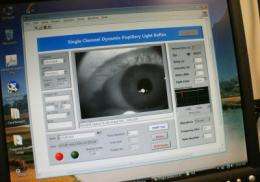
The computerized binocular infrared pulillography device produces a movie and other data that demonstrate how the eye's pupil reacts to a flash of light. Credit: University of Missouri
Autism affects 1 in 150 children today, making it more common than childhood cancer, juvenile diabetes and pediatric AIDS combined. Despite its widespread effect, autism is not well understood and there are no objective medical tests to diagnose it. Recently, University of Missouri researchers have developed a pupil response test that is 92.5 percent accurate in separating children with autism from those with typical development. In the study, MU scientists found that children with autism have slower pupil responses to light change.
"No comprehensive study has been conducted previously to evaluate the pupils' responses to light change, or PLR, in children with autism," said Gang Yao, associate professor of biological engineering in the MU College of Agriculture, Food and Natural Resources and the College of Engineering. "In this study, we used a short light stimulus to induce pupil light reflexes in children under both dark and bright conditions. We found that children with autism showed significant differences in several PLR parameters compared to those with typical development."
In the study, scientists used a computerized binocular infrared device, which eye doctors normally use for vision tests, to measure how pupils react to a 100-millisecond flash light. A pupil reaction test reveals potential neurological disorders in areas of the brain that autism might affect. The results showed that pupils of children diagnosed with autism were significantly slower to respond than those of a control group.
"There are several potential mechanisms currently under study," Yao said. "If these results are successfully validated in a larger population, PLR response might be developed into a biomarker that could have clinical implications in early screening for risks of autism. Studies have shown that early intervention will improve these children's developmental outcome."
-
Research tool can detect autism at 9 months of age
May 20, 2008 |
not rated yet |
0
-
Laughter Differs In Children With Autism
Jul 10, 2009 |
not rated yet |
0
-
Epilepsy drug may increase risk of autism in children
Dec 01, 2008 |
not rated yet |
0
-
Toward a long-sought saliva test for autism
Jan 12, 2009 |
not rated yet |
0
-
No link found between autism and celiac disease
May 01, 2007 |
not rated yet |
0
-
Engineers build first sub-10-nm carbon nanotube transistor
Feb 01, 2012 |
4.9 / 5 (30) |
30
-
Something old, something new: Evolution and the structural divergence of duplicate genes
Jan 31, 2012 |
4.6 / 5 (7) |
1
-
The hidden nanoworld of ice crystals: Revealing the dynamic behavior of quasi-liquid layers
Jan 30, 2012 |
5 / 5 (3) |
1
-
Stock market network reveals investor clustering
Jan 27, 2012 |
3.9 / 5 (23) |
8
-
Of microchemistry and molecules: Electronic microfluidic device synthesizes biocompatible probes
Jan 26, 2012 |
5 / 5 (1) |
0
-
Classical and Quantum Mechanics via Lie algebras
Apr 15, 2011
- More from Physics Forums - Independent Research
More news stories
Study suggests girls can 'rewire' brains to ward off depression
(Medical Xpress) -- What if you could teach your brain to respond differently to things that make you feel sad, down or stressed out? What if doing that helped ward off depression?
Medicine & Health / Psychology & Psychiatry
9 minutes ago |
not rated yet |
0
UNC investigator issues call to action for schizophrenia research
(Medical Xpress) -- Much of medical research is aimed at figuring out what role a single gene or molecule plays in the development of disease.
Medicine & Health / Psychology & Psychiatry
4 minutes ago |
not rated yet |
0
What does love look like?
What does love look like? A dozen roses delivered on an ordinary weekday? Breakfast in bed? Or just a knowing glance between lovers?
Medicine & Health / Psychology & Psychiatry
3 minutes ago |
not rated yet |
0
High school students test best with 7 hours' rest
(Medical Xpress) -- Whether or not you know any high school students that actually get nine hours of sleep each night, thats what federal guidelines currently prescribe.
40 minutes ago |
not rated yet |
0
Using economic evaluations for drug reimbursement decisions - what have we achieved?
Researchers at the University of York perform evaluations of the clinical and cost-effectiveness of drugs for the National Institute for Health and Clinical Excellence (NICE).
37 minutes ago |
not rated yet |
0
New error-correcting codes guarantee the fastest possible rate of data transmission
Error-correcting codes are one of the triumphs of the digital age. Theyre a way of encoding information so that it can be transmitted across a communication channel such as an optical fiber o ...
A frank discussion of the power law and linking correlation to causation
(PhysOrg.com) -- Michael Stumpf a mathematics professor at Imperial College in London, and Mason Porter a lecturer at Oxford have teamed together to write and publish a perspective piece in Science regarding the in ...
Mars Science Laboratory computer issue resolved
(PhysOrg.com) -- Engineers have found the root cause of a computer reset that occurred two months ago on NASA's Mars Science Laboratory and have determined how to correct it.
Advanced power-grid model finds low-cost, low-carbon future in West
(PhysOrg.com) -- The least expensive way for the Western U.S. to reduce greenhouse gas emissions enough to help prevent the worst consequences of global warming is to replace coal with renewable and other ...
Small modular reactor design could be a 'SUPERSTAR'
(PhysOrg.com) -- Though most of today's nuclear reactors are cooled by water, we've long known that there are alternatives; in fact, the world's first nuclear-powered electricity in 1951 came from a reactor ...
The question of life in the ancient world
Theres a general feeling that we dont get the Greeks ancient or modern. Many, including heads of state like Angela Merkel, visibly shake their head in exasperation, rightly or wrongly, at ...