Rapid star formation spotted in 'stellar nurseries' of infant galaxies
November 11, 2009
Rapid star formation spotted in 'stellar nurseries' of infant galaxies

Enlarge

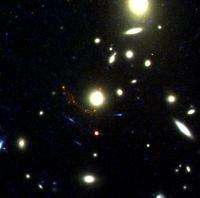
This is a Hubble Space Telescope observation showing the red 'arc' of the rapid star forming galaxy MS1358arc -- seen as it was 12.5 billion years ago. The galaxy is magnified by a factor of 10 by the younger foreground galaxies. Credit: Dr Johan Richard, Durham University.

The Universe's infant galaxies enjoyed rapid growth spurts forming stars like our sun at a rate of up to 50 stars a year, according to scientists at Durham University.

The findings show that "stellar nurseries" within the first galaxies gave birth to at a much more rapid rate than previously expected, the researchers from Durham's Institute for Computational Cosmology revealed.

The research looked back 12.5 billion years to one of the most distant known galaxies, about one billion years after the Big Bang.

Using a technique called gravitational lensing - where distant galaxies are magnified using the gravity of a nearby galaxy cluster - the scientists observed the rapid bursts of star formation in the galaxy called MS1358arc.

Within the star-forming regions, new stars were being created at a rate of about 50 stars per year - around 100 times faster than had been previously thought.

The researchers, who say their work represents the most detailed study of a galaxy at such a young age, believe the observed galaxy is typical of others in the early Universe.

They say the galaxy, which measures 6,000 across, also has all the characteristics that would allow it to eventually evolve into a galaxy such as our Milky Way, giving an insight into how our sun and galaxy formed.

The Durham researchers based their findings on observations from the Gemini North telescope, based in Hawaii, and NASA's Hubble and Spitzer Space Telescopes. The research appears in the . The research was funded by the Royal Astronomical Society.

Lead author Dr Mark Swinbank, in the Institute for Computational Cosmology, at Durham University, said: "The runaway effect in this galaxy suggests it is growing much faster than expected.

"Given the size of the star forming regions, we would expect it to be forming stars at the rate of about one sun per year, but it seems to be much more active than that.

"We think this galaxy is fairly typical of at this time and we expect that the Milky Way once looked like this as it formed its first stars.

"In effect we are seeing the first generation of stars being born in a galaxy like the Milky Way. This gives unique insight into the birth of our own galaxy."

The researchers say most of the observed stars eventually exploded as supernovae, spewing debris back into space where it formed into new stars

Dr Swinbank added: "In this respect these stars are the seeds of future in the Universe."

Royal Astronomical Society President Professor Andy Fabian said: "It is exciting to see such a detailed picture of a very distant galaxy.

"This pioneering work shows what our own galaxy might have looked like when it was a tenth of its present age."

More information: A Spatially Resolved Map of the Kinematics, Star-Formation and Stellar Mass Assembly in a Star-Forming Galaxy at z=4.9, Swinbank, AM, et al, Monthly Notices of the Royal Astronomical Society, 2009, DOI (10.1111/j.1365-2966.2009.15617.x)

Source: Durham University (news : web)

Filter


Move the slider to adjust rank threshold, so that you can hide some of the comments.


Display comments: newest first

yyz
Nov 11, 2009

Rank: 5 / 5 (1)
Interesting to see the researchers identified five star forming regions ~400-600pc in diameter with a SFR consistent with 30 Dor in the LMC. They also noted no central organization of these stellar clumps in the lensed galaxy they studied with Hubble and GEMINI North telescopes.

An interesting reconstruction of the lensed galaxy appears in the paper by Swinbank et al: http://arxiv1.lib...11v1.pdf . These observations seem to favor the 'superwind' hypothesis in early galaxy formation, though more work on distant systems like this one is needed.
Rank 4 /5 (5 votes)
Relevant PhysicsForums posts
  • Titan's lack of impact craters
    createdFeb 09, 2012
  • Real pictures of black hole eating a star?
    createdFeb 08, 2012
  • Hypothetical way to travel faster than light, but not technically exceed lightspeed
    createdFeb 06, 2012
  • How do scientists monitor the Sun's activity?
    createdFeb 05, 2012
  • Search patterns in observational studies
    createdFeb 05, 2012
  • Derivation of Pogson's law
    createdFeb 03, 2012
  • More from Physics Forums - General Astronomy

More news stories

Could Venus be shifting gear?

(PhysOrg.com) -- ESA’s Venus Express spacecraft has discovered that our cloud-covered neighbour spins a little slower than previously measured. Peering through the dense atmosphere in the infrared, the ...

Space & Earth / Space Exploration

created 3 hours ago | popularity 5 / 5 (4) | comments 4 | with audio podcast

Humans may have helped the decline of African rainforests 3000 years ago

(PhysOrg.com) -- Large areas of rainforests in Central Africa mysteriously disappeared over three thousand years ago, to be replaced by savannas. The prevailing theory has been that the cause was a change ...

Space & Earth / Environment

created 7 hours ago | popularity 5 / 5 (3) | comments 7 | with audio podcast report

Clam fields found at deep, low-temperature Mariana vents

(PhysOrg.com) -- Scientists have marveled at the unusual life forms thriving at high temperature hydrothermal vents of the deep ocean.

Space & Earth / Earth Sciences

created 3 hours ago | popularity not rated yet | comments 0 | with audio podcast

Mars Science Laboratory computer issue resolved

(PhysOrg.com) -- Engineers have found the root cause of a computer reset that occurred two months ago on NASA's Mars Science Laboratory and have determined how to correct it.

Space & Earth / Space Exploration

created 4 hours ago | popularity 5 / 5 (5) | comments 2 | with audio podcast

Two new moons for Jupiter

Advances in technology have lead to the discovery of new planets outside of our Solar System, and now even new moons in our own backyard.

Space & Earth / Space Exploration

created 3 hours ago | popularity not rated yet | comments 2


New understanding of DNA repair could eventually lead to cancer therapy

A research group in the Faculty of Medicine & Dentistry at the University of Alberta is hoping its latest discovery could one day be used to develop new therapies that target certain types of cancers.

Zuckerberg's focus drives Facebook's ascent

When Mark Zuckerberg showed up to rent Judy Fusco's Los Altos, Calif., house in the fall of 2004, soon after he'd arrived in Silicon Valley, the landlord was immediately struck by his confidence.

Both maternal and paternal age linked to autism

Older maternal and paternal age are jointly associated with having a child with autism, according to a recently published study led by researchers at The University of Texas Health Science Center at Houston (UTHealth).

Night, weekend delivery OK for babies with birth defects

Weekday delivery is no better than night or weekend delivery for infants with birth defects, according to a new study presented today at The Pregnancy Meeting, the Society for Maternal-Fetal Medicine's annual conference. ...

Sonic Cradle lands spot in TED exhibition

A Simon Fraser University graduate student project that melds music, meditation and modern technology has landed a rare spot as an exhibit at TEDActive 2012 in Palm Springs, California this month.

From virginity to Viagra

Americans will spend more than $17 billion on Valentine's Day, but far less on programs like sex education for adolescents. The editors of the new book, Sex for Life, From Virginity to Viagra, How Sexuality Changes Throughout ...