Warm-blooded dinosaurs worked up a sweat
(PhysOrg.com) -- Were dinosaurs endothermic (warm-blooded) like present-day mammals and birds or ectothermic (cold-blooded) like present-day lizards? The implications of this simple-sounding question go beyond deciding whether or not you'd snuggle up to a dinosaur on a cold winter's evening.
In a study published this week in the journal PLoS ONE, a team of researchers, including Herman Pontzer, Ph.D., assistant professor of anthropology in Arts & Sciences, has found strong evidence that many dinosaur species were probably warm-blooded.
If dinosaurs were endothermic (warm-blooded) they would have had the potential for athletic abilities rivalling those of present day birds and mammals, and possibly similar quick thinking and complicated behaviours as well¬. Their internal furnace would have enabled them to live in colder habitats that would kill ectotherms (cold-blooded animals), such as high mountain ranges and the polar regions, allowing them to cover the entire Mesozoic landscape. These advantages would have come at a cost, however; endothermic animals require much more food than their ectothermic counterparts because their rapid metabolisms fatally malfunction if they cool down too much, and so a constant supply of fuel is required.
Pontzer worked with colleagues John R. Hutchinson and Vivian Allen from the Structure and Motion Laboratory at the Royal Veterinary College, UK, to bring a combination of simple measurements, rigorous computer modeling techniques and their knowledge of physiology in present-day animals to bear in a new study on this hot topic. Using their combined experience, the authors set out to determine whether a variety of dinosaurs and closely related extinct animals were endothermic or ectothermic, and when, where and how often in the dinosaur family tree this important trait may have evolved.
"It's exciting to apply our studies of living animals back to the fossil record to test different evolutionary scenarios," Pontzer said. "I work on the evolution of human locomotion, using studies of living humans and other animals to figure out the gait and efficiency of our earliest fossil ancestors. When I realized this approach could be applied to the dinosaur record, I contacted John Hutchinson, an expert on dinosaur locomotion, and suggested we collaborate on this project. Our results provide strong evidence that many dinosaur species were probably warm-blooded. The debate on this issue will no doubt continue, but we hope our study will add a useful new line of evidence."
Studies of present-day animals have shown that endothermic animals are able to sustain much higher rates of energy use (that is, they have a higher "VO2max") than ectothermic animals can. Following this observation, the researches reasoned that if the energy cost of walking and running could be estimated in dinosaurs, the results might show whether these extinct species were warm- or cold-blooded. If walking and running burned more energy than a cold-blooded physiology can supply, these dinosaurs were probably warm-blooded.
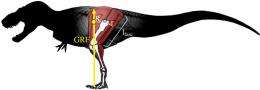
But metabolism and energy use are complex biological processes, and all that remains of extinct dinosaurs are their bones. So, the authors made use of a recent work by Pontzer showing that the energy cost of walking and running is strongly associated with leg length - so much so that hip height (the distance from the hip joint to the ground) can predict the observed cost of locomotion with 98% accuracy for a wide variety of land animals. As hip height can be simply estimated from the length of fossilized leg bones, Pontzer and colleagues were able to use this to obtain simple but reliable estimates of locomotor cost for dinosaurs.
To back up these estimates, the authors used a more complex method based on estimating the actual volume of leg muscle dinosaurs would have had to activate in order to move, using methods Hutchinson and Pontzer had previously developed. Activating more muscle leads to greater energy demands, which may in turn require an endothermic metabolism to fuel. Estimating active muscle volume in an extinct animal is a great deal more complicated than measuring the length of the legs, however, and so the authors went back to basic principles of locomotion.
First, how large would the forces required from the legs have to be to move the animal? In present-day animals, this is mainly determined by how much the animal weighs and what sort of leg posture it uses - straight-legged like a human or bent-legged like a bird, for example. Second, how much muscle would be needed to supply these forces? Experiments in biological mechanics have shown that this depends mainly on the limb muscles' mechanical advantage, which in turn depends strongly on the size of the bony levers they are attached to.
To apply these principles to extinct dinosaurs, Pontzer and colleagues examined recent anatomical models of 13 extinct dinosaur species, using detailed measurements of the fossilized bony levers that limb muscles attached to. From this, the authors were able to reconstruct the mechanical advantage of the limb muscles and calculate the active muscle volume required for each dinosaur to walk or run at different speeds. The cost of activating this muscle was then compared to similar costs in present-day endothermic and ectothermic animals.
The results of both the simple and complex method were in very close agreement: based on the energy they consumed when moving, many dinosaurs were probably endothermic, athletic animals because their energy requirements during walking and running were too high for cold-blooded animals to produce. Interestingly, when the results for each dinosaur were arranged into an evolutionary family tree, the authors found that endothermy might be the ancestral condition for all dinosaurs. This pushes the evolution of endothermy further back into the ancient past than many researchers expected, suggesting that dinosaurs were athletic, endothermic animals throughout the Mesozoic era. This early adoption of high metabolic rates may be one of the key factors in the massive evolutionary success that dinosaurs enjoyed during the Triassic, Jurassic and Cretaceous periods, and continue to enjoy now in feathery, flying form.
Their methods add to the many lines of evidence, from bone histology to lung ventilation and insulatory "protofeathers," that are all beginning to support the fundamental conclusion that dinosaurs were generally endothermic. Ironically, indirect anatomical evidence for active locomotion in dinosaurs was originally some of the first evidence used by researchers John Ostrom and Robert Bakker in the 1960s to infer that dinosaurs were endothermic.
Pontzer and his colleagues provide a new perspective on dinosaur anatomy, linking limb design to energetics and metabolic strategies. The debate over dinosaur physiology will no doubt continue to evolve, and while the physiology of long-extinct species will always remain a bit speculative, the authors hope the methods developed in this study provide a new tool for researchers in the field.
More information: Pontzer H, Allen V, Hutchinson JR (2009) Biomechanics of Running Indicates Endothermy in Bipedal Dinosaurs. PLoS ONE 4(11): e7783. doi:10.1371/journal.pone.0007783
Source: Washington University in St. Louis


