Crops and Weeds: Climate Change's First Responders
(PhysOrg.com) -- A team of Agricultural Research Service (ARS) plant physiologists is studying how global climate change could affect food crop production--and prompt the evolution of even more resilient weeds.
Lewis Ziska, Richard Sicher and Jim Bunce all work at the ARS Crops Systems and Global Change Laboratory in Beltsville, Md. Over the past several years, the three scientists have conducted research on a range of food crops-including soybean, rice, wheat and corn-to learn more about how rising temperatures and rising carbon dioxide (CO2) levels could change production dynamics and crop yields.
For instance, in a typical production year, almost all the soybeans planted in the United States are genetically modified to resist herbicides. This allows farmers to eradicate weeds in soybean fields without harming their crops.
Ziska found that with typical precipitation levels, the growth of genetically modified Roundup-Ready soybeans is stimulated by elevated CO2 levels, but the CO2 also supports the growth of weeds that are typically kept in check by the herbicide glyphosate.
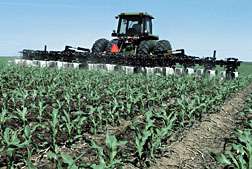
Studies on corn, meanwhile, suggest that the higher levels of CO2 do not stimulate growth. But as CO2 levels rise, so do air temperatures. The warmer conditions prompt leaves to develop earlier and slow down leaf expansion, so above-ground biomass accumulation in the corn plant is suppressed.
Other work by the scientists shows that cheatgrass and Canada thistle--which are both aggressive and invasive weeds--flourish when CO2 levels rise, and that some varieties of dandelions have the genetic ability to adapt rapidly to rising CO2 levels. On the other hand, the same variability in dandelions and other weeds that facilitates rapid adaptation to global climate change might provide genetic material that could be used to breed cultivated crops with improved vigor and yield.
More information: Read more about this research in the November/December 2009 issue of Agricultural Research magazine.
Provided by USDA Agricultural Research Service


