Cornell releases predator beetle to battle hemlock pest
November 11, 2009 By Krishna Ramanujan
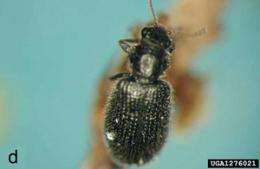
Laricobius nigrinus. Photo: Ashley Lamb, Virginia Polytechnic Institute and State University
(PhysOrg.com) -- Cornell researchers released a well-studied beetle predator to test its ability to ward off a hemlock-killing aphid-like insect.
Hemlock woolly adelgids (HWA) -- aphidlike insects that have destroyed stands of hemlocks throughout the East Coast -- were first identified in hemlocks in the central Finger Lakes in summer 2008 and then in trees in Cornell Plantations' natural areas in early spring 2009.
To battle the hemlock-killing insects, a team of entomologists has released one of the adelgids' natural predators as a local case study. Specifically, researchers from Cornell, the U.S. Forest Service (USFS) and University of Massachusetts-Amherst released 900 Laricobius nigrinus beetles into a stand of adelgid-infested hemlocks on Cornell Plantations land near Lansing and at two other sites on Seneca Lake.
L. nigrinus beetles are native to the Pacific Northwest, where the black, 3-milllimeter-long beetle keeps HWA in check by preying on them. As HWA spread through the Northeast, the insects flourished and decimated hemlocks, since no natural predators lived in the region. HWA avoid predators by growing in the winter. But L. nigrinus beetles have synchronous life cycles with the HWA, and they feed and grow during winter.
"It's important to reassure people, the release of this beetle is not haphazard," said Mark Whitmore, a Cornell forest entomologist in the Department of Natural Resources. "People have been studying L. nigrinus for a long time and have established that it will feed only on adelgids and successfully reproduce only on a diet of HWA."
The Lansing site was ideal for the case study, the researchers said, since the hemlocks there are only lightly infested with HWA, and there are many hemlocks to sustain a long-term study.
Volunteers trained to identify adelgids by Whitmore and Cornell Plantations staff discovered the Lansing site last spring. The site will be left untreated with pesticides for 10 years to study how well the L. nigrinus beetles become established, said Todd Bittner, director of natural areas.
If the experiment proves successful the researchers expect the population will take two to three years to build to levels where they can be readily detected.
Cornell natural areas staff will continue to survey Cornell Plantations, train volunteers and research strategies for stopping the spread of adelgids, Bittner said.
-
Japanese beetle may help fight hemlock-killing insect
Sep 10, 2007 |
not rated yet |
0
-
Loss of hemlocks will affect water dynamics in southern Appalachian forests
Jul 09, 2007 |
not rated yet |
0
-
New York's Ash Trees Threatened by Newly Found Beetle
Jun 18, 2009 |
not rated yet |
0
-
Study finds hemlock trees dying rapidly, affecting forest carbon cycle
Feb 26, 2009 |
not rated yet |
0
-
Researchers test biological ways to control alfalfa pest
May 01, 2009 |
not rated yet |
0
-
Engineers build first sub-10-nm carbon nanotube transistor
Feb 01, 2012 |
4.9 / 5 (32) |
30
-
Something old, something new: Evolution and the structural divergence of duplicate genes
Jan 31, 2012 |
4.6 / 5 (7) |
1
-
The hidden nanoworld of ice crystals: Revealing the dynamic behavior of quasi-liquid layers
Jan 30, 2012 |
5 / 5 (4) |
1
-
Stock market network reveals investor clustering
Jan 27, 2012 |
3.9 / 5 (23) |
8
-
Of microchemistry and molecules: Electronic microfluidic device synthesizes biocompatible probes
Jan 26, 2012 |
5 / 5 (2) |
0
-
Factors affecting beet root cell membrane
6 hours ago
-
Stem cell question.
Feb 10, 2012
-
Protease cleavage
Feb 10, 2012
-
Pertubance in a model
Feb 10, 2012
-
Cancer drugs and Alzheimer's, Oh my!
Feb 09, 2012
-
Squishing cells
Feb 09, 2012
- More from Physics Forums - Biology
More news stories
A mitosis mystery solved: How chromosomes align perfectly in a dividing cell
Although the process of mitotic cell division has been studied intensely for more than 50 years, Whitehead Institute researchers have only now solved the mystery of how cells correctly align their chromosomes during symmetric ...
1 hour ago |
5 / 5 (3) |
0
|
The proteins ensuring genome protection
Researchers from the University of Geneva (UNIGE), Switzerland, have discovered the crucial role of two proteins in developing a cell 'anti-enzyme shield'. This protection system, which operates at the level of molecular ...
1 hour ago |
5 / 5 (2) |
0
|
Researchers find extensive RNA editing in human transcriptome
In a new study published online in Nature Biotechnology, researchers from BGI, the world's largest genomics organization, reported the evidence of extensive RNA editing in a human cell line by analysis of RNA-seq data, demons ...
1 hour ago |
5 / 5 (3) |
0
|
Entire genome of extinct human decoded from fossil
(PhysOrg.com) -- In 2010, Svante Pääbo and his colleagues presented a draft version of the genome from a small fragment of a human finger bone discovered in Denisova Cave in southern Siberia. The ...
Feb 07, 2012 |
4.7 / 5 (58) |
48
|
Why are there so few fish in the Earth's oceans?
(PhysOrg.com) -- A Stony Brook University researcher has found that, contrary to popular belief, there are not plenty of fish in the sea.
Feb 08, 2012 |
4.3 / 5 (17) |
27
|
Scientists discover molecular secrets of 2,000-year-old Chinese herbal remedy
For roughly two thousand years, Chinese herbalists have treated Malaria using a root extract, commonly known as Chang Shan, from a type of hydrangea that grows in Tibet and Nepal. More recent studies suggest that halofuginone, ...
New method to examine batteries -- MRI from the inside
There is an ever-increasing need for advanced batteries for portable electronics, such as phones, cameras, and music players, but also to power electric vehicles and to facilitate the distribution and storage of energy derived ...
Lab study raises questions over nano-particle impact
Tests involving chickens have raised questions about the impact on health from engineered nano-particles, the ultra-fine grains commonly used in drugs and processed foods, scientists said on Sunday.
Google might launch Drive for cloud storage soon
(PhysOrg.com) -- Google's next big move, according to the Wall Street Journal, is a cloud storage service called Drive. Hardly first to the plate, Google is simply catching up to introducing its cloud reposi ...
Starve a virus, feed a cure? Findings show how some cells protect themselves against HIV
A protein that protects some of our immune cells from the most common and virulent form of HIV works by starving the virus of the molecular building blocks that it needs to replicate, according to research published online ...
Injured boomers beware: Know when to see doctor
(AP) -- It happened to nurse Jane Byron years after an in-line skating fall, business owner Haralee Weintraub while doing "men's" push-ups, and avid cyclist Gene Wilberg while lifting a heavy box.