A bubbling ball of gas (w/ Video)
November 11, 2009 A bubbling ball of gas

Enlarge

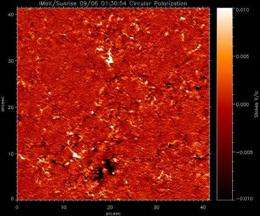
The IMaX instrument not only depicts the solar surface, it also makes magnetic fields visible; these appear as black or white structures in the polarised light. SUNRISE enables tiny magnetic fields on the surface of the Sun to be measured at a level of detail never before achieved. Credit: Image: MPS/IMAX consortium

The Sun is a bubbling mass. Packages of gas rise and sink, lending the sun its grainy surface structure, its granulation. Dark spots appear and disappear, clouds of matter dart up - and behind the whole thing are the magnetic fields, the engines of it all. The SUNRISE balloon-borne telescope, a collaborative project between the Max Planck Institute for Solar System Research in Katlenburg-Lindau and partners in Germany, Spain and the USA, has now delivered images that show the complex interplay on the solar surface to a level of detail never before achieved.

The largest solar telescope ever to have left Earth was launched from the ESRANGE Space Centre in Kiruna, northern Sweden, on June 8, 2009. The total equipment weighed in at more than six tons on launch. Carried by a gigantic helium balloon with a capacity of a million cubic metres and a diameter of around 130 metres, SUNRISE reached a cruising altitude of 37 kilometres above the Earth's surface.

FLV player

This video shows the surface of the sun in close up. Credit: Max Planck Institute for Solar System Research

The observation conditions in this layer of the , known as the stratosphere, are similar to those in outer space: for one thing, the images are no longer affected by air turbulence; and for another, the camera can also zoom in on the in ultraviolet light, which would otherwise be absorbed by the ozone layer. After separating from the balloon, SUNRISE parachuted safely down to Earth on June 14th, landing on Somerset Island, a large island in Canada's Nunavut Territory situated in the Northwest Passage, the seaway through the Arctic Ocean between the Atlantic and the Pacific.

The work of analysing the total of 1.8 terabytes of observation data recorded by the telescope during its five-day flight has only just begun. Yet the first findings already give a promising indication that the mission will bring our understanding of the Sun and its activity a great leap forward. What is particularly interesting is the connection between the strength of the magnetic field and the brightness of tiny . Since the magnetic field varies in an eleven-year cycle of activity, the increased presence of these foundational elements brings a rise in overall solar brightness - resulting in greater heat input to the Earth.

The variations in solar radiation are particularly pronounced in ultraviolet light. This light does not reach the surface of the Earth; the absorbs and is warmed by it. During its flight through the stratosphere, SUNRISE carried out the first ever study of the bright magnetic structures on the solar surface in this important spectral range with a wavelength of between 200 and 400 nanometres (millionths of a millimetre).
A bubbling ball of gas
Enlarge

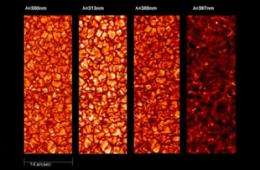
Grainy sun: the images show the so-called granulation in four different wavelengths in near ultraviolet light. The image section depicts 1/20,000 of the entire surface. The smallest recognisable structures have an angular resolution equal to that of looking at a coin from a distance of 100 kilometres. The light structures are the foundational elements of the magnetic fields. Credit: Image: MPI for Solar System Research

"Thanks to its excellent optical quality, the SUFI instrument was able to depict the very small magnetic structures with high intensity contrast, while the IMaX instrument simultaneously recorded the and the flow velocity of the hot gas in these structures and their environment," says Dr. Achim Gandorfer, project scientist for SUNRISE at the Max Planck Institute for Solar System Research.

Previously, the observed physical processes could only be simulated with complex computer models. "Thanks to SUNRISE, these models can now be placed on a solid experimental basis," explains Prof. Manfred Schüssler, solar scientist at the MPS and co-founder of the mission.

Source: Max-Planck-Gesellschaft (news : web)


print this article email this article download pdf blog this article bookmark this article     Stumble it Digg this share on Facebook retweet share on Reddit add to delicious
Rate this story - 4.9 /5 (18 votes)

Rank Filter

Move the slider to adjust rank threshold, so that you can hide some of the comments.


Display comments: newest first

  • yyz - Nov 11, 2009
    • Rank: 5 / 5 (1)
    Congrats to all the Max Planck researchers taking part in this experiment. The combination image/magnetograms are superb in their resolution and clarity. Just fascinating to see the photosphere in such detail.
  • Alizee - Nov 11, 2009
    • Rank: 1 / 5 (1)
    Raising of bubbles seems to be a good idea for theory of sunspot formation.
  • mharratsc - Nov 11, 2009
    • Rank: 1 / 5 (1)
    This article misses the physics relevant to the observations.
    At those temperatures, that 'gas' is ionized- a plasma. It is obeying Maxwell's Laws, not thermodynamic ones.
    It also explains the patently obvious cellular structure appearance- hence why the 1st state of matter was dubbed 'plasma' to begin with- it very strongly resembles blood plasma.
    I can state with some conviction, that I do not see a single 'bubble' in any of those graphics...

    BTW- if those are magnetic fields surrounding plasma, where do they suppose the electric currents are flowing? They MUST be there after all- unless Maxwell's Laws have been repealed?

    I smell a paradigm shift in the wind... ;)

    Mike H.
  • Sonhouse - Nov 11, 2009
    • Rank: 4 / 5 (1)
    I believe the currents would be flowing in spiral motions around each magnetic field line.
    They mentioned the resolution as being like a coin seen at 100 km. I assumed the coin was one cm, and that works out to a resolution of roughly 0.1 arc second, a nice telescope indeed! That makes the Hubble only twice as good! Not bad for a scope dangling from a helium balloon! And the fact it survived recovery sounds like a sequel is in the works!
  • brant - Nov 12, 2009
    • Rank: 1 / 5 (1)
    "The Sun is a bubbling mass. Packages of gas rise and sink, lending the sun its grainy surface structure, its granulation."

    That is not the behavior that one would expect of plasma. The sun is mostly a plasma since it is mostly ionized. There would be no bubbles rising and falling from gravity.. There would be structures probably in the shape of a toroid around the equator under the surface from the plasma flows, creating an electric current.
    The sun spots and photosphere granulation are the result of columns of plasma flows. Same phenomena that you see on the surface of a electrode in a thin plasma. This is definitely not a fluid flow especially at the "surface" of the sun. You notice how everything generally goes outward and heats up. This leads on to posit that (using the simplest mechanism for ion acceleration) there is an electric field present.
  • barakn - Nov 12, 2009
    • Rank: not rated yet
    There's a lot of jaw-flapping around here by folks who are apparently unaware their pet theories have already been discounted by observational evidence. The photosphere, at a temperature of only 5700 K, is only minimally ionized (~ 1 in in every 10,000 hydrogen atoms). Especially amusing is the statement that thermodynamics doesn't apply. Even in the presence of an extremely strong magnetic field (and ignoring all the neutral atoms), ions and electrons would still be able to move parallel to the field and encounter each other - thermodynamics with fewer degrees of freedom. And nobody ever said there weren't electric currents.
  • maxmc - Nov 16, 2009
    • Rank: not rated yet
    you know, i think this is cool and all, but the telescope got me wondering. 1cm resolution from 100km...hmm this is a civilian effort? I think i would hire them to do the google earth. Btw most of the google earth images are one square meter per pixel, and if this telescope was a satellite orbiting about 200km up, at the very worst it'd have a resolution of 4cm^2 hmm that's .0016 square meters...and not only is that incredible, but it's being viewed in ULTRAVIOLET, can you imgaine just ordinary visible light!? I can see the brand of cigarette in ur front yard ;-)

November 11, 2009 all stories

Comments: 7

4.9 /5 (18 votes)
  • Stumble this up

  • Digg this

  • share this

  • hide
  • Related Stories

  • Solar telescope reaches 120,000 feet on jumbo-jet-sized balloon
    created Oct 23, 2007 | popularity not rated yet | comments 0
  • First Images from Hinode Offer New Clues About Our Violent Sun
    created Dec 22, 2006 | popularity not rated yet | comments 0
  • Scientists find elusive waves in sun's corona
    created Aug 30, 2007 | popularity not rated yet | comments 0
  • Science with the solar space observatory Hinode
    created Mar 20, 2008 | popularity not rated yet | comments 0
  • How Strongly Does the Sun Influence the Global Climate?
    created Aug 02, 2004 | popularity not rated yet | comments 0


  • hide
  • Relevant PhysicsForums posts

  • basic 'our universe' question..
    created 2 hours ago
  • deriving keplers law
    created Nov 19, 2009
  • rotation of Earth
    created Nov 18, 2009
  • elliptical orbits
    created Nov 18, 2009
  • Apophis
    created Nov 18, 2009
  • Summer Research project
    created Nov 18, 2009
  • More from Physics Forums - General Astronomy

Other News

Cassini's Big Sky: The View from the Center of Our Solar System

Cassini's Big Sky: The View from the Center of Our Solar System

Space & Earth / Space Exploration

created 10 hours ago | popularity 4.7 / 5 (10) | comments 1

(PhysOrg.com) -- When NASA's Cassini spacecraft began orbiting Saturn five years ago, a dozen highly-tuned science instruments set to work surveying, sniffing, analyzing and scrutinizing the Saturnian system.


More than 18 million cubic metres of sand are set to be poured onto the new coastal band of dunes until 2011

Dutch build more dunes against rising seas

Space & Earth / Environment

created 5 hours ago | popularity 5 / 5 (1) | comments 0

On the beach at Monster, bulldozers painstakingly turn sand dredged from the bottom of the North Sea bed into dunes in an ambitious effort to safeguard the Netherlands from flooding.


NJIT receives funding to improve Big Bear Telescope, study solar energy

NJIT receives funding to improve Big Bear Telescope, study solar energy

Space & Earth / Astronomy

created 3 hours ago | popularity 4 / 5 (2) | comments 0

NJIT researchers are at work on many scientific and technological frontiers. The National Science Foundation has recently provided support that totals nearly $4.3 million for the diverse efforts of the following ...


New Method to Measure Snow, Soil Moisture With GPS May Benefit Meteorologists, Farmers

Space & Earth / Earth Sciences

created 5 hours ago | popularity not rated yet | comments 1

(PhysOrg.com) -- A research team led by the University of Colorado at Boulder has found a clever way to use traditional GPS satellite signals to measure snow depth as well as soil and vegetation moisture, a technique expected ...


Astronauts await word of baby girl on Earth (AP)

Astronauts await word of baby girl on Earth

Space & Earth / Space Exploration

created 7 hours ago | popularity 5 / 5 (1) | comments 0

(AP) -- Atlantis' astronauts anxiously awaited word on the birth of one crewman's daughter Friday, as they moved more supplies into the International Space Station and geared up for another spacewalk.