Why can't chimps speak? Study links evolution of single gene to human capacity for language
November 11, 2009 Why can't chimps speak? Study links evolution of single gene to human capacity for language

Enlarge

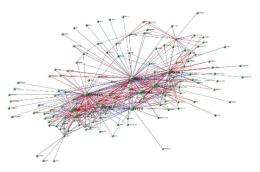
Genes targeted by human and chimp forms of FOXP2: Red lines show target genes that both species express in the same direction, while blue lines indicate target genes that the two species express in opposite directions. Bold text and large green circles denote the most connected genes.

(PhysOrg.com) -- If humans are genetically related to chimps, why did our brains develop the innate ability for language and speech while theirs did not?

Scientists suspect that part of the answer to the mystery lies in a gene called FOXP2. When mutated, FOXP2 can disrupt speech and language in humans. Now, a UCLA/Emory study reveals major differences between how the and chimp versions of FOXP2 work, perhaps explaining why language is unique to humans.

Published Nov. 11 in the online edition of the journal Nature, the findings provide insight into the evolution of the human brain and may point to possible drug targets for human disorders characterized by speech disruption, such as autism and schizophrenia.

"Earlier research suggests that the amino-acid composition of human FOXP2 changed rapidly around the same time that language emerged in modern humans," said Dr. Daniel Geschwind, Gordon and Virginia MacDonald Distinguished Chair in at the David Geffen School of Medicine at UCLA. "Ours is the first study to examine the effect of these amino-acid substitutions in FOXP2 in human cells.

"We showed that the human and chimp versions of FOXP2 not only look different but function differently too," said Geschwind, who is currently a visiting professor at the Institute of Psychiatry at King's College London. "Our findings may shed light on why human brains are born with the circuitry for speech and language and chimp brains are not."

FOXP2 switches other genes on and off. Geschwind's lab scoured the genome to determine which genes are targeted by human FOXP2. The team used a combination of human cells, human tissue and post-mortem from chimps that died of natural causes.

The chimp dissections were performed in the laboratory of coauthor Todd Preuss, associate research professor of neuroscience at Emory University's Yerkes National Research Center.

The scientists focused on — the process by which a gene's DNA sequence is converted into cellular proteins.

To their surprise, the researchers discovered that the human and chimp forms of FOXP2 produce different effects on gene targets in the human cell lines.

"We found that a significant number of the newly identified targets are expressed differently in human and chimpanzee brains," Geschwind said. "This suggests that FOXP2 drives these genes to behave differently in the two species."

The research demonstrates that mutations believed to be important to FOXP2's evolution in humans change how the gene functions, resulting in different gene targets being switched on or off in human and chimp brains.

"Genetic changes between the human and chimp species hold the clues for how our brains developed their capacity for language," said first author Genevieve Konopka, a postdoctoral fellow in neurology at the David Geffen School of Medicine at UCLA. "By pinpointing the genes influenced by , we have identified a new set of tools for studying how human speech could be regulated at the molecular level."

The discovery will provide insight into the of humans' ability to learn through the use of higher cognitive skills, such as perception, intuition and reasoning.

"This study demonstrates how critical chimps and macaques are for studying humans," noted Preuss. "They open a window into understanding how we evolved into who we are today."

Because speech problems are common to both autism and schizophrenia, the new molecular pathways will also shed light on how these disorders disturb the brain's ability to process language.

Source: University of California - Los Angeles


Rate this story - 3.9 /5 (15 votes)

Rank Filter

Move the slider to adjust rank threshold, so that you can hide some of the comments.


Display comments: newest first

  • superhuman - Nov 12, 2009
    • Rank: 3.5 / 5 (2)
    Produce a chimp with human variant then, if it's truly due to one particular different gene he will say so.
  • Velanarris - Nov 12, 2009
    • Rank: 5 / 5 (1)
    From what I understand this gene is shared (the same) in only two primates. Us and Neanderthals.
  • otto1923 - Nov 12, 2009
    • Rank: not rated yet
    YES. Do it because it will change the world. Do it because it is inevitable. Do it because we need to know what they would have to say. DO IT.

November 11, 2009 all stories

Comments: 3

3.9 /5 (15 votes)

  • hide
  • Related Stories

  • Bats add their voice to the FOXP2 story
    created Sep 19, 2007 | popularity not rated yet | comments 0
  • Neandertals, humans share key changes to 'language gene'
    created Oct 18, 2007 | popularity not rated yet | comments 0
  • A gene implicated in human language affects song learning in songbirds
    created Dec 04, 2007 | popularity not rated yet | comments 0
  • Why can we talk? 'Humanized' mice speak volumes
    created May 28, 2009 | popularity not rated yet | comments 0
  • Geneticists Aim to Unravel Where Chimp and Human Brains Diverge
    created Nov 13, 2006 | popularity not rated yet | comments 0


  • hide
  • Relevant PhysicsForums posts

Other News

IQ among strongest predictors of cardiovascular disease -- second only to cigarette smoking

Medicine & Health / Health

created 4 hours ago | popularity 5 / 5 (2) | comments 6 | with audio podcast

as reflected by low results on written or oral tests of IQ - have been associated with a raised risk of cardiovascular disease, no study has so far compared the relative strength of this association with other established ...


Communication breakdown: What happens to nerve cells in Parkinson's disease

Medicine & Health / Neuroscience

created 5 hours ago | popularity not rated yet | comments 0 | with audio podcast

A new study from The Montreal Neurological Institute and Hospital - The Neuro - at McGill University is the first to discover a molecular link between Parkinson's disease and defects in the ability of nerve cells to communicate. ...


Whooping cough vaccine may be losing its punch: study

Medicine & Health / Diseases

created 2 hours ago | popularity not rated yet | comments 0

(PhysOrg.com) -- Vaccination programs against whooping cough may not be fully effective because the bacteria that cause the disease have evolved new strains, a new study has found. A team of Australian scientists has ...


A common cholesterol drug fights cataracts, too

Medicine & Health / Medications

created 3 hours ago | popularity not rated yet | comments 1

Statins, a class of drugs used to lower cholesterol levels, have been successfully fighting heart disease for years. A new study from Tel Aviv University has now found that the same drugs cut the risks of cataracts in men ...


Changes proposed in how psychiatrists diagnose

Medicine & Health / Psychology & Psychiatry

created 3 hours ago | popularity not rated yet | comments 1

(AP) -- Don't say "mental retardation" - the new term is "intellectual disability." No more diagnoses of Asperger's syndrome - call it a mild version of autism instead. And while "behavioral addictions" will be new to doctors' ...