Creating 3D models with a simple webcam (w/ Video)
November 11, 2009 Creating 3D models with a simple webcam

Enlarge

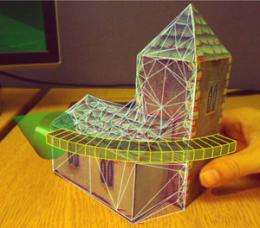
Object 3D reconstruction with texture mapping

(PhysOrg.com) -- Constructing virtual 3D models usually requires heavy and expensive equipment, or takes lengthy amounts of time. A group of researchers at the University of Cambridge, Qi Pan, Dr Gerhard Reitmayr and Dr Tom Drummond have created a program able to build 3D models of textured objects in real-time, using only a standard computer and webcam. This allows 3D modeling to become accessible to everybody.

Qi, Gerhard and Tom presented the system at the 20th British Machine Vision Conference (BMVC'09), in London.

During the last few years, many methods have been developed to build a realistic 3D model of a real object. Various equipment has been used: 2D/, (in visible spectrum or other wave lengths), , , camera, etc. These pieces of equipment are usually expensive, complicated to use or inconvenient and the model is not built in real-time. The data (for example laser information or photos) must first be acquired, before going through the lengthy reconstruction process to form the model. If the 3D reconstruction is unsatisfactory, then the data must be acquired again.

FLV player

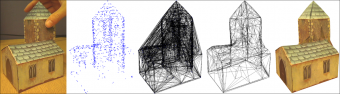
The method proposed by Qi and his colleagues needs only a simple webcam. The object is moved about in front of the webcam and the software can reconstruct the object "on-line" while collecting live video. The system uses points detected on the object to estimate object structure from the motion of the camera or the object, and then computes the Delaunay tetrahedralisation of the points (the extension of the 2D Delaunay triangulation to 3D). The points are recorded in a mesh of tetrahedra, within which is embedded the surface mesh of the object.
Creating 3D models with a simple webcam
Enlarge

Left to right (a) Object rotated by hand in front of camera. (b) Point cloud obtained from on-line structure from motion estimation followed by bundle adjustment. (c) Delaunay Tetrahedralisation of point cloud, partitioning the convex hull into tetrahedra. (d) Carved mesh obtained from recursive probabilisitic tetrahedron carving. (e) Texture-mapped surface mesh.

The software can then tidy up the final reconstruction by taking out the invalid tetrahedra to obtain the surface mesh based on a probabilistic carving algorithm, and the object texture is applied to the 3D mesh in order to obtain a realistic model. Thanks to this simple and cheap system, 3D reconstruction can become accessible to everybody.

The project won "Best Demo Prize" at a conference called ISMAR 2009 (International Symposium of Mixed and Augmented Reality).

Provided by University of Cambridge (news : web)


print this article email this article download pdf blog this article bookmark this article     Stumble it Digg this share on Facebook retweet share on Reddit add to delicious
Rate this story - 5 /5 (25 votes)

Rank Filter

Move the slider to adjust rank threshold, so that you can hide some of the comments.


Display comments: newest first

  • designmemetic - Nov 11, 2009
    • Rank: 1 / 5 (1)
    fantastic, I want it now. why are there artifacts on the chimney?. they look like spider webs connecting the chimeney to the roof or filling in the interior corners. . . it seems to have generated the 3d model incorrectly because of the the spider web artifacts. I guess I could clean it up manually, but it should be easy enough to use the same process to clean up the mistakes from examing additional views. or maybe they were introduced by the hand being in the scene?
  • antialias_physorg - Nov 11, 2009
    • Rank: not rated yet
    Such procedures have a lot of problems with concave structures. But for simple objects it works well.
  • SincerelyTwo - Nov 11, 2009
    • Rank: 5 / 5 (1)
    Well, real world objects just are not made out of simple polygons, irl everything is grainy. This is obviously proof of concept, you could easily get significant improvements by post-processing algorithms to identify and adjust groups of polygons based on certain conditions.

    The software by default was likely designed to convert what it sees as it is, and that includes a lot of details you might not want in a final scan.

    Don't bother getting carried away with demos, what's important here is the technology, the results can be processed as needed.

    Of course, understanding that is taken for granted in the context of science, it's always implied that proof of concept technology isn't going to be production ready.
  • definitude - Nov 12, 2009
    • Rank: not rated yet
    It will be a mix of conformity and innovation that drives the use of this modeling engine. Not every real world condition can be accounted for, however I am thinking more along the line of cost estimating and the like.

    I see the long run implications of triangulated planes limiting. Model compilation may tend toward some more comprehensive geometric analysis.

    Either way, the management of information will still be needed for non-coplanar vector sets. These are good guidelines and design tools for voluming as it is presented here.
  • Assaad33 - Nov 12, 2009
    • Rank: not rated yet
    Is there a demo version of this software?
  • HellCook - Nov 16, 2009
    • Rank: not rated yet
    Model compilation may tend toward some more comprehensive geometric analysis.

    There are very efficients mesh's decication algorithms that could do it.

November 11, 2009 all stories

Comments: 6

5 /5 (25 votes)
  • Stumble this up

  • Digg this

  • share this

  • hide
  • Related Stories

  • New robot skier takes to the slopes (w/ Video)
    created Oct 23, 2009 | popularity not rated yet | comments 0
  • BlackBerry Storm 2 coming soon (w/ Video)
    created Oct 20, 2009 | popularity not rated yet | comments 0
  • Flying MAV Navigates Without GPS (w/ Video)
    created Nov 02, 2009 | popularity not rated yet | comments 0
  • Li-Air: Argonne opens new chapter in battery research (w/ Video)
    created Sep 23, 2009 | popularity not rated yet | comments 0
  • Superior 3D Graphics for the Web a Step Closer
    created Sep 22, 2009 | popularity not rated yet | comments 0


  • hide
  • Relevant PhysicsForums posts

Other News

Chicken farm

Chicken waste turned to watts

Technology / Energy

created 3 hours ago | popularity 4.5 / 5 (2) | comments 1

A Nevada energy developer says it has developed an environmentally clean way of using animal waste from chicken farms across the state to light up homes and offices. Green Energy Solutions wants to convert ...


A man surfs the web at a cafe in Beijing, China where two Chinese bloggers have been fined for defamation

China bloggers fined for defamation: report

Technology / Internet

created 3 hours ago | popularity not rated yet | comments 0

Two Chinese bloggers were ordered to pay about 290,000 yuan (42,478 dollars) in compensation to the widow of film director Xie Jin for claiming he died in the arms of a prostitute, a report said Saturday.


Comcast settles data discrimination lawsuit

Technology / Internet

created Dec 23, 2009 | popularity not rated yet | comments 3

(AP) -- Comcast will pay up to $16 million to settle a class-action lawsuit accusing the cable TV operator of delaying certain Internet traffic.


NORAD is tracking Santa Claus's progress

Follow Santa Claus, courtesy Google and NORAD

Technology / Internet

created Dec 24, 2009 | popularity 3.4 / 5 (5) | comments 0

Santa Claus is coming to your town -- and NORAD is tracking him as he drops off presents around the world. The North American Aerospace Defense Command, which monitors the North American airspace, on Thursday ...


A man uses a laptop computer at a wireless cafe

China cracks down on online games: report

Technology / Internet

created 18 hours ago | popularity not rated yet | comments 0

China has placed more than 4.65 million computers at some 80,000 Internet cafes under watch in a bid to crack down on violent or pornographic online games, state media reported Friday.