Do we need dark matter?
November 12, 2009 by Pete Wilton
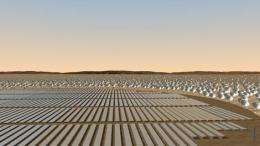
Illustration showing the proposed Square Kilometre Array telescope, image: Xilo Studios
It's the biggest problem in physics: the matter we can see in the universe accounts for just five per cent of the observed gravity that holds galaxies together.
The conventional explanation is that enormous amounts of invisible dark matter make up the missing 95 per cent but some have argued that it’s Einstein’s theory that’s at fault.
In a review in this week’s Science Pedro Ferreira of Oxford’s Department of Physics and Glenn Starkman of Case Western University assess how alternatives to dark matter are shaping up.
‘For over 25 years there has been a proposal that there is no dark matter, that we are simply misinterpreting the data and that what in fact is happening is that we don't understand gravity,’ Pedro tells me.
‘A rudimentary alternative was proposed in the early 80s but only recently were a few complete theories constructed that modify Einstein's theory of general relativity and that could in principle solve the dark matter problem without dark matter.’
Israeli physicist Mordehai Milgrom got the ball rolling in 1983 with a proposal that became known as modified Newtonian dynamics (MOND). Other alternatives build upon this work, such as Jacob Bekenstein’s TeVeS.
Pedro comments: ‘In the review we emphasize two main things. First of all that all of these theories seem to bring in something akin to dark matter through the back door. It is not that they need dark matter as well as modifications to gravity but that any attempt to modify gravity necessarily generates something dark.’
‘The second point is that, even though waters seem to be muddied, there should be observational tests which can distinguish between the two paradigms. By looking at how galaxies are distributed and how they distort any background light, it should be possible to pick out clues for modified gravity, i.e. to test whether Einstein was indeed correct.’
The hope is that galactic surveys, such as those carried out by the Joint Dark Energy Mission or Square Kilometre Array, will be able to see if the telltale signs predicted by these alternative theories really are out there.
More information: Einstein’s Theory of Gravity and the Problem of Missing Mass, Science 6 November 2009: Vol. 326. no. 5954, pp. 812 - 815; DOI: 10.1126/science.1172245
Source: University of Oxford, Science Blog. By Pete Wilton


a = H . c =(8 +- 1) x 10^-10 meters/second^2
The resulting difference can be assigned to hot portion of dark matter and/or errors of measurements - all these effects are indeed quite minute at solar system scale.
Yup, DM/DE smell of pre-Copernican epicycles...
Only EU gives a whole new theory? Do you know all of the other alternative theories?
Si la materia conocida solo es el 5%, y la mataria obscura (Dark matter) es el 95%, entonces, proporcionalmente, somos 95% materia obscura!!!??
We have already investigated Aether theories probably just not the right one. If we put as much money into the aether as we put into the big bang I dont think we would have a universe that is 99.99% unknown.
If you look back, what we did is just blow right past the Aether for Relativity, without the aether ever being fully explored. Then we had to come up with dark matter and energy to fill the gap.
I will entertain "dark matter" theories only after these so-called mundane candidates have been thoroughly discounted.
Physics is the art to create well-mannered models. Not to probe for metaphysical entities like "truth" and "reality". A well-mannered model agrees with observational data and yields falsifiable predictions.
Another observer is trying to describe the very same blob from outside. He is not deformed by its density gradient, so he can see lensing phenomena and curvature of light path, spreading through it. Such view basically corresponds the view of quantum mechanics.
What the physicists are doing during the last 70 years is, they're trying to reconcile these two mutually inconsistent perspectives by common formal model. They can never succeed in it, but it's not so great problem, because they've families and perspective of job.
This is done in the same way that Einstein's equations did away with the unseen mass behind the sun that was needed to explain peculiarities in Mercury's orbit.
Be warned: Be prepared for a paradigm shift.
Try to read old Greek philosopher Parmenides to understand difference between Aether filling the space and Luminiferous Aether.
OK, I see where you got it from. Carmeli is a dedicated evolutionist. It seems the creationists have simply followed the evidence and picked up on his work.
Evidence at the moment is that the Microwave BG radiation is not uniform, implying non-uniform matter creation and hence dispersion. This non-uniform dispersion has just been "officially" confirmed and is being studied further. Coupled to this, quantization of redshift evidence also indicates the same[google all the work done on it]. On top of that the quantization displays a mathematical topology which can only occur if the Milky way is within 1 million light years of the centre of the observations. Hence: a new line of thought is required to explain the evidence. And hence Carmeli's theory.
You can religiously stick with the original Big Bang assertion of a homogeneous universe that looks the same in all directions and deal with dark matter and energy or you can accept the evidence and follow where it goes. Your choice
TeVeS theory proposes better approach: From GR follows, every curvature of space has it's own energy density - this is basically, what the Einstein's field equations are about. But as we know from E=mc^2 formula, every energy density can be assigned to its corresponding mass energy density, which should exhibit it's own additional gravitational field and resulting additional curvature of space. As we know, the highest gradient of gravity field exists at the surface of massive object, so that such gradient results into sparse "cloud" of matter, which partially balances the gravity of matter, which has caused this gradient originally. http://arxiv.org/abs/0708.2639
In this way, dark matter phenomena is source of anomalous deceleration, if you're sitting inside of gravity field and it behaves like anomalous acceleration, when you're sitting outside of it - so it can accelerate expansion of massive bodies in Universe, which is interpreted like result of dark energy.
Compare this situation to spreading of ripples at water surface, where ripples are condensing with increasing speed, which may be experienced like acceleration of space-time expansion, when you're observing water surface via surface ripples only.
http://www.scienc...4056.htm
I used to like MOND but cannot see how strength of gravity can remain the same at vastly different distances. Of course I do wonder about pressure from external source appearing to be a gravitic pull from internal source.
One also wonders if it is possible that expansion of space may produce a side effect of external pressure on galaxies - as in some kind of wave force back lash.
In any case, yes, theories are easy to come up with, proof is a lot harder.
You write about dark matter and energy as if it actually exists, yet no-one has ever seen or detected it! I'd be much more comfortable with your writing if your language included words like "It is thought.." or "the latest models speculate that...". Just a thought. UseItDon'tUseIt....
There was also an article here: http://www.physor...620.html
Whether any of you like it or not, there are natural phenomena being observed *right now that did not match the results of our previous models. So what we did was explore how our models could be extended to maintain reliable predictions. The reason why those extensions are *not necessarily 'band-aid' fixes is because we have DIRECT OBSERVATIONAL EVIDENCE of an EFFECT that we can't explain, but we CAN DESCRIBE.
Scientists are NOT saying that something we can't see exists, they ARE saying that something is CAUSING an EFFECT we DO OBSERVE, and we CAN DESCRIBE. What we don't know is the CAUSE of the EFFECT, but we can SEE it is there.
Lensing effects, universal structure distributions, and rates of change in distance between large bodies contain the information which exposes the evidence.
If our physics didn't work, we wouldn't be exploring space with robots.