A faraway planet intrigues: Exoplanet with extremely tilted orbit raises new interest in stellar astronomy
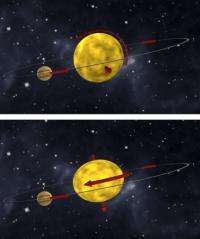
(PhysOrg.com) -- Two teams of astronomers have found a planet outside the solar system that might be orbiting backwards compared to its star's rotation, a discovery that could shed light on how unique the relatively perfect alignment of our solar system is compared to that of other planetary systems.
By measuring the rotation of the parent star of HAT-P-7b, a planet discovered in 2008, the two teams, including one led by MIT assistant professor of physics Joshua Winn and the other by Norio Narita at the National Astronomical Observatory of Japan, found that the orbit is tilted by at least 86 degrees with respect to the star’s equator. The drastic misalignment of the exoplanet, or planet outside our solar system, suggests that it is either rotating over both poles of its star or actually rotating backwards, a phenomenon that does not occur in our solar system and that could help explain why life thrives here.
More than 400 exoplanets have been discovered since 1995 thanks to large ground-based telescopes that have made it easier to observe such planets. Their study is important because their diverse orbits provide evidence that can help astronomers better understand how planets form.
The popularity of studying exoplanets has revived stellar astronomy, the study of how stars form, which had taken a backseat to other fields like cosmology until recently, according to Adam Burrows, an astrophysicist at Princeton University. But “in order to understand the planets, we need to understand the stars,” Burrows explained, noting that many planet properties evolved in terms of stellar parameters like masses, radii and spectra. Because planet formation is understood in the context of star formation, planetary and stellar astronomy “need each other,” Burrows said.
The planets in our solar system are well-aligned and prograde, revolving in the same direction as that of their parent star, the sun. For hundreds of years, astronomers have considered this pattern as a clue that the planets and sun formed from the same spinning disk of gas and dust. They have assumed the same about other planetary systems, Winn said.
But recent developments in exoplanetary science suggest that exoplanets do not conform to previous theories of orbital evolution and may have developed in a manner entirely different from that of the solar system.
The study of exoplanets provides the context for understanding how unusual, or perhaps normal, the solar system is. That there’s life in our solar system could have something to do with the fact that its planets are aligned nearly perfectly with the sun. Or perhaps this orderly alignment of planets is the norm, and it is the tilted exoplanet systems that are “the weird oddballs,” Winn explained.
The HAT-P-7b discovery is not the first exoplanet found to have a tilted orbit. In February, Winn’s team found another exoplanet with a tilt of 37 degrees. But his latest discovery is “by far the most drastic case of a misalignment” ever found, according to Winn, whose research was published in a paper in the Astrophysical Journal in October.
In addition to Winn and Simon Albrecht, a postdoctoral fellow in Winn’s group at MIT, the team included John Asher Johnson of the University of Hawaii; Andrew Howard and Geoffrey Marcy of the University of California, Berkeley; Ian Crossfield of the University of California, Los Angeles; and Matthew Holman of the Harvard-Smithsonian Center for Astrophysics. The work was funded by the NASA Origins program.
Uncovering the oddball
Winn’s team discovered the misalignment in July using the Japanese Subaru telescope in Hawaii. To measure the angle of orbit of HAT-P-7b, which is 1.4 times as wide and 1.8 times as massive as Jupiter and located about 1,000 light years away, it was necessary that it be an “eclipsing” planet, or one that passes in front of its sun from our perspective.
“There are only about 60 eclipsing exoplanets known, and we’ve just been making our way down the list,” said Albrecht. HAT-P-7b is the 15th exoplanet measured by Winn and his colleagues as it eclipses.
The eclipsing exoplanet allows astronomers to rely on the Doppler shift phenomenon that creates subtle color changes measured by a high resolution spectograph when something moves, such as a rotating star. When something moves toward us, it looks slightly bluer, and when it moves away from us, it looks slightly redder, Winn explained.
If an exoplanet’s orbit happens to be viewed from just the right angle, so that the planet passes directly in front of the star once per orbit, then the planet blocks a small fraction of the starlight from reaching Earth. This not only causes the star to appear dimmer, but also changes the spectrum of the star, which is the rainbow of colors you see when light passes through a prism. According to Winn, if a planet is prograde, it first passes in front of the approaching or blue half of the star, and this causes a red shift in the observed starlight. The planet then passes over the receding or blue half of the star, causing a blue shift.
Winn’s team observed the opposite pattern for HAT-P-7b. “First, we saw the starlight get bluer, and then redder,” Albrecht said. “In all the other cases we’ve looked at, the light got redder and then bluer. This told us that from our vantage point on Earth, the HAT-P-7b star seems to rotate in the opposite direction as the revolution of its planet.”
By measuring these changes, one can estimate the angle between the star’s axis and the planet’s orbit. Winn’s team estimates that angle is anywhere between at least 86 and 180 degrees. This means the exoplanet is either orbiting its star’s poles at about a 90 degree tilt, or it is rotating backwards along the star’s equator at 180 degrees.
“There is a large range of uncertainty because we have not measured the true angle between the orbit and the stellar equator. Instead we can only measure the angle that we see from our perspective on Earth,” Winn explained. What remains unknown is how tilted the stellar rotation axis is with respect to our line of sight.
The Japanese team reported similar results in a paper published in the Publications of Astronomical Society of Japan Letters in October.
Explaining the misalignment
Because theorists are reluctant to abandon the theory that all planets and their stars form from a disk of the same material, they are focusing on the notion that the exoplanets formed in a “normal” orbit and somehow got tipped over, according to Winn.
One possibility is that multiple planets formed in what turned out to be an unstable configuration, with their gravity scrambling each other’s orbits to some degree, giving way to “something more chaotic with planets going every which way,” Winn said.
Or perhaps there is a third object, such as an additional planet or a companion star, in the system whose gravity perturbs the orbit of the exoplanet and tilts it, a phenomenon known as the Kozai effect.
“The goal is to figure out how frequently this happens to determine how unlikely our little corner of the galaxy may be,” Winn said. In August, a European team announced it had discovered a retrograde exoplanet known as WASP-17b, although the team’s findings have not yet been published.
Adam Burrows predicts that HAT-P-7b will be highly scrutinized because it is one of the few exoplanets that can be seen by the NASA satellite Kepler and could help break open the field of stellar astronomy.
“Years ago the field was in the doldrums,” Burrows explained. “But now, because of these findings, the field is coming into its own again. There is a renaissance, and this is in no small measure because of observers like Josh who have galvanized the subject.”
Provided by Massachusetts Institute of Technology (news : web)


