A glimpse at the Earth's crust deep below the Atlantic
November 12, 2009 A glimpse at the Earth's crust deep below the Atlantic

Enlarge

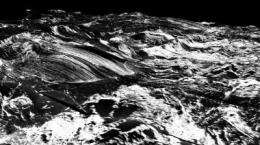
TOBI sidescan sonar imagery draped over multibeam bathymetry provides a unique 3-D view of an active oceanic core complex at 13°19'N, the Mid-Atlantic Ridge. The core complex is the smooth, striated dome forming the left-hand side of the image. To its right is the hummocky neovolcanic zone where recent volcanoes erupt lavas forming the the new oceanic crust. The field of view is around 30km wide. Credit: NOCS

Long-term variations in volcanism help explain the birth, evolution and death of striking geological features called oceanic core complexes on the ocean floor, says geologist Dr Bram Murton of the National Oceanography Centre, Southampton.

Oceanic core complexes are associated with faults along slow-spreading mid-ocean ridges. They are large elevated massifs with flat or gently curved upper surfaces and prominent corrugations called 'megamullions'. Uplifting during their formation causes exposure of lower crust and mantle rocks on the seafloor.

Murton was member of a scientific team that in 2007 sailed to the mid Atlantic Ridge aboard the royal research ship RRS James Cook to study the Earth's crust below the ocean.

"We wanted to know why some faults develop into core complexes, whereas others don't," he says: "It had been suggested that core complexes form during periods of reduced magma supply from volcanism, but exactly how this would interact with the that deform the Earth's crust was unclear."

Using the deep-towed vehicle TOBI equipped with sophisticated equipment for profiling the deep seafloor, Murton and his colleagues discovered three domed and corrugated massifs, from which they dredged and drilled rock samples.

"These massifs turned out to be oceanic core complexes at different stages of a common life cycle," says Murton: "By comparing them we are able to get a much better understanding of the birth, evolution and death of these fascinating ."

It turns out that there is indeed a close link between core complex formation and long-term variations in magma supply. "Core complex development may take a million years or so and is associated with suppressed or absent volcanism," says Murton.

Faults that initiate core complex formation start off pretty much like normal faults around them. But in the absence of sufficient magma, the two sides of the fault continue to slip, and this slippage is further lubricated by seawater penetration and talc formation along the fault zones, leading to deep and large off-set faulting.

However, renewed volcanism can increase the supply of magma, overwhelming the fault. "We believe that renewed or increased volcanism is what eventually terminates the process of core complex formation." says Murton.

More information: MacLeod, C. et al. Life cycle of oceanic core complexes. Earth and Planetary Science Letters 283, 333-344 (2009).

Source: National Oceanography Centre, Southampton


Rate this story - 5 /5 (3 votes)


November 12, 2009 all stories

Comments: 0

5 /5 (3 votes)

  • hide
  • Related Stories

  • Slippery stretching explains ocean floor formation
    created Jul 28, 2006 | popularity not rated yet | comments 0
  • Fragmented Structure of Seafloor Faults May Dampen Effects of Earthquakes
    created Jul 12, 2007 | popularity not rated yet | comments 0
  • Towards a better understanding of hot spot volcanism
    created Jan 31, 2008 | popularity not rated yet | comments 0
  • Mysteries of the Atlantic
    created Mar 01, 2007 | popularity not rated yet | comments 0
  • New Images Reveal Different Magma Pools Form the Ocean's Crust
    created Aug 29, 2005 | popularity not rated yet | comments 0


  • hide
  • Relevant PhysicsForums posts

  • Carbon Dioxide emissions question
    created Feb 08, 2010
  • Photosynthesis vs. carbonization
    created Feb 07, 2010
  • Sheep's footprints
    created Feb 05, 2010
  • How did Victorians estimate the ages of fossils?
    created Feb 03, 2010
  • More from Physics Forums - Earth

Other News

A new 3-D map of the interstellar gas within 300 parsecs from the sun

A new 3D map of the interstellar gas within 300 parsecs from the Sun

Space & Earth / Astronomy

created 16 seconds ago | popularity not rated yet | comments 0 | with audio podcast

(PhysOrg.com) -- Astronomy & Astrophysics is publishing new 3D maps of the interstellar gas in the local area around our Sun. A French-American team of astronomers presents new absorption measurements toward ...


New international satellite observations help assess future earthquake risk in Haiti

New international satellite observations help assess future earthquake risk in Haiti

Space & Earth / Earth Sciences

created 30 minutes ago | popularity not rated yet | comments 0

Virginia Key, Florida--Scientists at the University of Miami have analyzed images based on Synthetic Aperture Radar (SAR) observations taken before and just after Haiti's earthquake, on January 12. The images ...


Rho Ophiuchus cloud

Professor: We have a 'moral obligation' to seed universe with life

Space & Earth / Astronomy

created 8 hours ago | popularity 3.6 / 5 (18) | comments 27 | with audio podcast report

(PhysOrg.com) -- Eventually, the day will come when life on Earth ends. Whether that’s tomorrow or five billion years from now, whether by nuclear war, climate change, or the Sun burning up its fuel, the last ...


Russian Soyuz TMA-17 rocket blasts off to the International Space Station

Russia wants to charge more for rides to space: report

Space & Earth / Space Exploration

created 10 hours ago | popularity 5 / 5 (1) | comments 2

Russia, which is set to hold a monopoly on flights to the international space station (ISS), wants to charge more for rides on its Soyuz rocket, the space agency head said Tuesday.


UB geographers help map devastation in Haiti

Space & Earth / Earth Sciences

created 4 hours ago | popularity not rated yet | comments 0

In the wake of the earthquake in Haiti, University at Buffalo geography students are participating in a global effort to enhance the international response and recovery effort by helping to assess damage, using images hosted ...