Pushing light beyond its known limits
November 12, 2009 Pushing light beyond its known limits

Enlarge

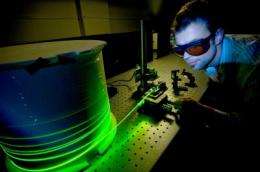
A researcher is testing an optical fiber system in the Institute for Photonics & Advanced Sensing, University of Adelaide. Credit: Photo by Jennie Groom.

Scientists at the University of Adelaide have made a breakthrough that could change the world's thinking on what light is capable of.

The researchers in the University's new Institute for Photonics & Advanced Sensing (IPAS) have discovered that within optical fibers can be squeezed into much tighter spaces than was previously believed possible.

Optical fibers usually act like pipes for light, with the light bouncing around inside the pipe. As you shrink down the size of the fiber, the light becomes more and more confined too, until you reach the ultimate limit - the point beyond which light cannot be squeezed any smaller.

This ultimate point occurs when the strand of glass is just a few hundred nanometers in diameter, about one thousandth of the size of a human hair. If you go smaller than this, light begins to spread out again.

The Adelaide researchers have discovered they can now push beyond that limit by at least a factor of two.

They can do this due to new breakthroughs in the theoretical understanding of how light behaves at the nanoscale, and thanks to the use of a new generation of nanoscale optical fibers being developed at the Institute.

This discovery is expected to lead to more efficient tools for optical data processing in telecommunications networks and optical computing, as well as new light sources.

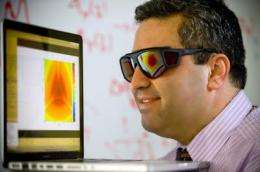
IPAS Research Fellow Dr Shahraam Afshar has made this discovery ahead of today's launch of the new Institute for & Advanced Sensing.

Pushing light beyond its known limits
Enlarge

This is Dr. Shahraam Afshar, Research Fellow with the Institute for Photonics & Advanced Sensing, University of Adelaide. Dr. Afshar theorized that light could be squeezed into much tighter spaces than was previously believed possible. Those theories have now been proven. Credit: Photo by Jennie Groom

IPAS is a world leader in the science and application of light, developing unique lasers, optical fibers and sensors to measure various aspects of the world around us.

"By being able to use our optical fibers as sensors - rather than just using them as pipes to transmit light - we can develop tools that, for example, could easily detect the presence of a flu virus at an airport; could help IVF (in vitro fertilization) specialists to determine which egg should be chosen for fertilization; could gauge the safety of drinking water; or could alert maintenance crews to corrosion occurring in the structure of an aircraft," says Professor Tanya Monro, Federation Fellow at the University of Adelaide and Director of IPAS.

Professor Monro says Dr Afshar's discovery is "a fundamental breakthrough in the science of light".

Another IPAS researcher, Dr Yinlan Ruan, has recently created what is thought to be the world's smallest hole inside an - just 25 nanometers in diameter.

"These breakthroughs feed directly into our applied work to develop nanoscale sensors, and they are perfect examples of the culture of research excellence that exists among our team members," Professor Monro says.

"They will enable us to study the applications of light at much smaller scales than we've ever thought possible. It will help us to better understand and probe our world in ever smaller dimensions."

Source: University of Adelaide (news : web)


print this article email this article download pdf blog this article bookmark this article     Stumble it Digg this share on Facebook retweet share on Reddit add to delicious
Rate this story - 3.9 /5 (18 votes)

Rank Filter

Move the slider to adjust rank threshold, so that you can hide some of the comments.


Display comments: newest first

  • frajo - Nov 12, 2009
    • Rank: 2 / 5 (2)
    There's no scientific content. Just the word "breakthrough" and some unscientific terms like "squeezing light".
  • Alexa - Nov 12, 2009
    • Rank: 3.7 / 5 (3)
    What they found is, by using of special geometry of unimode optical fiber can be achieved, light pulse is propagating like soliton, which is autofocusing and reinforcing itself like wave in Russel's aquaduct.

    http://coephotoni...ode1.jpg

    Analogously, it's well known, inside of channel of conical profile soliton wave is propagating in sharper form, then along flat channel, because such profile increases a nonlinear behavior of soliton waveguide.
  • YawningDog - Nov 12, 2009
    • Rank: 2 / 5 (1)
    I agree. I've been getting more from the comments lately than the articles themselves.
  • PeterROwen - Nov 13, 2009
    • Rank: 1 / 5 (1)
    Are we able to manufacture photon-conduits of the order of the Planck-length?
  • Alexa - Nov 13, 2009
    • Rank: 3 / 5 (2)
    Are we able to manufacture photon-conduits of the order of the Planck-length
    Nope, the smallest waveguides achieved are formed by thin metal wires and they're spreading EM field in form of surface waves (so called surface plasmons) of electron fluid, which is filling metals. Due its density, these waves can be up to ten times smaller, then the ordinary waveguides (in 30 - 60 nm range). This is currently technological limit for directional spreading of EM waves.
  • antialias_physorg - Nov 15, 2009
    • Rank: 3.7 / 5 (3)
    Are we able to manufacture photon-conduits of the order of the Planck-length?


    The Planck length is 100000000000000000000 times smaller than the diameter of a proton. The best conceivable manufacturing processes would scale down to atomic size (which is still a good bit larger than a proton in diameter). So no - Planck length size waveguides are pretty unlikely to ever come about.

November 12, 2009 all stories

Comments: 6

3.9 /5 (18 votes)
  • Stumble this up

  • Digg this

  • share this

  • hide
  • Related Stories

  • Silicon optical fiber made practical
    created Oct 28, 2008 | popularity not rated yet | comments 0
  • Single-crystal semiconductor wire built into an optical fiber
    created Mar 12, 2008 | popularity not rated yet | comments 0
  • A Broadband Light Amplifier on a Photonic Chip
    created Jul 06, 2006 | popularity not rated yet | comments 0
  • New process builds electronic function into optical fiber
    created Mar 16, 2006 | popularity not rated yet | comments 0
  • New technique to compress light could open doors for optical communications
    created Jul 30, 2008 | popularity not rated yet | comments 0


  • hide
  • Relevant PhysicsForums posts

  • Hydrostatic pressure in a submerged pipe
    created 1hour ago
  • Preservation of information?
    created 2 hours ago
  • Goddard
    created 2 hours ago
  • Nonlinear Vs. Chaotic
    created 2 hours ago
  • Pressure vs length vs optimal speed vs volume
    created 4 hours ago
  • Scanning tunneling microscopes, physics lab
    created 5 hours ago
  • More from Physics Forums - General Physics

Other News

First Neutrino Events Observed at T2K Near Detector

First Neutrino Events Observed at T2K Near Detector

Physics / General Physics

created 12 hours ago | popularity 5 / 5 (13) | comments 0

(PhysOrg.com) -- Physicists from the Japanese-led multi-national T2K neutrino collaboration announced today that over the weekend they detected the first events generated by their newly built neutrino beam ...


Researchers develop virtual streams to help restore real ones

Physics / General Physics

created 7 hours ago | popularity not rated yet | comments 0

Researchers at the University of Minnesota have developed a unique new computer model called the Virtual StreamLab, designed to help restore real streams to a healthier state. The Virtual StreamLab, which demonstrates the ...


New tool for helping pediatric heart surgery

Physics / General Physics

created 21 hours ago | popularity not rated yet | comments 0

A team of researchers at the University of California, San Diego and Stanford University has developed a way to simulate blood flow on the computer to optimize surgical designs. It is the basis of a new tool that may help ...


Scientists react as they stand in front of a screen at CERN

First atoms reported smashed in Large Hadron Collider (Update)

Physics / General Physics

created Nov 23, 2009 | popularity 4.7 / 5 (26) | comments 19

Two circulating beams on Monday produced the first particle collisions in the world's biggest atom smasher, the Large Hadron Collider (LHC), three days after its restart, scientists announced.


In the Brain, Seven Is A Magic Number

In the Brain, Seven Is A Magic Number

Physics / General Physics

created Nov 23, 2009 | popularity 4.4 / 5 (28) | comments 8

Having a tough time recalling a phone number someone spoke a few minutes ago or forgetting items from a mental grocery list is not a sign of mental decline; in fact, it's natural.