Rosetta spacecraft may help unravel cosmic mystery (w/ Video)
November 12, 2009
Rosetta

Enlarge

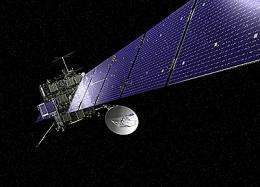
Artist view of ESA's Rosetta cometary probe. The spacecraft is covered with dark thermal insulation in order to keep its warmth while venturing into the coldness of the outer Solar System, beyond Mars orbit. Credits: ESA, image by AOES Medialab

When Europe's comet chaser Rosetta swings by Earth tomorrow for a critical gravity assist, tracking data will be collected to precisely measure the satellite's change in orbital energy. The results could help unravel a cosmic mystery that has stumped scientists for two decades.

Since 1990, scientists and mission controllers at ESA and have noticed that their spacecraft sometimes experience a strange variation in the amount of orbital energy they exchange with Earth during planetary swingbys. The unexplained variation is noticed as a tiny difference in speed gained or lost during the swingby when comparing that predicted by fundamental physics and that actually measured after the event.

This video is not supported by your browser at this time.

This animation shows Rosetta's closest approach to Earth during its second swingby of our planet, Nov. 13, 2007. Credit: ESA

Tiny unexplained speed variations

The unexplained speed variations are extremely small: NASA's Galileo satellite experienced an increase of just 3.9 mm/s above the expected value when it swung past Earth in December 1990. The largest unexpected variation - a boost of 13.0 mm/s - was observed with NASA's NEAR spacecraft at its Earth swingby in January 1998. On the other hand, variations seen at the swingbys of NASA's in 1999 and Messenger in 2005 were so small that they lay within the bounds of uncertainty.

ESA's Rosetta has made two Earth swingbys, in 2005 and 2007. It too, experienced the strange anomaly. Frustratingly, Rosetta sped up by an unexplained 1.8 mm/s during the first passage, but experienced no slowing or speeding in 2007. No one knows what will happen on 13 November 2009 for Rosetta's third and last Earth swingby: scientists are stumped.

"It's a mystery as to what is happening with these gravity events. Some studies have looked for answers in new interpretations of current physics. If this proves correct, it would be absolutely ground-breaking news," says Trevor Morley, lead flight dynamics specialist working on Rosetta at ESOC, ESA's European Space Operations Centre, Darmstadt, Germany.

ESA researchers study Rosetta

Together with ESA colleague and orbital mechanics specialist Frank Budnik, Morley co-authored a scientific report in 2006 that studied the Rosetta anomaly during the 2005 swingby and listed possible causes.

These range from tidal effects peculiar to the near-Earth environment, atmospheric drag, or the pressure of radiation emitted or reflected by the Earth, to much more extreme possibilities, such as dark matter, dark energy or previously unseen variations in General Relativity, one of the most fundamental and well-tested theories of modern physics.

One American research team, led by ex-NASA scientist John Anderson, is even looking at the possibility that Earth's rotation may be distorting space-time - the fundamental fabric of our Universe - more than expected, thus affecting nearby spacecraft. But there is as yet no explanation how this could happen.

Before even considering such exotic explanations, all the usual causes of spacecraft speed errors have been thoroughly eliminated by numerous investigations conducted over the years at both ESA and NASA. Software bugs, calculation errors, tracking uncertainties and other, much more mundane, causes have all been systematically eliminated or accounted for, leaving the speed anomaly maddeningly unexplained.

NASA's Pionneer 10 & 11 similarly affected

Scientists at a number of universities and research centres in Europe, the US and Japan have worked on the anomaly problem over the past years. The swingby anomaly has been compared to another unexplained anomaly - one experienced by NASA's Pioneer 10 and 11 spacecraft.

As they travel on trajectories that will take them eventually into interstellar space, both have experienced an unexpected acceleration directed toward the Sun, which has yet to be explained.

Watching through the night

At ESOC on 13 November, the mission control and flight dynamics teams will be watching closely as ESA's 35m New Norcia station in Australia tracks Rosetta during the closest approach, expected at 08:45:40.0 CET, followed - after a visibility gap of 20 minutes - by ESA's 15m Maspalomas station.

The tracking activity will generate highly precise data that will record whether the spacecraft speeds up or slows down more or less than expected. Deep space ground stations operated by NASA, at Canberra, Australia, and Goldstone, California, will also observe the spacecraft before and after closest approach.

"We are using as many ground stations as are available to maximise the amount of swingby data we record. The more data we get, the better the chance that we may eventually come up with an answer," says Morley.

The data is keenly awaited by scientists on a number of continents, who are hoping to see whether the anomaly is present and whether an explanation is finally possible.

"As it stands now, no one knows what's behind this - it really is a mystery. And your prediction as to whether Rosetta will experience any swingby speed anomaly at all on 13 November is as good as anyone's," says Morley.

Source: European Space Agency (news : web)

Filter


Move the slider to adjust rank threshold, so that you can hide some of the comments.


Display comments: newest first

VOR
Nov 12, 2009

Rank: 5 / 5 (1)
Am I right in saying there is actually no such thiing as a 'gravity boost', but it's actually
a boost from the orbital velocity of the planet, using gravity as just the means to grab some of that orbital velocity? (it seems to me if the planet was somehow motionless there would be no net change in vehicle velocity after such a manuever) - right?
yyz
Nov 12, 2009

Rank: 4 / 5 (1)
"One American research team, led by ex-NASA scientist John Anderson, is even looking at the possibility that Earth's rotation may be distorting space-time - the fundamental fabric of our Universe - more than expected, thus affecting nearby spacecraft. But there is as yet no explanation how this could happen."

Would this be a reference to relativistic frame dragging?
Shootist
Nov 12, 2009

Rank: 5 / 5 (1)
Am I right in saying there is actually no such thiing as a 'gravity boost', but it's actually
a boost from the orbital velocity of the planet, using gravity as just the means to grab some of that orbital velocity? (it seems to me if the planet was somehow motionless there would be no net change in vehicle velocity after such a manuever) - right?


Orbital momentum is transferred in such a way that the planet gains (or loses) the amount lost (or gained) by the spacecraft. IOW, if the spacecraft speeds up, the planet, in proportion to the difference in mass, slows down.
gmurphy
Nov 12, 2009

Rank: not rated yet
exactly, the phenonemon was first observed by Victorian astronomers who noticed that comets increased their speed on their return orbit around the sun. http://en.wikiped...y_assist
Rank 5 /5 (3 votes)
Related Stories
Relevant PhysicsForums posts
  • Titan's lack of impact craters
    created20 hours ago
  • Real pictures of black hole eating a star?
    createdFeb 08, 2012
  • Hypothetical way to travel faster than light, but not technically exceed lightspeed
    createdFeb 06, 2012
  • How do scientists monitor the Sun's activity?
    createdFeb 05, 2012
  • Search patterns in observational studies
    createdFeb 05, 2012
  • Derivation of Pogson's law
    createdFeb 03, 2012
  • More from Physics Forums - General Astronomy

More news stories

Humans may have helped the decline of African rainforests 3000 years ago

(PhysOrg.com) -- Large areas of rainforests in Central Africa mysteriously disappeared over three thousand years ago, to be replaced by savannas. The prevailing theory has been that the cause was a change ...

Space & Earth / Environment

created 2 hours ago | popularity 5 / 5 (2) | comments 0 | with audio podcast report

NASA budget will axe Mars deal with Europe: scientists

US President Barack Obama's budget proposal to be submitted next week for 2013 will cut NASA's budget by 20 percent and eliminate a major partnership with Europe on Mars exploration, scientists said Thursday.

Space & Earth / Space Exploration

created 1 hour ago | popularity not rated yet | comments 1

New views show old NASA Mars landers

(PhysOrg.com) -- The High Resolution Imaging Science Experiment (HiRISE) camera on NASA's Mars Reconnaissance Orbiter recorded a scene on Jan. 29, 2012, that includes the first color image from orbit showing ...

Space & Earth / Space Exploration

created 23 hours ago | popularity 4.9 / 5 (7) | comments 9 | with audio podcast

Black holes and star formation

(PhysOrg.com) -- It has long been recognized that galaxy mergers or even close interactions can play a vital role in shaping the morphology of galaxies. One way they can do so, it is thought, is by triggering ...

Space & Earth / Astronomy

created 22 hours ago | popularity 4.1 / 5 (7) | comments 5 | with audio podcast

Ocean microbe communities changing, but long-term environmental impact is unclear

As oceans warm due to climate change, water layers will mix less and affect the microbes and plankton that pump carbon out of the atmosphere – but researchers say it's still unclear whether these processes ...

Space & Earth / Earth Sciences

created 17 hours ago | popularity 5 / 5 (2) | comments 2 | with audio podcast


Breastfeeding protects against asthma up to six years of age

(Medical Xpress) -- Research by the University of Otago in Christchurch and Wellington has shown that breastfeeding of infants has a clear protective effect against children developing asthma or wheezing up to six years of ...

Study finds stress hormones fluctuate with mood during pregnancy

(Medical Xpress) -- While pregnant, women pay particular attention to factors such as diet and exercise to ensure their babies are born healthy and develop normally. New research from the University of Calgary’s Faculty ...

Japan scientist makes 'Avatar' robot

A Japanese-developed robot that mimics the movements of its human controller is bringing the Hollywood blockbuster "Avatar" one step closer to reality.

Protein libraries in a snap

(PhysOrg.com) -- A Rice University undergraduate will depart with not only a degree but also a possible patent for his invention of an efficient way to create protein libraries, an important component of biomolecular ...

Miami battling invasion of giant African snails

No one knows how they got there. But an invasion of African giant snails has southern Florida in a panic over potential crop damage, disease and general yuckiness surrounding the slimy gastropods.

Sleep breathing machine shows clear benefits in children with sleep apnea

Children and adolescents with obstructive sleep apnea had substantial improvements in attention, anxiety and quality of life after treatment with positive airway pressure (PAP)—a nighttime therapy in which a machine ...