In touch with molecules
November 12, 2009 In touch with molecules

Enlarge

Copyright: CAU

The performance of modern electronics increases steadily on a fast pace thanks to the ongoing miniaturization of the utilized components. However, se-vere problems arise due to quantum-mechanical phenomena when conven-tional structures are simply made smaller and reach the nanometer scale. Therefore current research focuses on the so-called bottom-up approach: the engineering of functional structures with the smallest possible building blocks - single atoms and molecules.

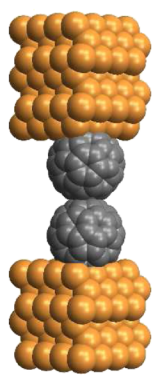
For the first time a collaboration of researchers across Europe now achieved to investigate the electrical behaviour of only two C60 touching each other. The molecule which is shaped like a football was discovered in 1985 and since then has attracted tremendous attention by researchers all over the world due to its unique chemistry and potential technological applications in nano-technology, materials science and electronics.

The findings of the researchers from institutes in Germany, France, Spain and Denmark were published in the latest issue of the prestigious magazine . A scanning tunnelling microscope (STM) was used to con-struct an ultra small comprised of only two C60 molecules, each just 1 nanometer in diameter. The researchers first picked up a single C60 mole-cule with the STM tip and thereafter approached a second molecule with a pre-cision of a few trillionths of meters. During this controlled approach the physi-cists were able to measure the that flows between the two molecules. Understanding this current, which depends critically on the distance between the molecules, is important for utilizing molecules in future electronics.

The investigation revealed that the electrical current does not flow easily be-tween the two touching C60 molecules - the conductance is 100 times smaller than for a single molecule. This finding is crucial for future devices with closely packed molecules as it indicates that leakage currents between neighbouring circuits will be controllable.

These experimental findings are strongly supported by quantum-mechanical calculations which too come to the result of poor electrical conductivity between two C60 molecules.

The extreme precision of manipulation and control of single molecules pre-sented in this work open up a new route for exploring other promising mole-cules. The deeper understanding of electrical current on the nanometer scale is an essential step towards novel molecular nanoelectronics.

More information: PRL 103, 206803 (2009), DOI: 10.1103/PhysRevLett.103.206803

Source: Kiel University


print this article email this article download pdf blog this article bookmark this article     Stumble it Digg this share on Facebook retweet share on Reddit add to delicious
Rate this story - 5 /5 (2 votes)

Rank Filter

Move the slider to adjust rank threshold, so that you can hide some of the comments.


Display comments: newest first

  • Picky - Nov 13, 2009
    • Rank: not rated yet
    Did some-one get hyphen-happy? Or was the-re a form-atting iss-ue?

November 12, 2009 all stories

Comments: 1

5 /5 (2 votes)
  • Stumble this up

  • Digg this

  • share this

  • hide
  • Related Stories

  • Single-Molecule Chemical-Field-Effect Transistor with Nanometer-Sized Gates
    created May 07, 2004 | popularity not rated yet | comments 0
  • Molecules that suck
    created Nov 21, 2005 | popularity not rated yet | comments 0
  • UIC and Japanese chemists close in on molecular switch
    created Jul 10, 2007 | popularity not rated yet | comments 0
  • Researchers control chemical reactions one molecule at a time
    created Dec 14, 2004 | popularity not rated yet | comments 0
  • Scientists create nanotech simulation tool
    created Aug 16, 2005 | popularity not rated yet | comments 0


  • hide
  • Relevant PhysicsForums posts

  • Magnetic Oscillation Equations
    created 6 hours ago
  • US Physics Test Eligibility
    created 7 hours ago
  • Are Active Noise Control Stereo Possible?
    created 12 hours ago
  • New Supercomputer at Brown University
    created 22 hours ago
  • More from Physics Forums - General Physics

Other News

Using superconducting probes to get a picture of what it's like inside CNTs

Nanotechnology / Nanophysics

created 23 hours ago | popularity 4.9 / 5 (7) | comments 0

(PhysOrg.com) -- "Carbon nanotubes are exciting for fundamental physics, and for potential technological applications," Nadya Mason tells PhysOrg.com. "However, we are generally limited in the way that we can study them. ...


Nanoparticles used in common household items caused genetic damage in mice

Nanotechnology / Bio & Medicine

created Nov 16, 2009 | popularity 4.7 / 5 (22) | comments 11

Titanium dioxide (TiO2) nanoparticles, found in everything from cosmetics to sunscreen to paint to vitamins, caused systemic genetic damage in mice, according to a comprehensive study conducted by researchers at UCLA's Jonsson ...


Nanotube defects equal better energy and storage systems

Nanotube defects equal better energy and storage systems

Nanotechnology / Nanomaterials

created Nov 19, 2009 | popularity 4.4 / 5 (9) | comments 2

(PhysOrg.com) -- Most people would like to be able to charge their cell phones and other personal electronics quickly and not too often. A recent discovery made by UC San Diego engineers could lead to carbon ...


When It Comes to Drug Delivery, Size Matters

Nanotechnology / Bio & Medicine

created Nov 20, 2009 | popularity 5 / 5 (1) | comments 0

(PhysOrg.com) -- One of the great promises of nanotechnologies lies in its ability to create drug-containing nanoparticles decorated with targeting molecules that recognize and bind to cancer cells, providing drug delivery ...


Scientists synthesize graphene-like material: Polymer with honeycomb structure

Scientists synthesize graphene-like material: Polymer with honeycomb structure

Nanotechnology / Nanomaterials

created Nov 19, 2009 | popularity 4.5 / 5 (6) | comments 1

Two-dimensional carbon layers, so-called graphenes, are regarded as a possible substitute for silicon in the semiconductor industry. The electronic properties of these layers can be varied by "building in" ...