To make memories, new neurons must erase older ones
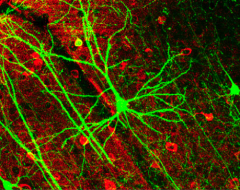
Short-term memory may depend in a surprising way on the ability of newly formed neurons to erase older connections. That's the conclusion of a report in the November 13th issue of the journal Cell that provides some of the first evidence in mice and rats that new neurons sprouted in the hippocampus cause the decay of short-term fear memories in that brain region, without an overall memory loss.
The researchers led by Kaoru Inokuchi of The University of Toyama in Japan say the discovery shows a more important role than many would have anticipated for the erasure of memories. They propose that the birth of new neurons promotes the gradual loss of memory traces from the hippocampus as those memories are transferred elsewhere in the brain for permanent storage. Although they examined this process only in the context of fear memory, Inokuchi says he "thinks all memories that are initially stored in the hippocampus are influenced by this process."
In effect, the new results suggest that failure of neurogenesis will lead to problems because the brain's short-term memory is literally full. In Inokuchi's words, we may perhaps experience difficulties in acquiring new information because the storage capacity of the hippocampus is "occupied by un-erased old memories."
Of course, Inokuchi added, "our finding does not necessary deny the important role of neurogenesis in memory acquisition." Hippocampal neurogenesis could have a dual role, he says, in both erasing old memories and acquiring new ones.
Earlier studies had shown a crucial role for the hippocampus in memorizing new facts. Studies in people with impaired and normal memories and in animals also showed that information recall initially depends on the hippocampus. That dependence progressively decays over time as memories are transferred to other regions, such as the neocortex. Scientists have also observed a similar decay in the strength of connections between neurons of the hippocampus, a phenomenon known as long-term potentiation (LTP) that is considered the cellular basis for learning and memory.
Scientists also knew that new neurons continue to form in the hippocampuses of adults, even into old age. But it wasn't really clear what those newborn brain cells actually do. Inokuchi's team suspected that the integration of new neurons was required to maintain neural connections, but they realized it might also go the other way. The incorporation of new neurons into pre-existing neural circuits might also disturb the structure of pre-existing information, and indeed that is what their new findings now show.
The researchers found that irradiation of rat's brains, which drastically reduces the formation of new neurons, maintains the strength of neural connections in the hippocampus. Likewise, studies of mice in which hippocampal neurogenesis was suppressed by either physical or genetic means showed a prolonged dependence of fear memories on that brain region.
On the other hand, voluntary exercise, which causes a rise in the birth of new neurons, sped up the decay rate of hippocampus-dependency of memory, without any memory loss.
"Enhanced neurogenesis caused by exercise may accelerate memory decay from the hippocampus and at the same time it may facilitate memory transfer to neocortex," Inokuchi said. "Hippocampal capacity of memory storage is limited, but in this way exercise could increase the [brain's overall] capacity."
The study sets the stage for further examination of the connections between neurogenesis and learning capacity, the researchers say. They also plan to examine how the gradual decay of memory dependence on the hippocampus relates to the transformation of memory over time from a detailed and contextually-rich form to a more generic one.
Source: Cell Press (news : web)


