Surgeon 'gluing' the breastbone together after open-heart surgery
November 12, 2009
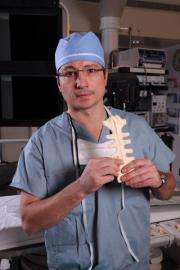
Dr. Paul Fedak from the University of Calgary Faculty of Medicine has developed an innovative method to repair the breastbone after it is intentionally broken to provide access to the heart during open-heart surgery. The technique uses a state-of-the-art adhesive that rapidly bonds to bone and accelerates the recovery process Credit: Paul Rotzinger
An innovative method is being used to repair the breastbone after it is intentionally broken to provide access to the heart during open-heart surgery. The technique uses a state-of-the-art adhesive that rapidly bonds to bone and accelerates the recovery process.
"We can now heal the breastbone in hours instead of weeks after open-heart surgery. Patients can make a full recovery after surgery and get back to full physical activities in days instead of months," reports Dr. Paul W.M. Fedak, MD PhD FRCSC, a cardiac surgeon at Foothills Medical Centre and scientist at the Faculty of Medicine who pioneered the new procedure.
Over 20 patients have received the new technique in Calgary as part of a pilot study. Fedak and Kathryn King, RN PhD are the co-principal investigators on the study. King, a cardiovascular nurse scientist, is an expert in post-operative recovery after open-heart surgery. "We know that recovery from sternotomy is a multi-faceted process that includes not only healing of the breastbone but the ability to return to normal activities," she says. "Being able to resume normal activities is a hallmark of a good recovery; this surgical innovation should enable that."
The patients report substantially less pain and discomfort after surgery and the use of strong pain medication, such as narcotics, is profoundly reduced if not completely eliminated with use of the procedure. The ability to deep breathe, known to play a key role in recovery, is also substantially improved.
Richard Cuming's chest was repaired in June Kryptonite adhesive, a biocompatible polymer (manufactured by Doctors Research Group Inc., (Connecticut USA). Two years earlier he had open-heart surgery repaired the traditional way - sewing his breastbone back together with wire. That wire broke, his breastbone opened, and Cuming had a difficult time.
"I couldn't accomplish simple tasks like squeezing toothpaste, turning the steering wheel in my car or pulling open a heavy door without discomfort and pain. Anytime I coughed or sneezed there was movement in my chest and significant pain, I think the worst part of the ordeal was that I stopped doing things 'in case they would hurt'" says Cuming.
After his chest was 'glued' back together using Kryptonite adhesive and wires he had an entirely different experience. "I had a little bit of pain, but this was a walk in the park compared to my earlier recovery. I can do anything I could do prior to the original surgery. I feel wonderful."
The encouraging results of this pilot study have prompted the Calgary researchers to establish a worldwide study to further investigate its benefits. The STICK Trial (STernal Innovative Closure with Kryptonite) aims to apply the technique in over 500 patients across the globe over the next 12 - 24 months.
"We are proud of the innovative work being done at Foothills Medical Centre," says Dr. L. Brent Mitchell, Director of the Libin Cardiovascular Institute of Alberta and Head of the Clinical Department of Cardiac Sciences at Alberta Health Services, "I used to warn my open-heart surgery patients that they would feel like they had been hit by a truck during a long recovery period; I'm glad I don't have to say that anymore."
More than one million open-heart surgeries are performed in the world each year by splitting the breastbone. Until this recent discovery, wire closure of the breastbone had been standard practice since routine heart surgery was established a half century ago.
The investigators believe that this improved method of chest closure will become a new standard of care for patients undergoing open-heart surgery. Fedak has started training surgeons in other Canadian and European hospitals where it is rapidly gaining popularity.
-
Heart valves implanted without open-heart surgery
Jan 07, 2009 |
not rated yet |
0
-
Performing surgery on a beating heart may be safer
Jan 31, 2007 |
not rated yet |
0
-
Robot-assisted minimally-invasive CABG surgery
Apr 07, 2008 |
not rated yet |
0
-
Study examines prevalence of chest pain in patients 1 year after heart attack
Jun 23, 2008 |
not rated yet |
0
-
Open chest surgery alternative found
Nov 20, 2006 |
not rated yet |
0
-
Engineers build first sub-10-nm carbon nanotube transistor
Feb 01, 2012 |
4.9 / 5 (31) |
30
-
Something old, something new: Evolution and the structural divergence of duplicate genes
Jan 31, 2012 |
4.6 / 5 (7) |
1
-
The hidden nanoworld of ice crystals: Revealing the dynamic behavior of quasi-liquid layers
Jan 30, 2012 |
5 / 5 (3) |
1
-
Stock market network reveals investor clustering
Jan 27, 2012 |
3.9 / 5 (23) |
8
-
Of microchemistry and molecules: Electronic microfluidic device synthesizes biocompatible probes
Jan 26, 2012 |
5 / 5 (1) |
0
-
Classical and Quantum Mechanics via Lie algebras
Apr 15, 2011
- More from Physics Forums - Independent Research
More news stories
FDA-approved drug rapidly clears amyloid from the brain, reverses Alzheimer's symptoms in mice
Neuroscientists at Case Western Reserve University School of Medicine have made a dramatic breakthrough in their efforts to find a cure for Alzheimer's disease. The researchers' findings, published in the journal Science, show t ...
Medicine & Health / Neuroscience
Feb 09, 2012 |
4.9 / 5 (53) |
21
|
Green tea found to reduce disability in the elderly
(Medical Xpress) -- A lot of research has been done over the past several years looking into the health benefits of green tea. As a result, scientists have found that regular consumption of the beverage leads ...
Teen school drop-outs three times as likely to be on benefits in later life
Teen school drop-outs are almost three times as likely to be on benefits in later life as their peers who complete their schooling, indicates research published online in the Journal of Epidemiology and Community Health.
Feb 06, 2012 |
not rated yet |
12
To perform with less effort, practice beyond perfection
Whether you are an athlete, a musician or a stroke patient learning to walk again, practice can make perfect, but more practice may make you more efficient, according to a surprising new University of Colorado Boulder study.
Medicine & Health / Neuroscience
Feb 09, 2012 |
4.4 / 5 (15) |
6
|
Anyone can learn to be more inventive, cognitive researcher says
There will always be a wild and unpredictable quality to creativity and invention, says Anthony McCaffrey, a cognitive psychology researcher at the University of Massachusetts Amherst, because an "Aha moment" is rare and ...
Medicine & Health / Psychology & Psychiatry
Feb 09, 2012 |
4.6 / 5 (11) |
5
|
Google might launch Drive for cloud storage soon
(PhysOrg.com) -- Google's next big move, according to the Wall Street Journal, is a cloud storage service called Drive. Hardly first to the plate, Google is simply catching up to introducing its cloud reposi ...
Walney offshore wind farm is world's biggest (for now)
(PhysOrg.com) -- The Walney wind farm on the Irish Sea--characterized by high tides, waves and windy weather--officially opened this week. The farm is treated in the press as a very big deal as the Walney ...
Latin America mining boom clashes with conservation
Latin America is experiencing a mining boom as prices rise fuelled by a hike in global demand, but the region is also being hit by a wave of violent protests, strikes and rallies by environmentalists.
Love a click away in Indonesia's Twitter Republic
He was a geeky kid from Yogyakarta, she a glamorous city girl in Jakarta. In a country with one of the world's most vibrant social networking scenes they fell in love on Twitter.
Europeans protest controversial Internet pact
Tens of thousands of people marched in protests in more than a dozen European cities Saturday against a controversial anti-online piracy pact that critics say could curtail Internet freedom.
Navy to begin tests on electromagnetic railgun prototype launcher
The Office of Naval Research (ONR)'s Electromagnetic (EM) Railgun program will take an important step forward in the coming weeks when the first industry railgun prototype launcher is tested at a facility ...