A biology whodunnit: are rodents helping protect trees from fire?
November 12, 2009 A biology whodunnit: are rodents helping protect trees from fire?

Enlarge

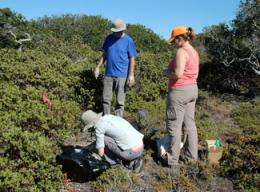
Tom Parker (center) and his team setting up trays of fruit to attract rodents at Fort Ord Natural Reserve in Santa Cruz.

Tom Parker has made an unusual find. In California forests and shrubland that burned in 2008, he has spotted Manzanita seedlings sprouting in tight clusters, suggesting that the young shrubs emerged from underground stashes of seeds. But how did they get there?

Each year, wildfires provide the biology professor with new evidence about how California native cope with intense heat and smoke. This fall, Parker is spending nights in the field, tracking mice, meadow voles and , which he believes are squirreling away Manzanita seeds and helping these plants adapt to fire conditions.

"We believe that rodents open up Manzanita's cherry-like fruit and bury the seeds found inside, similar to a squirrel hiding its nuts to eat later," said Parker, an expert on Manzanita, a group of evergreen and shrubs. "What's critical is that they bury the seeds at a depth that the seeds can survive the heat if a fire breaks out."

Parker's nocturnal experiments near Monterey and Santa Cruz attract rodents to trays of fruit and track their footprints using fluorescent powder that shows up under UV light. "We want to get the rodents to bury the seeds so we can see how many they are burying in one cache and how deep they are burying them," Parker said. "We follow the footprints and where the seed cache is, there is usually a mess of fluorescent powder on the ground where the rodents have been stamping down the soil on top of their seeds."

Parker plans to replicate the depth and distribution of the seeds in lab experiments to test whether the rodent's caches are improving the plants' survival rates.

As an insurance policy against fire, Manzanita species rely on underground stores of that repopulate the area after a fire. Through such natural means as wind or gravity, botanists believe it takes as many as 25 years for adult shrubs to develop a in the soil, but the process could be much faster if rodents are involved.

"Sometimes plants develop survival strategies that use the help of animals, like bees pollinating flowers," Parker said. "If our hypothesis is correct, we'll show that contrary to popular belief, rodents are more of a help than a hindrance to Manzanita -- a finding that will inform the management and conservation of this group of plants, two-thirds of which are rare or listed species."

Like much of Parker's research, his latest project will increase the understanding of California's native plants and the results will inform park managers' efforts to manage fragile habitats. North America's West Coast is one of the world's biodiversity hotspots, home to more than 2,000 species that only grow in this region, including the 60 species in the Manzanita, or Arctostaphylos, genus. In recent years, Parker and colleagues have described two new Manzanita species, one of which has just 100 plants in its population.

Parker has spent more than 30 years researching west coast plant life, including studies of fire ecology and San Francisco Bay's salt marshes and wetlands. He has just assumed a new role as President of the California Botanical Society for 2009-12. Parker hopes to propose special issues of the Society's scientific journal, one devoted to climate change and another exploring how California's growing population is impacting the state's rare plants.

Provided by San Francisco State University (news : web)


print this article email this article download pdf blog this article bookmark this article     Stumble it Digg this share on Facebook retweet share on Reddit add to delicious
Rate this story - 5 /5 (1 vote)


November 12, 2009 all stories

Comments: 0

5 /5 (1 vote)
  • Stumble this up

  • Digg this

  • share this

  • hide
  • Related Stories

  • Small rodents encourage the formation of scrubland in Spain
    created Aug 27, 2009 | popularity not rated yet | comments 0
  • UK botanists bank 10% of world's plant species
    created Oct 15, 2009 | popularity not rated yet | comments 0
  • Rooted plants move mysteriously down greenways, scientists say
    created Dec 03, 2008 | popularity not rated yet | comments 0
  • Spread of Western Juniper Seeds Studied
    created Nov 05, 2009 | popularity not rated yet | comments 0
  • Evolutionary biology research on plant shows significance of maternal effects
    created Nov 15, 2007 | popularity not rated yet | comments 0


  • hide
  • Relevant PhysicsForums posts

  • Breeding program
    created 14 hours ago
  • How does a concentration gradient provide energy?
    created 18 hours ago
  • Eyesight and Neural Damage from Electronics
    created Nov 19, 2009
  • Quick question about the Golgi Apparatus?
    created Nov 19, 2009
  • More from Physics Forums - Biology

Other News

Atomic-level Snapshot Catches Protein Motor in Action (w/ Video)

Atomic-level Snapshot Catches Protein Motor in Action (w/ Video)

Biology / Cell & Microbiology

created 15 hours ago | popularity 4.5 / 5 (2) | comments 1

(PhysOrg.com) -- The atomic-level action of a remarkable class of ring-shaped protein motors has been uncovered by researchers with the Lawrence Berkeley National Laboratory using a state-of-the-art protein ...


Termite creates sustainable monoculture fungus-farming

Termite creates sustainable monoculture fungus-farming

Biology / Plants & Animals

created 14 hours ago | popularity 5 / 5 (1) | comments 0

(PhysOrg.com) -- Food production of modern human societies is mostly based on large-scale monoculture crops, but it now appears that advanced insect societies have the same practice. Our societies took just ...


Sponges against cancer

Biology / Cell & Microbiology

created 17 hours ago | popularity 5 / 5 (1) | comments 0

Deep under the sea, there's a battle of life and death going on, with no holds barred. Sponges and other marine animals which cannot move around might seem to be defenceless against predators. Yet nothing is further from ...


We're off then: the evolution of bat migration

We're off then: The evolution of bat migration

Biology / Plants & Animals

created 17 hours ago | popularity not rated yet | comments 0

(PhysOrg.com) -- Not just birds, but also a few species of bats face a long journey every year. Researchers at Princeton University in the U.S. and at the Max Planck Institute for Ornithology in Radolfzell, ...


Dutch researchers make breakthrough in bioethanol production from agricultural waste

Biology / Cell & Microbiology

created 18 hours ago | popularity 3.7 / 5 (3) | comments 0

With the introduction of a single bacterial gene into yeast, researchers from Delft University of Technology in the Netherlands achieved three improvements in bioethanol production from agricultural waste material: 'More ...