Elephant seals take naps while diving
November 13, 2009 by Lin Edwards
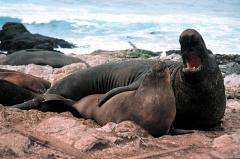
Northern elephant seal, male and female (Mirounga angustirostris), Gulf of the Farallones National Marine Sanctuary (California). Photo: National Oceanic and Atmospheric Administration
(PhysOrg.com) -- A new study may have solved the long-standing question of how elephants sleep during their long migrations at sea, when they can be away from land for up to eight months.
Whales and dolphins are believed to be able to sleep at the surface by having one hemisphere of their brains asleep while the other remains awake, but northern elephant seals (Mirounga angustirostris) cannot do the same, and they rarely spend much time at the surface. Scientists have therefore wondered how these animals can sleep during their migrations from the Californian breeding colonies to feeding areas around Alaska and the mid-Pacific. Now a new study suggests they may sleep underwater as they slowly sink.
The team of researchers from the US and Japan fitted six young northern elephant seals from the seal colony at the A?o Nuevo State Reserve in California with data loggers. The instruments recorded the speed, depth, temperature, location and three-dimensional movements of the seals and allowed the scientists to model their dives in three dimensions. The seals were released up to 70 km from their colony and then tracked as they made their way back home.
The results of the study showed the seals made the same kind of repetitive deep dives as they are known to make during their migrations. They also found the seals sometimes roll over and then spiral down towards the bottom of the sea in a slow descent known as the drift dive.
According to Russel Andrews, one of the authors of the paper, the periodic wobbling associated with the drift dive resembles the fluttering of a leaf falling to the ground, and slows down the rate of descent. The scientists believe the seals use the long dive to rest, process their food, and possibly even sleep. The depth of the dive (800 m or more for males and 600 m for females) also reduces the risk of attack by predators.
The northern elephant seal migrates twice a year between the breeding colonies in California and Mexico and feeding grounds in the north Pacific. The males head for the Gulf of Alaska and the Aleutian Islands, while the feeding grounds used by adult females are further south. Elephant seals are the only animals that migrate biannually, and they spend between 250 and 300 days a year at sea, and travel up to 21,000 km.
The paper was published in the Royal Society's Biology Letters.
© 2009 PhysOrg.com
-
Secret Life of Elephant Seals Not Secret Anymore
Aug 07, 2007 |
not rated yet |
0
-
Whales, seals used as ocean reporters
Sep 05, 2005 |
not rated yet |
0
-
Seals head for California highway
Feb 04, 2008 |
not rated yet |
0
-
Seals protect brain during icy dives
Oct 10, 2006 |
not rated yet |
0
-
DNA reveals hooded seals have wanderlust
May 09, 2007 |
not rated yet |
0
-
Engineers build first sub-10-nm carbon nanotube transistor
Feb 01, 2012 |
4.9 / 5 (31) |
30
-
Something old, something new: Evolution and the structural divergence of duplicate genes
Jan 31, 2012 |
4.6 / 5 (7) |
1
-
The hidden nanoworld of ice crystals: Revealing the dynamic behavior of quasi-liquid layers
Jan 30, 2012 |
5 / 5 (3) |
1
-
Stock market network reveals investor clustering
Jan 27, 2012 |
3.9 / 5 (23) |
8
-
Of microchemistry and molecules: Electronic microfluidic device synthesizes biocompatible probes
Jan 26, 2012 |
5 / 5 (1) |
0
-
Protease cleavage
6 hours ago
-
Pertubance in a model
12 hours ago
-
Cancer drugs and Alzheimer's, Oh my!
20 hours ago
-
Squishing cells
21 hours ago
-
Any books/articles for evolutionary stable strategy models in humans?
Feb 09, 2012
-
Science behind the bore feeling?
Feb 09, 2012
- More from Physics Forums - Biology
More news stories
The power of estrogen -- male snakes attract other males
A new study has shown that boosting the estrogen levels of male garter snakes causes them to secrete the same pheromones that females use to attract suitors, and turned the males into just about the sexiest ...
10 hours ago |
4.8 / 5 (5) |
0
|
Grass to gas: Researchers' genome map speeds biofuel development
Researchers at the University of Georgia have taken a major step in the ongoing effort to find sources of cleaner, renewable energy by mapping the genomes of two originator cells of Miscanthus x giganteus, a large perenn ...
7 hours ago |
3.7 / 5 (3) |
0
|
Experts reveal how plants don't get sunburn
(PhysOrg.com) -- Experts at the University of Glasgow have discovered how plants survive the harmful rays of the sun.
10 hours ago |
5 / 5 (2) |
0
|
Protein libraries in a snap
(PhysOrg.com) -- A Rice University undergraduate will depart with not only a degree but also a possible patent for his invention of an efficient way to create protein libraries, an important component of biomolecular ...
14 hours ago |
5 / 5 (3) |
0
|
Miami battling invasion of giant African snails
No one knows how they got there. But an invasion of African giant snails has southern Florida in a panic over potential crop damage, disease and general yuckiness surrounding the slimy gastropods.
14 hours ago |
4 / 5 (1) |
4
Google users warned of threat to smartphone wallets
Users of Google smartphone wallets were being warned on Friday that there is a way to crack pass codes intended to thwart thieves from going on illicit shopping sprees.
Anonymous knocks CIA website offline (Update)
The website of the Central Intelligence Agency was inaccessible on Friday after the hacker group Anonymous claimed to have knocked it offline.
Complex wiring of the nervous system may rely on a just a handful of genes and proteins
Researchers at the Salk Institute have discovered a startling feature of early brain development that helps to explain how complex neuron wiring patterns are programmed using just a handful of critical genes. ...
New error-correcting codes guarantee the fastest possible rate of data transmission
Error-correcting codes are one of the triumphs of the digital age. Theyre a way of encoding information so that it can be transmitted across a communication channel such as an optical fiber o ...
Putting the squeeze on planets outside our solar system
(PhysOrg.com) -- Using high-powered lasers, scientists at Lawrence Livermore National Laboratory and collaborators discovered that molten magnesium silicate undergoes a phase change in the liquid state, abruptly ...
NASA sees wide-eyed cyclone Jasmine
Cyclone Jasmine's eye has opened wider on NASA satellite imagery, as it moves through the Southern Pacific Ocean.