Road trains may be coming soon to Europe (w/ Video)
November 13, 2009 by Lin Edwards
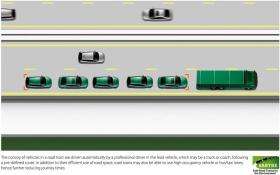
(PhysOrg.com) -- Road trains linking vehicles together in a traveling convoy are planned for Europe. With only the lead vehicle being actively driven, the road trains would allow commuters to sleep, read a book or watch TV, or anything else they fancy as they drive to work.
A research project financed by the EU's Framework 7 plan looked at ways to reduce the cost of traveling along European highways and has suggested the idea of a "road train" that could link up to eight vehicles to a lead vehicle by wireless sensors. The vehicles could be any mix of cars, trucks or buses, but the project focuses on commuters traveling long distances to work. The project is named Sartre, for Safe Road Trains for the Environment.
Early results suggest linking the vehicles and having them travel close together could reduce fuel consumption by around 20% for all the vehicles except the leader. Traveling as a group could also result in a reduction in travel time, fewer accidents and less congestion on the roads. Relaxing, or even sleeping on the way to work could also cut out the stress of driving.
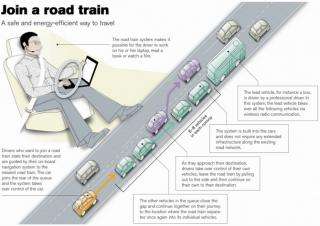
A professional driver (such as a bus or truck driver) in the leading vehicle would be charged with steering and controlling the convoy and monitoring its members. Drivers of the other vehicles could relax, since the leader would be controlling their vehicle.
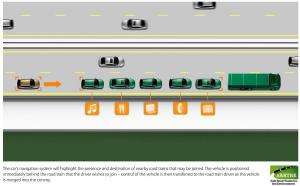
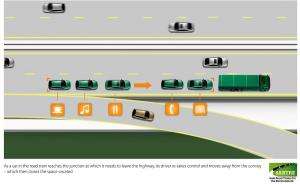
Enlarge
Co-ordinator of the project, Tom Robinson of British Consultancy firm Ricardo, told the BBC that each vehicle joining the road train would have its own control system, communications equipment, and software monitoring system, but the lead vehicle would monitor the entire road train. Vehicles would be able to join by stating their destination and using their navigation system to locate the nearest road train. They could leave it whenever they wished, by signalling the lead vehicle, and then taking control of their own vehicle.
It should be possible to use readily available components to enable vehicles to link up to the road train, and changes to the roads should not be necessary.
The Sartre project will be tested for about three years once the preliminary research on the elements required and on the safety issues is completed. Robinson said that the first platoon of two trucks and three cars will be tested on special tracks in Sweden, the UK, and Spain. Later tests will probably also be carried out on public roads in Spain.
According to Volvo, the first prototypes of the road train could be tested within a couple of years.
© 2009 PhysOrg.com


By somehow physically linking them together would be a real thing. Then the other vehicles would reduce fuel consumption by 100%. And ofcourse we already have this sort of thing, but with damaged cars.
I guess this would only work on motorways/highways. Surely getting cars driving on their own automatically is the first step before making them drive together automatically.
Making a car to "follow that car" is way easier than making a car that drives by itself. That's why such road trains are doable already. But to productize them, convince investors and law makers, that's what takes a few years.
But seriously: what happens when the first car gets in an accident. Do we automatically get an 8 car pileup?
While it may even be statistically provable that this system is afer than driving on your own I bet it will be a hard sell psychologically. I'd rather take (worse) chances driving myself than just being a statistic.
I also envision that this will be a pre-cursor to a version comprised entirely of mass transit vehicles, like diesel-electric "Bus-Trains"
The best solution for the future in regards to highway driving is an autonomous full-AI system that the driver will be OBLIGATED to hook up to when entering the highway.
But hey, who will get mister Ferrari to give up doing the cross-country ski on the highway at 150mph?
Defensive driving means that you always expect the unexpected (i.e. you always give yourself romm (which equals time) to react. With road trains that time is not given. Computers cannot react well to the unexpected (and oftentimes react in a much worse way than humans do)
could driving programs on cars do this? automatically?
i'll tell you i would not trust an autopilot program without having at least a built in functionality that allows me to take control at any instant.
to begin with, i'd feel much more comfortable easing into using an automated pilot slowly, as in putting it in control for a few mintues at a time and monitoring it.
finally, i think an accompanying digital display that shows you the dynamic reduction in real time air-resistance achieved by your current position in the train would help the driver not only accept and embrace the technology but help generate enough enthusiams in the driver to help market the device by word of mouth.
Even if you are given the possibility of intervening: you are then packed into a tight train of vehicles with very little room to maneouver.
Such a system would be great if it were on rails. But on roads with road conditions being subject to change on short/no notice? (flash rain, sudden overfreezing of moisture, ...). I wouldn't feel safe.
LOL. People always resist new and unfamiliar thing
I don't think anyone in the world knows whether this concept will work, unless some real life trials are made. The data should speak for itself.
If data from a pilot program shows reduction in accident statics and improvement in passenger-mile-per-gallon metric, then we'll know. But I think it's important that we find out.
If a train system is too costly to build, use a big bus that accommodates the passengers and hauls the cars physically. At pre-destined stops, the cars are detached/attached.