Drinking green tea helps prevent kidney stones
November 13, 2009 Drinking green tea helps prevent kidney stones

Enlarge

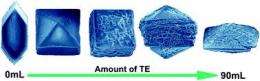
Picture of calcium oxalate crystals, changing shape with different amounts of green tea. The flatter crystals form less stable kidney stones that break up easily.

(PhysOrg.com) -- Drinking green tea can help prevent the formation of large kidney stones, report Chinese scientists in the Royal Society of Chemistry journal CrystEngComm.

The researchers have found that compounds in the tea make it difficult for larger stones to form, by changing the shape of mineral crystals that might otherwise clump together.

The smaller stones that are left are painlessly passed out in urine.

Kidney stones affect up to five per cent of the world population, and the prevalence is rising, says Xudong Li at Sichuan University, Chengdu, China, lead author of the article.

Compounds in the tea called phenols bond to the calcium oxalate, making the resulting crystals a different shape and less likely to clump together to form large .

More information: Original article: http://www.rsc.org/Publishing/Journals/CE/article.asp?doi=b913589h

Provided by Royal Society of Chemistry


Rate this story - 5 /5 (1 vote)


November 13, 2009 all stories

Comments: 0

5 /5 (1 vote)

  • hide
  • Related Stories

  • Of mice and men... and kidney stones
    created Mar 01, 2008 | popularity not rated yet | comments 0
  • How to ... avoid kidney stones
    created Jul 17, 2009 | popularity not rated yet | comments 0
  • Study finds bacteria may reduce risk for kidney stones
    created Mar 05, 2008 | popularity not rated yet | comments 0
  • Roux-en-Y weight loss surgery raises kidney stone risk
    created Jun 17, 2009 | popularity not rated yet | comments 0
  • Daily potassium citrate wards off kidney stones in seizure patients on high-fat diet
    created Jul 21, 2009 | popularity not rated yet | comments 0


  • hide
  • Relevant PhysicsForums posts

Other News

MDC researchers develop new tool to investigate ion channels

German researchers develop new tool to investigate ion channels

Chemistry / Biochemistry

created 15 minutes ago | popularity not rated yet | comments 0

Neurotoxins from cone snails and spiders help neurobiologists Sebastian Auer, Annika S. Stürzebecher and Dr. Ines Ibañez-Tallon of the Max Delbrück Center for Molecular Medicine (MDC) Berlin-Buch, Germany, ...


New approach to treating breast and prostate cancers

Chemistry / Biochemistry

created 23 hours ago | popularity 2.5 / 5 (2) | comments 0

In a new approach to developing treatments for breast cancer, prostate cancer and enlarged hearts, Loyola University Chicago Stritch School of Medicine researchers are zeroing in on a workhorse protein called RSK.


Energy from light and water: New photocatalytic method for the clean production of hydrogen from water

Chemistry / Materials Science

created Feb 09, 2010 | popularity 4.6 / 5 (14) | comments 10 | with audio podcast

(PhysOrg.com) -- Hydrogen-powered fuel cells and solar energy are the best hope for a more environmentally friendly and resource-sparing energy supply in the future. A combination of the two is considered to be particularly ...


New research rejects 80-year theory of 'primordial soup' as the origin of life

Chemistry / Biochemistry

created Feb 02, 2010 | popularity 4.3 / 5 (36) | comments 29 | with audio podcast

For 80 years it has been accepted that early life began in a 'primordial soup' of organic molecules before evolving out of the oceans millions of years later. Today the 'soup' theory has been over turned in a pioneering paper ...


It looks, feels and tastes like chicken, but it's made of soy

It looks, feels and tastes like chicken, but it's made of soy

Chemistry / Biochemistry

created Feb 04, 2010 | popularity 4.5 / 5 (18) | comments 14 | with audio podcast

Sure, some delicacies might taste just like chicken, but they usually feel and look much different. Soy meat alternatives, such as the soy burger, have become more popular recently, with increased sales of ...