El Nino Picking Up Steam
November 13, 2009 El Nino Picking Up Steam

Enlarge

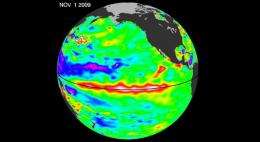
This image was created with data collected by the U.S./French satellite during a 10-day period centered on November 1, 2009. It shows a red and white area in the central and eastern equatorial Pacific that is about 10 to 18 centimeters (4 to 7 inches) above normal. Image credit: NASA/JPL Ocean Surface Topography Team

(PhysOrg.com) -- The latest image from the U.S./French Jason-2 satellite finds a strong wave of warm water heading toward the Americas, fueling El Nino.

El Niņo is experiencing a late-fall resurgence. Recent height data from the NASA/French Space Agency Surface Topography Mission/Jason-2 oceanography satellite show that a large-scale, sustained weakening of trade winds in the western and central equatorial Pacific during October has triggered a strong, eastward-moving wave of warm water, known as a Kelvin wave.

In the central and eastern equatorial Pacific, this warm wave appears as the large area of higher-than-normal sea surface heights (warmer-than-normal sea surface temperatures) between 170 degrees east and 100 degrees west longitude. A series of similar, weaker events that began in June 2009 initially triggered and has sustained the present El Niņo condition.

This image was created with data collected by the U.S./French during a 10-day period centered on November 1, 2009. It shows a red and white area in the central and eastern equatorial Pacific that is about 10 to 18 centimeters (4 to 7 inches) above normal. These regions contrast with the western equatorial Pacific, where lower-than-normal sea levels (blue and purple areas) are between 8 to 15 centimeters (3 and 6 inches) below normal. Along the equator, the red and white colors depict areas where temperatures are more than one to two degrees Celsius above normal (two to four degrees Fahrenheit).

"In the American west, where we are struggling under serious drought conditions, this late-fall charge by El Niņo is a pleasant surprise, upping the odds for much-needed rain and an above-normal winter snowpack," said JPL oceanographer Bill Patzert.

Provided by JPL/NASA (news : web)


print this article email this article download pdf blog this article bookmark this article     Stumble it Digg this share on Facebook retweet share on Reddit add to delicious
Rate this story - 4 /5 (6 votes)

Rank Filter

Move the slider to adjust rank threshold, so that you can hide some of the comments.


Display comments: newest first


November 13, 2009 all stories

Comments: 1

4 /5 (6 votes)
  • Stumble this up

  • Digg this

  • share this

  • hide
  • Related Stories

  • La Niņa Persists
    created Nov 07, 2007 | popularity not rated yet | comments 0
  • Floundering El Ninos Make for Fickle Forecasts
    created Sep 29, 2009 | popularity not rated yet | comments 0
  • Forecasters say El Nino may be developing
    created Jun 08, 2009 | popularity not rated yet | comments 0
  • Oscillation Rules as the Pacific Cools
    created Dec 10, 2008 | popularity not rated yet | comments 0
  • Larger Pacific Climate Event Helps Current La Nina Linger
    created Apr 22, 2008 | popularity not rated yet | comments 0


  • hide
  • Relevant PhysicsForums posts

  • West Mata - Explosive Deep-Ocean Volcano
    created Dec 20, 2009
  • did al gore really say that
    created Dec 20, 2009
  • AIRS and Atmospheric Carbon Dioxide
    created Dec 16, 2009
  • Opacity of the Earth's atmosphere
    created Dec 13, 2009
  • More from Physics Forums - Earth

Other News

A New Method of Estimating Stellar Distances

A New Method of Estimating Stellar Distances

Space & Earth / Astronomy

created 5 hours ago | popularity 4.9 / 5 (8) | comments 0

(PhysOrg.com) -- The star Chi Cygni is located about 550 light-years away, in the direction of the constellation of Cygnus the Swan. It is a notable star because, unlike the sun which still burns hydrogen ...


Ski Runs Are Not Created Equal

Space & Earth / Environment

created 2 hours ago | popularity not rated yet | comments 0

(PhysOrg.com) -- Building a new ski run by bulldozing a mountainside rather than only cutting its shrubs and trees is far more damaging ecologically, yet might offer only a week's earlier start to the downhill season, says ...


EPA, Army Corps urged to consider separating Great Lakes, river basin

Space & Earth / Environment

created 2 hours ago | popularity 5 / 5 (1) | comments 0

The once-radical idea of somehow plugging the Chicago Sanitary and Ship Canal to stop the flow of unwanted species from spilling between the Great Lakes and Mississippi River basin is quickly picking up political support.


Brown dwarf pair mystifies astronomers

Brown dwarf pair mystifies astronomers

Space & Earth / Astronomy

created 5 hours ago | popularity 4.7 / 5 (9) | comments 0

(PhysOrg.com) -- Two brown dwarf-sized objects orbiting a giant old star show that planets may assemble around stars more quickly and efficiently than anyone thought possible, according to an international ...


'Particle soup' discovery will improve climate predictions

'Particle soup' discovery will improve climate predictions

Space & Earth / Earth Sciences

created 5 hours ago | popularity 4.5 / 5 (4) | comments 0

(PhysOrg.com) -- New research from scientists at The University of Manchester is set to improve predictions about climate and air quality - and make life easier for those suffering from respiratory problems.