India to move all zoo elephants to wildlife parks
November 13, 2009 By NIRMALA GEORGE , Associated Press Writer India to move all zoo elephants to wildlife parks (AP)

Enlarge

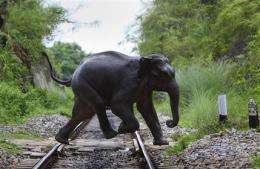
This July 30, 2009 file photograph, a wild elephant crossing a railway track along Deepor Beel, a wild life sanctuary on the outskirts of Gauhati, India. Wildlife authorities in India have ordered that all elephants living in zoos and circuses be moved to wildlife parks and game sanctuaries where the animals can graze more freely, officials said Friday, Nov. 13, 2009. (AP Photo/Anupam Nath, file)

(AP) -- All elephants living in Indian zoos and circuses will be moved to wildlife parks and game sanctuaries where the animals can graze more freely, officials said Friday.

The decision affects around 140 elephants in 26 zoos and 16 circuses in the country, said B.K. Gupta, an officer at India's Central Zoo Authority.

The order followed complaints from animal rights activists about elephants that are kept in captivity and often chained for long hours, Gupta said.

The elephants currently living in zoos or circuses are to be moved to "elephant camps" run by the government's forest department and located near protected areas and national parks. There they would be able to roam and graze freely, but "mahouts," or traditional elephant trainers, would still keep an eye on them.

Some elephant experts, however, were skeptical about moving the elephants to wildlife preserves, many of which are under pressure from encroaching human habitation.

"Special facilities have to be created, perhaps outside the wildlife sanctuaries. It may add to the pressures faced by natural habitats," said Raman Sukumar, a professor of ecology at the Indian Institute of Science, Bangalore.

Increasingly, research shows that elephants in the wild have longer life spans and better health and reproductive records than those in captivity, Sukumar said.

elephants often die prematurely and contract diseases or suffer obesity and arthritis more frequently than in their natural habitats, he said.

India has an estimated 28,000 wild elephants living in forest reserves and national parks, mainly in the southern and northeastern parts of the country. Another 3,500 live in captivity, many of them in temples, or working in logging camps where they are used to lift timber. No decision has been made about them.

©2009 The Associated Press. All rights reserved. This material may not be published, broadcast, rewritten or redistributed.


print this article email this article download pdf blog this article bookmark this article     Stumble it Digg this share on Facebook retweet share on Reddit add to delicious
Rate this story - 5 /5 (3 votes)


November 13, 2009 all stories

Comments: 0

5 /5 (3 votes)
  • Stumble this up

  • Digg this

  • share this

  • hide
  • Related Stories

  • Pygmy elephants tracked by GPS
    created Dec 17, 2005 | popularity not rated yet | comments 0
  • Study: Elephants might seek revenge
    created Feb 16, 2006 | popularity not rated yet | comments 0
  • Elephant populations decline in the wild, but zoos may not be the answer
    created Jan 04, 2009 | popularity not rated yet | comments 0
  • Fewer elephants with tusks born in China
    created Jul 18, 2005 | popularity not rated yet | comments 0
  • Uncertain future for elephants of Thailand
    created Jul 26, 2008 | popularity not rated yet | comments 0


  • hide
  • Relevant PhysicsForums posts

  • Human Leukocyte Antigen (HLA) typing
    created 5 hours ago
  • Breeding program
    created Nov 20, 2009
  • How does a concentration gradient provide energy?
    created Nov 20, 2009
  • Eyesight and Neural Damage from Electronics
    created Nov 19, 2009
  • More from Physics Forums - Biology

Other News

The Monarchs' annual migration ritual has yet to be scientifically explained

Tree-eating bugs threaten Monarch butterfly in Mexico

Biology / Ecology

created 6 hours ago | popularity 4 / 5 (1) | comments 0

The mysterious Monarch butterfly, which migrates en masse annually between Canada and Mexico, is now facing a new peril: another insect thriving in Western Mexican forests.


Extinct goat Myotragus balearicus

Extinct goat was cold-blooded

Biology / Plants & Animals

created Nov 18, 2009 | popularity 4.9 / 5 (33) | comments 10

(PhysOrg.com) -- An extinct goat that lived on a barren Mediterranean island survived for millions of years by reducing in size and by becoming cold-blooded, which has never before been discovered in mammals.


Bigger not necessarily better, when it comes to brains

Bigger not necessarily better, when it comes to brains

Biology / Plants & Animals

created Nov 17, 2009 | popularity 4.5 / 5 (17) | comments 11

(PhysOrg.com) -- Tiny insects could be as intelligent as much bigger animals, despite only having a brain the size of a pinhead, say scientists at Queen Mary, University of London.


Right-handed chimpanzees provide clues to the origin of human language

Biology / Plants & Animals

created Nov 16, 2009 | popularity 3 / 5 (1) | comments 7

Most of the linguistic functions in humans are controlled by the left cerebral hemisphere. A study of captive chimpanzees at the Yerkes National Primate Research Center (Atlanta, Georgia), reported in the January 2010 issue ...


The creature was found at a depth of 161 metres

Japanese researchers film rare baby fish 'fossil'

Biology / Plants & Animals

created Nov 17, 2009 | popularity 4.7 / 5 (7) | comments 4

Japanese marine researchers said Tuesday they had found and successfully filmed a young coelacanth -- a rare type of fish known as "a living fossil" -- in deep water off Indonesia.