LCROSS Impact Finds Water on the Moon
November 13, 2009 by Jonas Dino
LCROSS Impact Data Indicates Water on Moon

Enlarge

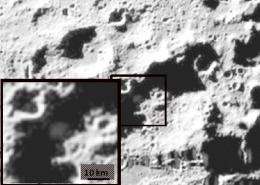
The visible camera image showing the ejecta plume at about 20 seconds after impact. Credit: NASA

(PhysOrg.com) -- The argument that the moon is a dry, desolate place no longer holds water. Secrets the moon has been holding, for perhaps billions of years, are now being revealed to the delight of scientists and space enthusiasts alike.

NASA today opened a new chapter in our understanding of the moon. Preliminary data from the Observation and Sensing Satellite, or LCROSS, indicates that the mission successfully uncovered during the Oct. 9, 2009 impacts into the permanently shadowed region of Cabeus cater near the moon’s south pole.

The impact created by the LCROSS Centaur upper stage rocket created a two-part plume of material from the bottom of the crater. The first part was a high angle plume of vapor and fine dust and the second a lower angle ejecta curtain of heavier material. This material has not seen sunlight in billions of years.

"We're unlocking the mysteries of our nearest neighbor and by extension the . It turns out the moon harbors many secrets, and LCROSS has added a new layer to our understanding," said Michael Wargo, chief lunar scientist at NASA Headquarters in Washington.

Scientists have long speculated about the source of vast quantities of hydrogen that have been observed at the lunar poles. The LCROSS findings are shedding new light on the question of water, which could be more widespread and in greater quantity than previously suspected.

Permanently shadowed regions could hold a key to the history and evolution of the solar system, much as an ice core sample taken on Earth reveals ancient data. In addition, water, and other compounds represent potential resources that could sustain future lunar exploration.

LCROSS Impact Data Indicates Water on Moon
Enlarge

Data from the down-looking near-infrared spectrometer. The red curve shows how the spectra would look for a "grey" or "colorless" warm (230 C) dust cloud. The yellow areas indicate the water absorption bands. Credit: NASA

Since the impacts, the LCROSS science team has been working almost nonstop analyzing the huge amount of data the spacecraft collected. The team concentrated on data from the satellite's spectrometers, which provide the most definitive information about the presence of water. A examines light emitted or absorbed by materials that helps identify their composition.

"We are ecstatic," said Anthony Colaprete, LCROSS project scientist and principal investigator at NASA's Ames Research Center in Moffett Field, Calif. "Multiple lines of evidence show water was present in both the high angle vapor plume and the ejecta curtain created by the LCROSS Centaur impact. The concentration and distribution of water and other substances requires further analysis, but it is safe to say Cabeus holds water."

The team took the known near infrared spectral signatures of water and other materials and compared them to the spectra collected by the LCROSS near infrared spectrometer of the impact.

"We were only able to match the spectra from LCROSS data when we inserted the spectra for water," said Colaprete. "No other reasonable combination of other compounds that we tried matched the observations. The possibility of contamination from the Centaur also was ruled out."

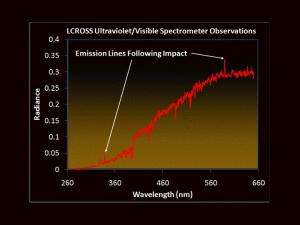
Additional confirmation came from an emission in the ultraviolet spectrum that was attributed to hydroxyl, one product from the break-up of water by sunlight. When atoms and molecules are excited, they release energy at specific wavelengths that are detected by the spectrometers. A similar process is used in neon signs. When electrified, a specific gas will produce a distinct color. The ultraviolet visible spectrometer detected hydroxyl signatures just after impact that are consistent with a water vapor cloud in sunlight.

Data from the other LCROSS instruments are being analyzed for additional clues about the state and distribution of the material at the impact site. The LCROSS science team along with colleagues are poring over the data to understand the entire impact event, from flash to crater, with the final goal being the understanding of the distribution of materials, and in particular volatiles, within the soil at the impact site.

"The full understanding of the LCROSS data may take some time. The data is that rich," said Colaprete. "Along with the water in Cabeus, there are hints of other intriguing substances. The permanently shadowed regions of the moon are truly cold traps, collecting and preserving material over billions of years."

LCROSS was launched June 18, 2009 as a companion mission to the Lunar Reconnaissance Orbiter, or LRO, from NASA's Kennedy Space Center in Florida. After separating from LRO, the LCROSS spacecraft held onto the spent Centaur upper stage rocket of the launch vehicle, executed a lunar swingby and entered into a series of long looping orbits around the Earth.
LCROSS Impact Data Indicates Water on Moon
Enlarge

Data from the ultraviolet/visible spectrometer taken shortly after impact showing emission lines (indicated by arrows). These emission lines are diagnostic of compounds in the vapor/debris cloud. Credit: NASA

After traveling approximately 113 days and nearly 5.6 million miles (9 million km), the Centaur and LCROSS separated on final approach to the moon. Traveling a fast as a speeding bullet, the Centaur impacted the lunar surface shortly after 4:31 a.m. PDT Oct. 9 with LCROSS watching with its onboard instruments. Approximately four minutes of data was collected before the LCROSS itself impacted the lunar surface.

Working closely with scientists from LRO and other observatories that viewed the impact, the LCROSS team is working to understand the full scope of the LCROSS data. LRO continues to make passes over the impact site to give the team additional insight into the mechanics of the impact and its resulting craters.

What other secrets will the reveal? The analysis continues!

Provided by JPL/ (news : web)

4.9 /5 (31 votes)  

Filter


Move the slider to adjust rank threshold, so that you can hide some of the comments.


Display comments: newest first

thales
Nov 13, 2009

Rank: 5 / 5 (1)
At last we have a real reason to go back to the moon. Giant moon telescopes, then a manned base, eventually a moon hotel, and finally a colony! Thank Science, there's water on the Moon!
Feldagast
Nov 13, 2009

Rank: 3 / 5 (1)
They already knew there was water on the moon, was proven by i think a Japanese probe in orbit around the moon. They didn't find out till after this mission was already launched so no sense in scrapping the mission but it just confirms what was already discovered
PieRSquare
Nov 13, 2009

Rank: 5 / 5 (1)
They already knew there was water on the moon, was proven by i think a Japanese probe in orbit around the moon.

You're probably thinking of the Indian orbiter which helped confirm a very small amount of water over the whole surface, this mission was to check for significant amounts of water hidden in permanently shaded craters which could potentially be used to provide water, air and fuel for future lunar missions.
chthonic
Nov 13, 2009

Rank: 1 / 5 (1)
Do they have a swimming pool at the Hyatt Mare Tranquillitatis?
mysticshakra
Nov 13, 2009

Rank: 1.7 / 5 (6)
And here's the rest of the story

http://www.enterp...Gun2.htm
am_Unition
Nov 14, 2009

Rank: 2 / 5 (4)
And here's the rest of the story

http://www.enterp...Gun2.htm


A Richard C. Hoagland page.

Check out his wikipedia article, it's *thrilling* -
"He has stated that a feature in an image of the lunar surface, mistakenly believed by professional planetary scientists to be a rock, is actually the severed head of a robot."
seanpu
Nov 14, 2009

Rank: not rated yet
"Additional confirmation came from an emission in the ultraviolet spectrum that was attributed to hydroxyl, one product from the break-up of water by sunlight."

or the combination of hydrogen and oxygen atoms, which are abundant in the "solar wind".
frajo
Nov 14, 2009

Rank: 2 / 5 (2)
The concentration and distribution of water and other substances requires further analysis, but it is safe to say Cabeus holds water.

How much? More than the sahara?
mysticshakra
Nov 14, 2009

Rank: 3 / 5 (3)
am_Unition

I guess you are one of those people who doesn't think much of *evidence*.

The best way to avoid having an intelligent discussion is to attack someone's person. Why don't you try "reading" the article and say something about it's content.

Regarding the head on the moon....have you actually taken the time to look at the photos or are you just ASSuming you already know the answer because you didn't hear about on CNN?
jadeb
Nov 15, 2009

Rank: 3 / 5 (2)
This is truly historic and will probably prove to be the most significant advancement in space exploration of the past several decades.

I am filled with excitement at the prospect we could use the water on the moon to generate a habitable environment on the moon. I don't mean just a contained environment inside a colony, although that's definitely more possible now. What I'm referring to is the possibility of somehow "seeding" the surface of the moon to create a vapor layer (atmosphere) that would insulate the surface and gradually build and accumulate to the point where it retained heat and allowed melting ice to contribute to the atmosphere.

It might take centuries to accomplish (or longer), but the scientific prospects are fascinating and irresistible.

I've started a website to begin collecting thoughts and ideas about "Greening the Moon." If you're excited about this too, spread the word and share your thoughts: http://www.jumpst...oon.com/
Feldagast
Nov 15, 2009

Rank: 5 / 5 (1)
what would hold an atmosphere on the moon?
jadeb
Nov 15, 2009

Rank: not rated yet
what would hold an atmosphere on the moon?

That's a good question. I don't claim to know the answer. This would make an excellent field of inquiry to discover how an atmosphere develops on a planetary body.

In theory, I imagine it would require something like the processes that created our own atmosphere. Perhaps a layer of a particularly heavy gas first, which would cling very close to the surface but allow the collection of heat beneath it.

But it's all conjecture at this point. If you're interested in the topic, please consider posting your thoughts on www.jumpstartthemoon.com or perhaps creating a thread at physicsforums.com (I may still do that but was a little intimidated by their posting rules regarding personal theories).
NotAsleep
Nov 16, 2009

Rank: not rated yet
For starters, the moon would have to have a "global" magnetic field to prevent radiation and the solar wind from blowing the atmosphere away, as has happened to a great extent on Mars
Feldagast
Nov 16, 2009

Rank: not rated yet
Was wondering about solar wind, but doesn't Earth's magnetic field extend to the moon somewhat?
thales
Nov 23, 2009

Rank: 5 / 5 (1)
The best way to avoid having an intelligent discussion is to attack someone's person. Why don't you try "reading" the article and say something about it's [sic] content.


Yeah, but Hoagland has no credibility. Reading content generated by a known fabricator is a waste of time and energy.
Rank 4.9 /5 (31 votes)
Related Stories
Relevant PhysicsForums posts
  • Scale of the Universe
    created10 hours ago
  • Titan's lack of impact craters
    createdFeb 09, 2012
  • Real pictures of black hole eating a star?
    createdFeb 08, 2012
  • Hypothetical way to travel faster than light, but not technically exceed lightspeed
    createdFeb 06, 2012
  • How do scientists monitor the Sun's activity?
    createdFeb 05, 2012
  • Search patterns in observational studies
    createdFeb 05, 2012
  • More from Physics Forums - General Astronomy

More news stories

Humans may have helped the decline of African rainforests 3000 years ago

(PhysOrg.com) -- Large areas of rainforests in Central Africa mysteriously disappeared over three thousand years ago, to be replaced by savannas. The prevailing theory has been that the cause was a change ...

Space & Earth / Environment

created 21 hours ago | popularity 4.3 / 5 (12) | comments 12 | with audio podcast report

Could Venus be shifting gear?

(PhysOrg.com) -- ESA’s Venus Express spacecraft has discovered that our cloud-covered neighbour spins a little slower than previously measured. Peering through the dense atmosphere in the infrared, the ...

Space & Earth / Space Exploration

created 17 hours ago | popularity 5 / 5 (7) | comments 7 | with audio podcast

NASA budget will axe Mars deal with Europe: scientists

US President Barack Obama's budget proposal to be submitted next week for 2013 will cut NASA's budget by 20 percent and eliminate a major partnership with Europe on Mars exploration, scientists said Thursday.

Space & Earth / Space Exploration

created 20 hours ago | popularity 5 / 5 (2) | comments 18

Two new moons for Jupiter

Advances in technology have lead to the discovery of new planets outside of our Solar System, and now even new moons in our own backyard.

Space & Earth / Space Exploration

created 17 hours ago | popularity 4 / 5 (1) | comments 7

Mars Science Laboratory computer issue resolved

(PhysOrg.com) -- Engineers have found the root cause of a computer reset that occurred two months ago on NASA's Mars Science Laboratory and have determined how to correct it.

Space & Earth / Space Exploration

created 18 hours ago | popularity 4.7 / 5 (6) | comments 3 | with audio podcast


Anonymous knocks CIA website offline (Update)

The website of the Central Intelligence Agency was inaccessible on Friday after the hacker group Anonymous claimed to have knocked it offline.

Google users warned of threat to smartphone wallets

Users of Google smartphone wallets were being warned on Friday that there is a way to crack pass codes intended to thwart thieves from going on illicit shopping sprees.

New error-correcting codes guarantee the fastest possible rate of data transmission

Error-correcting codes are one of the triumphs of the digital age. They’re a way of encoding information so that it can be transmitted across a communication channel — such as an optical fiber o ...

New power source discovered

(PhysOrg.com) -- Researchers at the Massachusetts Institute of Technology (MIT) and RMIT University have made a breakthrough in energy storage and power generation.

Small modular reactor design could be a 'SUPERSTAR'

(PhysOrg.com) -- Though most of today's nuclear reactors are cooled by water, we've long known that there are alternatives; in fact, the world's first nuclear-powered electricity in 1951 came from a reactor ...

The power of estrogen -- male snakes attract other males

A new study has shown that boosting the estrogen levels of male garter snakes causes them to secrete the same pheromones that females use to attract suitors, and turned the males into just about the sexiest ...