Mysterious X-rays from a Nearby Galaxy
November 13, 2009 Mysterious X-rays from a Nearby Galaxy

Enlarge

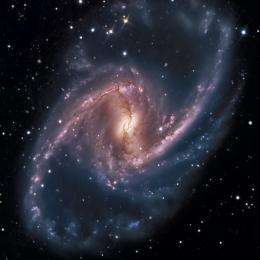
An optical image if the active galaxy NGC 1365; its nucleus contains a massive black hole that emits a strange mix of X-ray radiation. Credit: SSRO-South

(PhysOrg.com) -- The nucleus of an active galaxy, an AGN, contains a massive black hole that is vigorously accreting material. In the process it typically ejects jets of particles and radiates brightly at many wavelengths, in particular at X-ray wavelengths.

It turns out that nearly half of all AGN seem to have very thick gas clouds near their nuclei, a conclusion reached because only high energy X-rays are seen coming from them; the usual explanation is that gas clouds absorb the lower energy X-ray emission, while higher energy radiation is relatively unaffected.

X-ray AGN are important to astronomers not only because they provide new insights into black holes and their surroundings, but because the X-rays are often time variable, suggesting that these clouds of gas are in motion around the nucleus. These kinematics in turn provide information on how the AGN and its galaxy formed and evolved.

The galaxy NGC 1365 is about sixty light-years away. It is notable for having rapid variations in its low energy X-rays -- timescales of just days, suggesting that solar-system-sized gas clouds near the nucleus are moving across our view of the AGN, possibly part of a torus around the nucleus. SAO astronomers Guido Risaliti, Martin Elvis, Pepi Fabbiano, and Junfeng Wang have used a suite of orbiting X-ray telescopes to discover and track a very curious property of NGC 1365: its high energy X-ray emission is about twice that expected compared to the low energy emission, even when the low energy radiation is at its brightest.

The scientists offer three possible explanations for this so-far unique situation: the AGN has yet another layer of absorbing gas but one that does not vary (but where did it come from), there is a second black hole contributing its own X-rays (but no other galaxy of this type has two such ), or the shape of the absorber has a particular, complex geometry (which seems very artificial). Whatever the final solution, the new paper sheds light on the complex environment that can exist around active galactic nuclei.

Provided by Harvard-Smithsonian Center for Astrophysics (news : web)


Rate this story - 4.3 /5 (15 votes)

Rank Filter

Move the slider to adjust rank threshold, so that you can hide some of the comments.


Display comments: newest first

  • googly - Nov 13, 2009
    • Rank: not rated yet
    "The galaxy NGC 1365 is about sixty light-years away."

    Considering the galaxy closest to the Milky Way, Andromeda, is about 2.5 million ly away, this is an error.
  • Ensa - Nov 13, 2009
    • Rank: not rated yet
    The galaxy NGC 1365 is about sixty light-years away....

    Really?

    hah! Googly got there first - by 18 seconds.......... :)

  • googly - Nov 13, 2009
    • Rank: not rated yet
    Hehe. And that's with me even registering an account first!
  • Au-Pu - Nov 13, 2009
    • Rank: 1 / 5 (1)
    About 60 light years away is a rough approximation a more accurate estimate puts NGC 1365 at about 56 light years away.
    The Andromeda galaxy is not our nearest.
    It is the largest in what is termed "The Local Group" our galaxy the Milky Way galaxy is the next largest in this group
    Incidentlly the Andromeda galaxy is actually heading our way
  • chuckscherl - Nov 13, 2009
    • Rank: not rated yet
    NGC 1365 is 56 MILLION light years
  • brant - Nov 13, 2009
    • Rank: not rated yet
    "The scientists offer three possible explanations for this so-far unique situation: the AGN has yet another layer of absorbing gas but one that does not vary (but where did it come from), there is a second black hole contributing its own X-rays (but no other galaxy of this type has two such black holes), or the shape of the absorber has a particular, complex geometry (which seems very artificial). "

    Interesting. They posit every solution except the one that says that the source is variable.
    "Another layer." When they say stuff like that something is not quite right.
  • Au-Pu - Nov 14, 2009
    • Rank: not rated yet
    I must apologise for my foxes paw (faux pas) in forgetting the "million".
    Still what is a million or two between friends.
    Whether it is 56 light years or 56 million light years we will never reach either, except of course in movies.
    I will endeavour not to be so sloppy in future.
  • rgw - Nov 14, 2009
    • Rank: not rated yet
    or as Douglas Adams said, "Space is big. You just won't believe how vastly, hugely, mind-bogglingly big it is. I mean, you may think it's a long way down the road to the drug store, but that's just peanuts to space."

November 13, 2009 all stories

Comments: 8

4.3 /5 (15 votes)

  • hide
  • Related Stories

  • Chandra sees remarkable eclipse of black hole
    created Apr 12, 2007 | popularity not rated yet | comments 0
  • Astronomers unveil new type of active galaxy
    created Jul 30, 2007 | popularity not rated yet | comments 0
  • X-Ray Jets from Galaxies
    created Oct 19, 2009 | popularity not rated yet | comments 0
  • No matter their size black holes 'feed' in the same way
    created Dec 06, 2006 | popularity not rated yet | comments 0
  • NASA Performs Headcount of Local Black Holes
    created Oct 06, 2006 | popularity not rated yet | comments 0


  • hide
  • Relevant PhysicsForums posts

  • Spreading Life in the Universe
    created 16 hours ago
  • Force of Gravity in terms of Density
    created Feb 08, 2010
  • what is the relation between gravity and light?
    created Feb 08, 2010
  • Does the Thermoelectric effect apply in sun?
    created Feb 07, 2010
  • More from Physics Forums - General Astronomy

Other News

India announces long-range nuclear-capable missile test

Space & Earth / Space Exploration

created 28 minutes ago | popularity 5 / 5 (1) | comments 0

India will test a nuclear-capable missile with a range of over 5,000 kilometres (3,000 miles) within a year, its top military scientist said Wednesday, risking a rise in regional tensions.


Space shuttle Endeavour pulls in at space station (AP)

Space shuttle Endeavour pulls in at space station

Space & Earth / Space Exploration

created 5 hours ago | popularity 5 / 5 (1) | comments 0

(AP) -- Shuttle Endeavour arrived to a warm welcome at the International Space Station early Wednesday, delivering a new room and observation deck that will come close to completing construction 200 miles ...


Climate 'Tipping Points' May Arrive Without Warning, Says Top Forecaster

Space & Earth / Environment

created 15 hours ago | popularity 3.5 / 5 (11) | comments 10 | with audio podcast

(PhysOrg.com) -- A new University of California, Davis, study by a top ecological forecaster says it is harder than experts thought to predict when sudden shifts in Earth's natural systems will occur -- a worrisome finding ...


38 percent of world's surface in danger of desertification

38 percent of world's surface in danger of desertification

Space & Earth / Environment

created 12 hours ago | popularity 2 / 5 (4) | comments 6

A team of Spanish researchers has measured the degradation of the planet's soil using the Life Cycle Assessment (LCA), a scientific methodology that analyses the environmental impact of human activities, and ...


A new 3-D map of the interstellar gas within 300 parsecs from the sun

A new 3D map of the interstellar gas within 300 parsecs from the Sun

Space & Earth / Astronomy

created 18 hours ago | popularity 5 / 5 (6) | comments 0 | with audio podcast

(PhysOrg.com) -- Astronomy & Astrophysics is publishing new 3D maps of the interstellar gas in the local area around our Sun. A French-American team of astronomers presents new absorption measurements toward ...