Patient research to benefit from cutting edge heart scanner
November 13, 2009
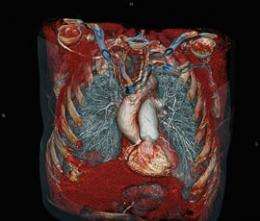
(PhysOrg.com) -- A state-of-the-art chest scanner, the first of its kind in the UK, will allow doctors and researchers to spot heart problems that were previously undetectable.
The scanner has been installed at the London Chest Hospital, part of Barts and The London NHS Trust.
The scanner will play a major role in cutting-edge research, enabling experts at Barts and The London Cardiovascular Biomedical Research Unit, to explore the best ways to treat heart disease and other cardiac conditions.
It delivers crystal-clear pictures of the heart, allowing earlier detection of heart problems. It is also the fastest in the UK, thereby exposing patients to the lowest possible dose of radiation.
The Siemens Definition Flash CT is regarded as state-of-the-art by clinicians because of its unique ability to perform a detailed scan of the entire heart in just 250 milliseconds - less than half a heart beat. Image quality is still high, even if a moving object is being scanned, such as the heart.
Previously, radiographers using older equipment had to slow the patient’s heart with beta blockers and request that the patient hold their breath for the duration of the scan, in order to achieve sufficiently high-quality clinical images.
Funding for the machine came from a £3.5 million award for biomedical research into cardio-vascular disease from the National Institute for Health Research.
The NIHR has designated Barts and the London NHS Trust and Queen Mary,University of London, a Biomedical Research Unit in advanced cardiac imaging.
Professor Anthony Mathur at The London Chest Hospital said: "This is a frontline diagnostic tool for patients presenting with chest pains.
"It will also be an invaluable tool for helping in the research of new treatments for heart disease, allowing us a much clearer picture of the workings of the heart."
Dr Ceri Davies, clinical director of the newCardiac CT service at the London Chest Hospital, added: "The new machine means patients get a diagnosis of heart disease, while being exposed to a low radiation dose.
"We can look for narrowing of the arteries which would not be visible on the scanners we have now, which are multi-functional and may also deliver a higher dose of radiation.
"A number of patients, who present with chest pain, may not be immediately diagnosed with a heart condition because they are at an early stage and their condition may not be picked up until much later.
"However, thanks to this new machine, we will be able to diagnose these people much sooner and potentially prevent the serious consequences of their heart condition."
Professor Dame Sally C. Davies, Director General of Research and Development and the Department of Health said: "I am delighted that the National Institute for Health Research is able to fund the purchase of this cutting edge new technology.
"Any new technology that allows us to detect heart problems at an earlier stage while exposing patients to less radiation is very good news. The sooner patients know there is a problem, the sooner they can begin to take action to prevent more serious problems later on."
Malcolm Pickering, Regional Sales Manager at Siemens Healthcare said: "The prevalence of heart disease is a growing threat in theUK and the joint efforts of cardiac researchers at Queen Mary, University of London and the The London Chest Hospital will assist in unlocking vital information and improving knowledge.
"As a new standard in CT, the Definition Flash will provide the research team with the speed and image accuracy it needs to enhance research work."
-
Comprehensive diagnosis of heart disease with a single CT scan
Mar 04, 2008 |
not rated yet |
0
-
Jefferson cardiologists fix broken heart
Jan 08, 2007 |
not rated yet |
0
-
Study examines prevalence of chest pain in patients 1 year after heart attack
Jun 23, 2008 |
not rated yet |
0
-
Radiation dose drastically reduced during whole chest MDCT
Jun 24, 2009 |
not rated yet |
0
-
Heart failure treated 'in the brain'
Mar 25, 2008 |
not rated yet |
0
-
Engineers build first sub-10-nm carbon nanotube transistor
Feb 01, 2012 |
4.9 / 5 (32) |
30
-
Something old, something new: Evolution and the structural divergence of duplicate genes
Jan 31, 2012 |
4.6 / 5 (7) |
1
-
The hidden nanoworld of ice crystals: Revealing the dynamic behavior of quasi-liquid layers
Jan 30, 2012 |
5 / 5 (4) |
1
-
Stock market network reveals investor clustering
Jan 27, 2012 |
3.9 / 5 (23) |
8
-
Of microchemistry and molecules: Electronic microfluidic device synthesizes biocompatible probes
Jan 26, 2012 |
5 / 5 (2) |
0
-
Is Everyday Technology Killing Us?
Feb 08, 2012
-
Exercise and weight loss
Feb 08, 2012
-
Why do we have head aches? Our brains can't feel anything.
Feb 07, 2012
-
"The end of diseases" by David Agus, interview from Daily Show with Jon Stewart
Feb 04, 2012
-
Oncolytic adenovirus
Feb 04, 2012
-
Nutrition label stuffs and diets
Feb 02, 2012
- More from Physics Forums - Medical Sciences
More news stories
Starve a virus, feed a cure? Findings show how some cells protect themselves against HIV
A protein that protects some of our immune cells from the most common and virulent form of HIV works by starving the virus of the molecular building blocks that it needs to replicate, according to research published online ...
2 hours ago |
5 / 5 (1) |
0
|
Injured boomers beware: Know when to see doctor
(AP) -- It happened to nurse Jane Byron years after an in-line skating fall, business owner Haralee Weintraub while doing "men's" push-ups, and avid cyclist Gene Wilberg while lifting a heavy box.
3 hours ago |
5 / 5 (1) |
0
FDA-approved drug rapidly clears amyloid from the brain, reverses Alzheimer's symptoms in mice
Neuroscientists at Case Western Reserve University School of Medicine have made a dramatic breakthrough in their efforts to find a cure for Alzheimer's disease. The researchers' findings, published in the journal Science, show t ...
Medicine & Health / Neuroscience
Feb 09, 2012 |
4.9 / 5 (55) |
21
|
Green tea found to reduce disability in the elderly
(Medical Xpress) -- A lot of research has been done over the past several years looking into the health benefits of green tea. As a result, scientists have found that regular consumption of the beverage leads ...
Teen school drop-outs three times as likely to be on benefits in later life
Teen school drop-outs are almost three times as likely to be on benefits in later life as their peers who complete their schooling, indicates research published online in the Journal of Epidemiology and Community Health.
Feb 06, 2012 |
not rated yet |
13
Scientists discover molecular secrets of 2,000-year-old Chinese herbal remedy
For roughly two thousand years, Chinese herbalists have treated Malaria using a root extract, commonly known as Chang Shan, from a type of hydrangea that grows in Tibet and Nepal. More recent studies suggest that halofuginone, ...
New method to examine batteries -- MRI from the inside
There is an ever-increasing need for advanced batteries for portable electronics, such as phones, cameras, and music players, but also to power electric vehicles and to facilitate the distribution and storage of energy derived ...
Lab study raises questions over nano-particle impact
Tests involving chickens have raised questions about the impact on health from engineered nano-particles, the ultra-fine grains commonly used in drugs and processed foods, scientists said on Sunday.
Google might launch Drive for cloud storage soon
(PhysOrg.com) -- Google's next big move, according to the Wall Street Journal, is a cloud storage service called Drive. Hardly first to the plate, Google is simply catching up to introducing its cloud reposi ...
A mitosis mystery solved: How chromosomes align perfectly in a dividing cell
Although the process of mitotic cell division has been studied intensely for more than 50 years, Whitehead Institute researchers have only now solved the mystery of how cells correctly align their chromosomes during symmetric ...
Researchers find extensive RNA editing in human transcriptome
In a new study published online in Nature Biotechnology, researchers from BGI, the world's largest genomics organization, reported the evidence of extensive RNA editing in a human cell line by analysis of RNA-seq data, demons ...