Rapacious Rasberry ants march north
November 13, 2009 Rasberry crazy ant

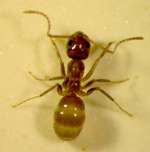
Rasberry crazy ant. Image: Texas A&M

Poor Texas. First it was killer bees, then fire ants. Now, it's the Rasberry ants.

The invasion of this new species of ants has scientists intrigued, businesses concerned and fire ants running for the hills, said Jerry Cook, an entomologist at Sam Houston State University.

Cook and other scientists are at a loss to explain the fast and furious spread of the rapacious ant, which is named after exterminator Tom Rasberry, who discovered the ant in 2002.

The bug was discovered in Houston in 2002 and has quickly spread as far north as Louisiana and Mississippi within the last year.

"This is a species that we do not know much about. Presumably the ant came from the Caribbean through the Port of Houston," Cook said. "We know the ant is in the Paratrechina genus and is capable of growing a population of billions and they need to eat. They especially like other bugs, like fire ants and honey bees."

You need Flash installed to watch this ideo

The population is growing so fast, and so large, that it is potentially an ecosystem disaster, according to Cook.

"If the Rasberry ant can virtually eliminate a pain like the fire ant, what else is it capable of doing?" he said. "If bees are eliminated, plants will not be pollinated which could result to the lack of crops producing fruits and vegetables. That in turn becomes a major problem for the agriculture community. They could become more than a nuisance, they could become a danger."

The Rasberry ant does not have a stinger and therefore cannot inject venom into a person's body; however, it does have formic acid, which creates an irritant reaction rather than a painful poison reaction.

"The bite of the Rasberry ant is far less painful than a fire ant's. Essentially you can get covered with them, and it might freak you out," Cook said.

The population of the Rasberry ant is constantly growing and scientists have not yet discovered a way to eliminate them.

"Without research, we won't discover a solution, and without proper funding we're not likely to get much research," Cook said.

With a research grant, government or otherwise, scientists could reach out to the community to include industries, such as pest control, to develop products and strategies that could control or even eliminate them.

Insecticides will reduce the population and remove them for about a week, but there is no known treatment that would eliminate them for good.

"If we would have had those grants a year ago, we may have been able to start a program that would have eliminated them but now it is probably beyond that point," Cook said.

"Until then, we need to learn how to live with them because the Rasberry, like the fire ant,is here to stay."

Source: Sam Houston State University


Rate this story - 4.4 /5 (10 votes)

Rank Filter

Move the slider to adjust rank threshold, so that you can hide some of the comments.


Display comments: newest first

  • SincerelyTwo - Nov 13, 2009
    • Rank: not rated yet
    "The Rasberry ant does not have a stinger and therefore cannot inject venom into a person's body; however, it does have formic acid, which creates an irritant reaction rather than a painful poison reaction."

    That's kind of cool, apparantly they drive away fireants. What do you guys think, is someone eco-hacking in texas? Seems like an awfully convenient situation, hmm? Or maybe it's just the eventuality of carelessly traveling... mixing all this crap together.
  • El_Nose - Nov 13, 2009
    • Rank: not rated yet
    yea i get tyour point Sincerely but -- but wouldn't the traveler have to just happen to have a queen ant in thier luggage... I forget how ants reproduce but i thought it was similar to bees -- and are queen ants known to go hunting for their own food ??? such that they jumped on a guys shoe and went off to Houston??
  • nkalanaga - Nov 13, 2009
    • Rank: 5 / 5 (1)
    Considering the variety of products coming through ports today, it wouldn't be surprising if there was a small colony in almost any load of food, lumber, paper, or other edible materials. All it would take would be a queen and a few males looking for a new colony site and deciding to settle in an export load.
  • Semmster - Nov 13, 2009
    • Rank: 4 / 5 (2)
    I'm from Jamaica. I think I know these little guys. I've known them since I was a child. They're the good guys. I don't think they'll wipe out bees and I've always had a suspicion, based on observation that they keep the stinging ants down. Study them a little first before trying to kill them, please?
  • ArtflDgr - Nov 13, 2009
    • Rank: not rated yet
    train them to eat kudzu... :)
  • Nartoon - Nov 14, 2009
    • Rank: not rated yet
    Just how do they dispatch Fire ants?
  • RBurr - Nov 14, 2009
    • Rank: not rated yet
    They apparently eat them. Rasberry ants seem to find fire ants yummy.
  • ArtflDgr - Nov 14, 2009
    • Rank: not rated yet
    raspberry ants are like the zulu nation and the fire ants are like the british. watch the video, they swarm and overwhelm the enemy with formic acid. the fire ants have to hold and sting, the other ants get to spray and so have a lower burden. also they are the agressors, so what happens is that they overwhelm smaller numbers as they come out (if its a nest) and grab them otherwise.
  • JRDarby - Nov 14, 2009
    • Rank: not rated yet
    raspberry ants are like the zulu nation and the fire ants are like the british.

    Then hopefully the Dutch won't come around because I'd be happier with something that rids us of fire ants than... well, pretty much anything else the Dutch could represent.

    I live in Texas and I've seen these ants around (a few of them have even made it into my apartment with the recent heavy rains). There are a lot of them but they haven't seemed to cause any problems.
  • fatcitymax - Nov 14, 2009
    • Rank: not rated yet
    Trust me, these are Caribbean Crazy Ants, and they are your worst nightmare. They invaded my house, and I had a heck of a time evicting them. You can kill them by the thousands, but they come back in the tens of thousands. On my property there are no longer any fire ants or carpenter ants (the only good thing). There are thousands per square meter. The only pesticide that I found to work reasonably well is Bifenthrin.

November 13, 2009 all stories

Comments: 10

4.4 /5 (10 votes)

  • hide
  • Related Stories


  • hide
  • Relevant PhysicsForums posts

Other News

bee

Are bees also addicted to caffeine and nicotine?

Biology / Plants & Animals

created 42 minutes ago | popularity 5 / 5 (2) | comments 1 | with audio podcast

A study carried out at the University of Haifa has found that bees prefer nectar with a small concentration of caffeine and nicotine over nectar that does not comprise these substances at all. "This could ...


giant oarfish

Bizarre giant oarfish filmed (w/ Video)

Biology / Plants & Animals

created 4 hours ago | popularity 4.4 / 5 (5) | comments 0 | with audio podcast report

(PhysOrg.com) -- A rare giant oarfish, probably the largest bony fish in the ocean, has been filmed off the Gulf of Mexico. This is possibly the first time the fish has been observed in its natural environment.


Scientists crash test DNA's replication machinery

Biology / Cell & Microbiology

created 3 hours ago | popularity 5 / 5 (2) | comments 0 | with audio podcast

(PhysOrg.com) -- Important molecular machines routinely crash into one another while plying their trades on DNA. New research shows that the enzymes that copy DNA before cell division, called replisomes, are the kings of ...


Great tits: birds with character

Great tits: birds with character

Biology / Plants & Animals

created 17 hours ago | popularity 5 / 5 (3) | comments 3 | with audio podcast

(PhysOrg.com) -- In humans and animals alike, individuals differ in sets of traits that we usually refer to as personality. An important part of the individual difference in personality is due to variation ...


Benefits of badger culling not long lasting for reducing cattle TB, says study

Benefits of badger culling not long lasting for reducing cattle TB, says study

Biology / Ecology

created 3 hours ago | popularity not rated yet | comments 0

(PhysOrg.com) -- Badger culling is unlikely to be a cost-effective way of helping control cattle TB in Britain, according to research published today in PLoS ONE.