The Future in Two Words: Ionic Liquids
November 13, 2009 The Future in Two Words: Ionic Liquids

Enlarge

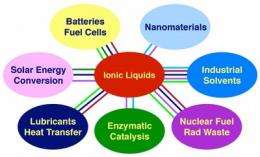
(PhysOrg.com) -- Ionic liquids are molecular solutions that have a wide range of potential applications, including next-generation solar cells, hydrogen fuel cells and lithium batteries.

As a neighbor tells a young Dustin Hoffman in The Graduate, “I just want to say one word to you - just one word: plastics. There’s a great future in plastics.” Well maybe so, but Rutgers Chemistry Professor Ed Castner thinks there is a great future in two words: ionic liquids.

These molecular soups can be many things to many people in many different applications, including next-generation , hydrogen fuel cells and lithium batteries. This may be what caught the eye of the U.S. Department of Energy, awarding Castner and his colleagues a grant for $2.4 million to delve into the nature of charge-transfer properties of ionic liquids. Previously, his Rutgers ionic liquids research was supported by the American Chemical Society’s Petroleum Research Fund. In addition to the new DOE funding, the Rutgers ionic liquids fundamental research is also currently funded by the National Science Foundation.

Ionic liquids by definition contain ions - atoms positively or negatively charged because they have too few or too many electrons or some other imbalance in their charge. Even with this imbalance, these ions are stable and exist freely in a solution, not bound to any other atoms as they would be in neutral (uncharged) compounds.

Successful with the DOE proposal, Castner is now the lead principal investigator on a three-year DOE-funded program. With his four co-principal investigators from Penn State, University of Iowa, University of Minnesota and Brookhaven National Laboratory, Castner and his Rutgers colleagues have assembled a top research team for investigating the properties of ionic liquids.

Batteries are a key , but they can only charge and discharge their electrical energy relatively slowly - think how a cell phone or computer takes hours to recharge. When the sun rises or sets on the Rutgers Solar Farm on the Livingston Campus, or when a hybrid car like a Toyota Prius uses regenerative braking technology, high performance capacitors are required.

The Future in Two Words: Ionic Liquids

Solar panel farm on the Rutgers Livingston Campus

New supercapacitors and ultracapacitors based on ionic liquid technology will do an even better job than the current technologies. Castner hopes to merge their basic science projects for understanding ionic liquids to help the Rutgers Energy Storage Research Group develop next-generation ultracapacitors and batteries.

Hydrogen fuel cells, a potential successor to conventional batteries, work best at temperatures well above the boiling point of water; evaporative losses can damage the device performance. Because ionic liquids almost never boil and are stable to high temperatures, fuel cells based on are expected to display enhanced performance.

Provided by Rutgers, The State University of New Jersey


print this article email this article download pdf blog this article bookmark this article     Stumble it Digg this share on Facebook retweet share on Reddit add to delicious
Rate this story - 4.4 /5 (8 votes)


November 13, 2009 all stories

Comments: 0

4.4 /5 (8 votes)
  • Stumble this up

  • Digg this

  • share this

  • hide
  • Related Stories

  • Metal-Air Battery Could Store 11 Times More Energy than Lithium-Ion
    created Nov 05, 2009 | popularity not rated yet | comments 0
  • Ionic Liquid's Makeup Measurably Non-Uniform at the Nanoscale
    created Nov 10, 2009 | popularity not rated yet | comments 0
  • Chemists look for cleaner, cheaper rocket fuel
    created Dec 02, 2008 | popularity not rated yet | comments 0
  • Understanding the chemistry of ionic liquids for nuclear fuel reprocessing
    created Sep 12, 2006 | popularity not rated yet | comments 0
  • New Web database improves access to ionic liquid data
    created Aug 18, 2006 | popularity not rated yet | comments 0


  • hide
  • Relevant PhysicsForums posts

  • why oxygen, cannot act as a pi-donor while NO can?
    created 2 hours ago
  • Aspirin
    created Nov 19, 2009
  • antibonding orbitals
    created Nov 19, 2009
  • Affect of adjacent amino acids on pKa values
    created Nov 19, 2009
  • What is the name of this pipette?
    created Nov 18, 2009
  • Calorimetery Problem. :( It's not a homework but I can't get the answer.
    created Nov 17, 2009
  • More from Physics Forums - Chemistry

Other News

Ethanol

Microbes to Take Over Ethanol Production?

Chemistry / Biochemistry

created 13 hours ago | popularity 4.3 / 5 (3) | comments 0

(PhysOrg.com) -- Not too long ago, it seemed that ethanol production was the wave of the future. The use of trash, wood chips or different types of plants -- usually grass or corn -- to make ethanol was considered ...


Just like old times: Generating RNA molecules in water

Chemistry / Biochemistry

created 12 hours ago | popularity 4 / 5 (3) | comments 0

A key question in the origin of biological molecules like RNA and DNA is how they first came together billions of years ago from simple precursors. Now, in a study appearing in this week's Journal of Biological Chemistry, resear ...


GE Scientists Developing Wearable RFID Sensors to Detect Airborne Chemical Agents

GE Scientists Developing Wearable RFID Sensors to Detect Airborne Chemical Agents

Chemistry / Analytical Chemistry

created 9 hours ago | popularity not rated yet | comments 0

GE Global Research, the technology development arm for the General Electric, today announced a $2 million award from the National Institute of Environmental Health Sciences to develop wearable RFID sensors ...


Accidental discovery produces durable new blue pigment for multiple applications

Accidental discovery produces durable new blue pigment for multiple applications

Chemistry / Biochemistry

created Nov 16, 2009 | popularity 4.5 / 5 (29) | comments 6

An accidental discovery in a laboratory at Oregon State University has apparently solved a quest that over thousands of years has absorbed the energies of ancient Egyptians, the Han dynasty in China, Mayan ...


One word: bioplastics

One word: bioplastics

Chemistry / Materials Science

created Nov 17, 2009 | popularity 4.5 / 5 (10) | comments 4

(PhysOrg.com) -- Every year, more than 250 billion pounds of plastic are produced worldwide. Much of it ends up in the world's oceans, a fact that troubles MIT biology professor Anthony Sinskey.