Cyclone Phyan raining on Tibet after breaking a record in India
November 13, 2009 Cyclone Phyan raining on Tibet after breaking a record in India

Enlarge

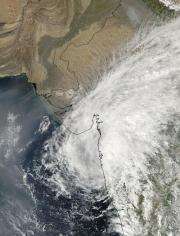
NASA's MODIS instrument on the Aqua satellite captured this stunning visual image of Tropical Cyclone Phyan making landfall north of Mumbai on Nov. 11 at 0845 UTC (3:45 ET). Credit: MODIS Rapid Response Team

Cyclone Phyan broke a 43 year record when it made landfall north of the city of Mumbai, India during the evening hours on November 11. NASA's Aqua satellite captured Phyan's landfall with one instrument, and a day later, another of Aqua's instruments show the storm's remnants raining Tibet as Phyan continues to dissipate.

Phyan is the first tropical cyclone to make an appearance in November in the Konkan region of India since 1996. The India Meteorological Department confirmed that the last November appearance of a storm in that region was 43 years ago. As Phyan was making landfall, NASA's Aqua satellite passed overhead, and the Moderate Imaging Spectroradiometer captured a stunning visual image of the storm on November 11 at 0845 UTC (3:45 ET).

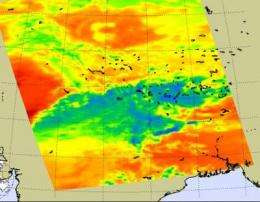
On November 12 at 1:30 p.m. local time (2:30 a.m. ET) another instrument on Aqua called the Atmospheric Infrared Sounder (AIRS) captured an image of Phyan's remnant cold clouds and showers over Tibet. The AIRS image showed that Phyan still had cold cloud tops as cold as -27F and was dumping moderate rainfall over Lake Manasarovar and Raksas Tal in Tibet.
Cyclone Phyan raining on Tibet after breaking a record in India
Enlarge

NASA's Aqua satellite AIRS instrument captured an infrared image of Cyclone Phyan's remnants over Tibet on Nov. 12. At that time, Phyan was still showing some moderate rainfall and cold cloud tops (in blue) as cold as -27F. Credit: NASA JPL, Ed Olsen

The official final warning on Phyan was issued on November 11 at 1500 UTC (10 a.m. ET) from the U.S. Navy's Joint Warning Center. Phyan's center was located near 19.2 degrees North latitude and 73.6 East longitude, about 30 miles east-northeast of Mumbai, . Cyclone Phyan had near 40 knots (46 mph) and it was moving northeast near 16 mph.

Phyan's remnants should dissipate over Tibet later today.

Source: JPL/NASA (news : web)


print this article email this article download pdf blog this article bookmark this article     Stumble it Digg this share on Facebook retweet share on Reddit add to delicious
Rate this story - 4.3 /5 (4 votes)


November 13, 2009 all stories

Comments: 0

4.3 /5 (4 votes)
  • Stumble this up

  • Digg this

  • share this

  • hide
  • Related Stories

  • NASA sees high thunderstorms in newly formed Tropical Cyclone 4A near India
    created Nov 10, 2009 | popularity not rated yet | comments 0
  • Tropical Storm Koppu poised for China landfall
    created Sep 14, 2009 | popularity not rated yet | comments 0
  • Warnings up for Philippines as Parma powers up to a super typhoon
    created Oct 01, 2009 | popularity not rated yet | comments 0
  • NASA's Aqua satellite catches 2 views of super Typhoon Choi-Wan
    created Sep 17, 2009 | popularity not rated yet | comments 0
  • Two NASA satellites capture monster Super Typhoon Melor
    created Oct 05, 2009 | popularity not rated yet | comments 0


  • hide
  • Relevant PhysicsForums posts

  • Looking for some temperature data
    created 21 hours ago
  • lat lon to ECEF conversion derivation...
    created Nov 29, 2009
  • Climate Science Update
    created Nov 27, 2009
  • The IPCC and the term "most"
    created Nov 23, 2009
  • More from Physics Forums - Earth

Other News

World forest observatory needed to monitor vital role of forests in climate deal

Space & Earth / Environment

created 8 minutes ago | popularity not rated yet | comments 0

A new scientific organisation is needed to monitor the commitments that will be made by developing countries at Copenhagen to cut their deforestation rates, according to research at the University of Leeds.


Climate change in Kuwait Bay

Climate change in Kuwait Bay

Space & Earth / Earth Sciences

created 30 minutes ago | popularity not rated yet | comments 0

Since 1985, seawater temperature in Kuwait Bay, northern Arabian Gulf, has increased on average 0.6°C per decade. This is about three times faster than the global average rate reported by the Intergovernmental ...


Black hole caught zapping galaxy into existence?

Black hole caught zapping galaxy into existence?

Space & Earth / Astronomy

created 2 hours ago | popularity 5 / 5 (5) | comments 0

(PhysOrg.com) -- Which come first, the supermassive black holes that frantically devour matter or the enormous galaxies where they reside? A brand new scenario has emerged from a recent set of outstanding ...


Big freeze plunged Europe into ice age in months

Space & Earth / Earth Sciences

created 1hour ago | popularity 5 / 5 (2) | comments 1

In the film, 'The Day After Tomorrow' the world enters the icy grip of a new glacial period within the space of just a few weeks. Now new research shows that this scenario may not be so far from the truth after all.


Peat fires drive temperatures up

Space & Earth / Environment

created 2 hours ago | popularity 1 / 5 (1) | comments 0

Peatlands, especially those in tropical regions, sequester gigantic amounts of organic carbon. Human activities are now having a considerable impact on these wetlands. For example, drainage projects, in combination with the ...