Underwater robot probes depths for Istanbul quake clues
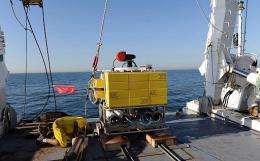
A state-of-the-art underwater robot called BOB may hold the key to protecting millions of people around Turkey's biggest city against a massive earthquake scientists say is all but inevitable.
Submersed into the dark waters of the Marmara Sea off Istanbul, BOB is a sophisticated turning sonar device similar to the kind of equipment used to detect shoals of fish.
Working at a depth of around 1,200 metres (3,960 feet), its mission however is not to track the movements of fish but to observe the expulsion of bubbles of gas, notably methane, from the seabed.
BOB -- which stands for Bubbles OBservatory module -- is the key piece of equipment on board the Suroit, an oceanographic vessel of the French Research Institute for Exploitation of the Sea (IFREMER).
The mission, which lasts until December 14, is aimed at observing possible clues emerging from the North Anatolian fault.
"We know that after earthquakes, there are significant emissions of gas," said Louis Geli, a geophysicist from IFREMER.
"What we would like to know is whether emissions like this occur before earthquakes or whether there are variations in emissions before earthquakes, which would work as a kind of alert."
Pointing to a map of the Marmara Sea, which connects the Black Sea to the Mediterranean, Geli explains the threat facing Istanbul, a crowded metropolis where mass emigration has led to rapid growth.
Some 15 million people live in and around Istanbul, but there is a lot of ramshackle planning and illegal construction, suggesting many homes would be vulnerable to a large quake.
The North Anatolia fault lies some 20 kilometres (12 miles) to the south of Istanbul.
Its eastern strand, the Izmit fault, ruptured in 1999 in two huge quakes that killed about 20,000 people in Turkey's densely-populated northwest, while its western strand, the Ganos fault, was responsible for a big quake in 1912.
"Between those two strands, there has been no movement since 1766. This is the most dangerous segment of the fault today," Geli said.
Pierre Henrym from France's National Centre for Scientific Research (CNRS), warned that the earthquake expected to hit Istanbul -- dubbed the "Big One" -- would be of a major magnitude.
"We know the tectonic plates in this area are moving a little more than two metres (seven feet) every century, so we can expect a shift of between two and five metres over a minimum distance of 80 kilometres," Henry said.
Such a movement would be capable of creating shocks of a magnitude between 7.2 and 7.4 on the open-ended Richter scale.
"But we do not know when this will happen," Henry cautioned.
Sukru Yurtsever, a Turkish geophysician on board the Suroit, said that on top of any earthquake, there could be a powerful tsunami effect because of the steep shores of the Marmara Sea.
There is a palpable unease among Istanbul residents about a quake.
A shopkeeper from Bostanci, on the Asian side of the city, told AFP he now maintains a personal earthquake rescue kit at home which contains a whistle, a torch, water, biscuits and a medical kit.
He has also done several evacuation exercises with his wife, with a best time so far of 13 seconds.
Sinan Ozoren, of Istanbul Technical University, said the wait was taking a psychological toll.
"Every time there is a small tremor the worry comes back. You can see it in the press and on television. This threat is triggering a lot of psychological problems," he said, also from on board the Suroit.
The IFREMER mission has deployed other tools as well as BOB. An unmanned submarine cruises the bottom of the sea drawing "high-resolution" maps, said acoustics expert Carla Scalabrin, while seismographs and sonars are used to trace bubble "chimneys."
The aim of the mission is to install permanent underwater observatories off Istanbul one day as part of the European Sea Floor Observatory Network.
Japan, the United States and Canada are also setting permanent underwater stations around the globe for seismic and environmental purposes.
"For the time being, nobody is able to predict earthquakes," said Henry.
"We are more or less in the same situation as a meteorologist who has data from a full year and is asked to say when the next tornado will take place."
(c) 2009 AFP


