Scientists pinpoint origin of dissolved arsenic in Bangladesh drinking water
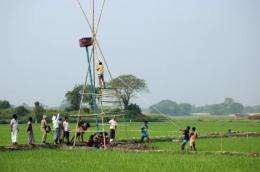
Researchers in MIT's Department of Civil and Environmental Engineering believe they have pinpointed a pathway by which arsenic may be contaminating the drinking water in Bangladesh, a phenomenon that has puzzled scientists, world health agencies and the Bangladeshi government for nearly 30 years. The research suggests that human alteration to the landscape, the construction of villages with ponds, and the adoption of irrigated agriculture are responsible for the current pattern of arsenic concentration underground.
The pervasive incidence of arsenic poisoning in Bangladesh and its link to drinking water were first identified in the scientific literature in the early 1980s, not long after the population began switching from surface water sources like rivers and ponds to groundwater from newly installed tube wells. That national effort to decrease the incidence of bacterial illnesses caused by contaminated drinking water led almost immediately to severe and widespread arsenic poisoning, which manifests as sores on the skin and often leads to cancers of the skin, lung, liver, bladder and pancreas.
Since then, scientists have struggled to understand how the arsenic, which is naturally occurring in the underground sediment of the Ganges Delta, is being mobilized in the groundwater.
By 2002, a research team led by Charles Harvey, the Doherty Associate Professor of Civil and Environmental Engineering at MIT, had determined that microbial metabolism of organic carbon was mobilizing the arsenic off the soils and sediments, and that crop irrigation was almost certainly playing a role in the process. But the exact sources of the contaminated water have remained elusive, until now.
In a paper appearing online in Nature Geoscience Nov. 15, Harvey, former graduate students Rebecca Neumann and Khandakar Ashfaque and co-authors explain that ponds excavated for the purpose of providing soil to build up villages for flood protection are the source of the organic carbon that presently mobilizes the arsenic in their 6-square-mile test site. The carbon settles to the bottom of the ponds, then seeps underground where microbes metabolize it. This creates the chemical conditions that cause arsenic to dissolve off the sediments and soils and into the groundwater.
The researchers also found that in their test area, which is flooded by annual monsoons, the rice fields irrigated with arsenic-laden water actually serve to filter out much of the arsenic from the water system.
"Our research shows that water from the ponds carries degradable organic carbon into the shallow aquifer. Groundwater flow, drawn by irrigation pumping, transports that pond water to the depth where dissolved arsenic concentrations are greatest and where it is then pumped up into the irrigation and drinking wells," says Harvey. "The other interesting thing we found is that the rice fields are a sink of arsenic — more arsenic goes in with the irrigation water than comes out in the groundwater."

Scott Fendorf, a professor at Stanford University who studies arsenic content in soils and sediments along the Mekong River in Cambodia, says Harvey's previous research, published in 2002, "transformed the scientific community's outlook on the problem." The current work, he adds, has two big ramifications: "It shows that human modifications are impacting the arsenic content in the groundwater; and that while the rice cropping system appears to be buffering the arsenic, the ponds excavated to provide fill to build up the villages are having a negative impact on the release of arsenic."
Neumann, now a postdoctoral associate at Harvard University, took seven trips and spent nearly a year doing fieldwork in Bangladesh, studying the hydrologic behavior and chemical nature of rice fields and ponds, and performing tests on rice field and pond waters to determine if the organic carbon in these water bodies would stimulate arsenic mobilization. She and Ashfaque developed an understanding of the surface and underground water flow patterns over a seven-year period, using natural tracers and a 3-D model to track rice field and pond water as it traveled into and through the subsurface.
"When we compared the chemical signatures of the different water sources in our study area to the signatures of the aquifer water, we saw that water with high arsenic content originates from the human-built ponds, and water with lower arsenic content originates from the rice fields," says Neumann. "It's likely that these same processes are occurring at other sites, and it suggests that the problem could be alleviated by digging deeper drinking water wells below the influence of the ponds or by locating shallow drinking wells under rice fields." The researchers suggest that irrigation wells remain at the shallow level.
At 159 million people, Bangladesh is the seventh most populous country in the world, and it is growing quickly. That means that new tube wells and ponds are being dug every day to accommodate the growing population. Most of those wells are being drilled to less than 100 feet. At that depth, they draw water directly from the contaminated shallow aquifer.
Holly Michael, a professor at the University of Delaware and former PhD student in the Harvey Lab, also studies the physics of groundwater flow and transport of the dissolved arsenic in Bangladesh, but in the deeper aquifer.
"Charlie's team is looking at the impacts at and near the surface, and my team is looking at the potential impacts of human activities at depth," says Michael. "My team found that if only the drinking-water wells are put into the deep, low-arsenic parts of the aquifer — at depths greater than 450 feet — then it is likely that the supply of low-arsenic water will continue for a very long time over much of the arsenic-affected area. Because so much more water is pumped for irrigation, it is important that irrigation wells are not installed deeper, as this would likely cause high-arsenic groundwater to flow downward toward the wells."
Harvey estimates that the prevalence of arsenic poisoning in Bangladesh is approximately 2 million cases and that the incidence of death from arsenic-induced cancer will rise to approximately 3,000 cases per year if consumption of contaminated water continues. He and a team of environmental scientists and physicians are making plans for a multi-year study that would provide deep wells for two villages in Bangladesh whose inhabitants suffer from arsenic poisoning. There they would combine continual testing of the well water and hydrogeological modeling of the groundwater system with a study of how the clean water effects the villagers' health, placing special emphasis on the neurological development of children.
"There are all sorts of studies to show how arsenic hurts people. We're trying to turn it around and show how removal of the arsenic will help them," says Harvey.
Source: Massachusetts Institute of Technology (news : web)


