Measuring Electron Orbitals
November 16, 2009
Measuring Electron Orbitals

Enlarge

A recent Science paper sheds a new light on electron density in individual molecular states.

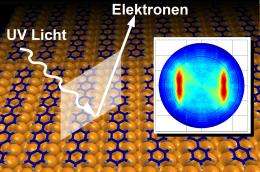
(PhysOrg.com) -- For the first time, it has been possible to measure electron density in individual molecular states using what is known as the photoelectric effect. Now published in Science, this method represents a key building block in the development of organic semiconductor elements. Supported by the Austrian Science Fund FWF, the success of this project rested on the mathematical transformation of the measured data. This made it possible to interpret the distribution of the electrons and draw conclusions about the potential properties of organic semiconductor elements.

Ultra-thin films made of organic molecules form the basis of future semiconductor technologies. Because organic molecules are extremely flexible, they can be used in a whole new range of applications, making it equally possible to create pliable screens and cost-effective . However, apart from these everyday applications for organic semiconductors, the most important task is to gain a better understanding of the interactions between organic materials and inorganic carrier substances. A team from the Universities of Graz and Leoben has now succeeded in developing a means of doing just that.

TIGHTLY PACKED

"The properties of an are defined to a large extent by specific electron states", explains Dr. Peter Puschnig of the Chair of Atomistic Modelling and Design of Materials at the University of Leoben, who led the research. He adds: "If we can determine their distribution within the molecule accurately, then we will be able to better understand how organic semiconductor components work and thus increase their efficiency." Until now, there has been a lack of effective methods of measuring this electron distribution. Dr. Puschnig and his team have therefore succeeded in making significant progress.

The team's achievement is based on the use of the photoelectric effect. This enables individual electrons to be "knocked out" of organic molecules. As part of this project, an organic molecule was exposed to ultraviolet light that emitted sufficient energy to separate individual electrons from the molecules. The direction and speed of the electrons thus released were then measured using highly-sensitive detectors, generating the basic data required to calculate the electron distribution within the molecule. As part of this process, Prof. Michael Ramsay and his team from the University of Graz used a hexaphenyl film just one molecule thick that had been applied to a copper surface. The team from Graz carried out the actual measurements at the Berliner Elektronen-Speicherring Gesellschaft für Synchrotronstrahlung (BESSY, Berlin Electron Storage Ring Society for Synchrotron Radiation).

A CALCULATED RESULT

Commenting on the evaluation of this data, Dr. Puschnig says: "It revealed a quite characteristic distribution of the electrons emitted. However, it initially proved difficult to interpret this distribution and it seemed it would be impossible to link the measured data to the original electron distribution in the molecule." It was only by using special mathematical transformations (Fourier Transformation) that the team was able to establish that the measured electron distribution matched that of the molecule. As the distribution was in this instance already known from calculations carried out as part of the density functional theory, it was possible to test and confirm the viability of the new method.

This new method is particularly valuable as it means measuring the behaviour of at the interfaces between organic semiconductors and metals is now relatively easy and highly accurate. The study "Interface controlled and functionalised organic thin films" supported by the FWF as part of the National Research Network (NFN) is thus making a fundamental contribution to future applications of organic semiconductors.

More information: Reconstruction of Molecular Orbital Densities from Photoemission Data, P. Puschnig, S. Berkebile, A. J. Fleming, G. Koller, K. Emtsev, T. Seyller, J. D. Riley, C. Ambrosch­Draxl, F. P. Netzer, M. G. Ramsey: Science 326, 702 (2009).

Provided by Austrian Science Fund


Rank 5 /5 (8 votes)
Related Stories
Relevant PhysicsForums posts
  • A grandfather pulls his granddaughter, whose mass is 20.5 kg
    created1 hour ago
  • what is significance of torque
    created1 hour ago
  • Difference between volume displaced fluid and volume of the object
    created2 hours ago
  • Questions about Galileo statement?
    created3 hours ago
  • Question on Kirchoff's Laws
    created7 hours ago
  • Changes in Water Weight
    created8 hours ago
  • More from Physics Forums - General Physics

More news stories

Borexino Collaboration succeeds in spotting pep neutrinos emitted from the sun

(PhysOrg.com) -- To learn more about how the sun works, scientists study particles that are emitted from it into space due to thermonuclear reactions that occur inside; by applying known physics principles, ...

Physics / General Physics

created 16 hours ago | popularity 4.6 / 5 (7) | comments 0 | with audio podcast report

Explained: Sigma

It's a question that arises with virtually every major new finding in science or medicine: What makes a result reliable enough to be taken seriously? The answer has to do with statistical significance -- but ...

Physics / General Physics

created 16 hours ago | popularity 5 / 5 (10) | comments 28

Physics research suggests new pathways for cancer progression

Observing that certain cancer cells may exhibit greater flexibility than normal cells, some scientists believe that this capability promotes rapid tumor growth. Now computer simulations developed by Boston University Biomedical ...

Physics / General Physics

created 13 hours ago | popularity 5 / 5 (1) | comments 0

Quantum physicist explains $100K offer for proof scaled-up quantum computing is impossible

(PhysOrg.com) -- MIT researcher Scott Aaronson has certainly riled the physics community with his offer this past Friday, of $100,000 to anyone who can prove that scaled-up quantum computing is impossible. ...

Physics / Quantum Physics

created Feb 08, 2012 | popularity 4.1 / 5 (11) | comments 31 | with audio podcast weblog

Physicists build highly efficient 'no-waste' laser

A team of University of California, San Diego researchers has built the smallest room-temperature nanolaser to date, as well as an even more startling device: a highly efficient, "thresholdless" laser that ...

Physics / General Physics

created Feb 08, 2012 | popularity 4.9 / 5 (20) | comments 5 | with audio podcast


'Dark plasmons' transmit energy

Microscopic channels of gold nanoparticles have the ability to transmit electromagnetic energy that starts as light and propagates via "dark plasmons," according to researchers at Rice University.

Hydrogen from acidic water: Researchers develop potential low cost alternative to platinum for splitting water

A technique for creating a new molecule that structurally and chemically replicates the active part of the widely used industrial catalyst molybdenite has been developed by researchers with the Lawrence Berkeley ...

FDA-approved drug rapidly clears amyloid from the brain, reverses Alzheimer's symptoms in mice

Neuroscientists at Case Western Reserve University School of Medicine have made a dramatic breakthrough in their efforts to find a cure for Alzheimer's disease. The researchers' findings, published in the journal Science, show t ...

Ultraviolet protection molecule in plants yields its secrets

Lying around in the sun all day is hazardous not just for humans but also for plants, which have no means of escape. Ultraviolet (UV) radiation from the sun can damage proteins and DNA inside cells, leading ...

Anyone can learn to be more inventive, cognitive researcher says

There will always be a wild and unpredictable quality to creativity and invention, says Anthony McCaffrey, a cognitive psychology researcher at the University of Massachusetts Amherst, because an "Aha moment" is rare and ...

Flexible paper robots

(PhysOrg.com) -- These inexpensive robots can stretch, bend and twist under control, and lift objects up to 120 times their own weight. Being soft, they can apply gentle and even pressure, and adapt to varied ...