Investigating muscle repair, scientists follow their noses
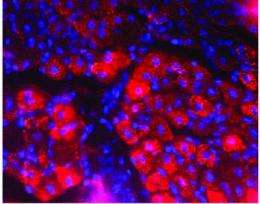
When muscle cells need repair, they use odor-detecting tools found in the nose to start the process, researchers have discovered.
The results are published online and scheduled for publication in the November issue of the journal Developmental Cell.
Found on the surfaces of neurons inside the nose, odorant receptors are molecules that bind and respond to substances wafting through the air. Researchers have shown that one particular odorant receptor gene, MOR23, is turned on in muscle cells undergoing repair.
"Normally MOR23 is not turned on when the tissue is at rest, so we wouldn't have picked it up without looking specifically at muscle injury," says Grace Pavlath, PhD, professor of pharmacology at Emory University School of Medicine. "There is no way we would have guessed this."
Interfering with MOR23 inhibits muscle cells' ability to migrate, stick to each other and form long fibers, Pavlath and her colleagues showed. In addition, MOR23 is the first molecule found to influence the process of myofiber branching, a form of degeneration seen in muscular dystrophies and aging.
The finding could lead to new ways to treat muscular dystrophies and muscle wasting diseases, and also suggests that odorant receptors may have additional unexpected functions in other tissues.
The stem cells that renew muscle tissue are called satellite cells. Several years ago, Pavlath observed that MOR23 was turned on when mouse satellite cells were fusing to form extended muscle fibers in culture. At the same time, graduate student Christine Griffin noticed a Japanese report that MOR23 is also turned on in sperm cells and influences their migration.
"At first glance, our result seemed like a fluke," Pavlath says. "Because Christine was writing a mock grant on MOR23 in sperm for a class assignment, we decided it would be fun to explore MOR23's function in muscle. It mushroomed from there."
MOR23 responds to lyral, a fragrance ingredient in many cosmetics that smells like lily-of-the-valley. Although Griffin could show that muscle cells migrate towards lyral, this doesn't mean muscles in the body use the same chemical.
Pavlath says that the molecule the body uses to direct muscle repair through MOR23 is present in an extract from crushed muscle cells.
"When you squish the cells, it leaks out - or an enzyme releases it," she says.
The human genome contains around 400 genes encoding odorant receptors, and mice have more than 900. It is not clear what the MOR23 equivalent is in humans, or whether the odorant receptors that respond to lyral in humans are also involved in muscle repair.
The team's results raise a number of intriguing questions about what odorant receptors do in muscle tissue. Pavlath says she wants to identify the molecule in the body that activates MOR23 and investigate what jobs other odorant receptors perform in muscle.
"There is a tremendous variation in humans as far as what odors individuals can recognize," she says. "Could this be linked somehow to differences in the ability to repair muscle?"
Source: Emory University (news : web)


