Close-up movie shows hidden details in the birth of super-suns (w/ Video)
November 16, 2009 Close-up movie shows hidden details in the birth of super-suns

Enlarge

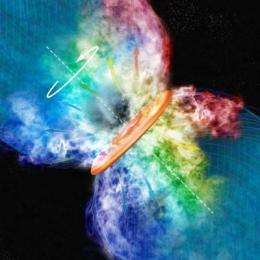
This is an artist's conception of the "boiling disk" surrounding the massive young stellar object known as Orion Source I. A disk of hot, ionized gas surrounds the central star, blocking our view. A cool wind of gas is driven from the upper and lower surfaces of the disk (as indicated by the colored arrows) and is sculpted into an hourglass shape by tangled magnetic field lines (shown as thin blue lines). This outflow is lit up by emission from silicon monoxide molecules -- emission that has been imaged and tracked by radio astronomers month-to-month. The entire disk and wind are rotating, leading to observable Doppler shifts of the material entrained in the wind; redder colors represent material with a component of motion away from the observer (into the plane of the sky), while bluer colors represent material moving toward the observer (out of the plane of the sky). Credit: Bill Saxton, NRAO/AUI/NSF

(PhysOrg.com) -- The constellation of Orion is a hotbed of massive star formation, most prominently in the Great Nebula that sits in Orion's sword. The glowing gas of the Nebula is powered by a group of young massive stars, but behind it is a cluster of younger stars and clumps of gas. Still gathering together under gravity's pull, these gas clumps will eventually ignite into stars.

The youthful cluster cannot be seen with traditional telescopes because of the surrounding and dust, but a new high-resolution time-lapse movie reveals the process of massive with radio images a thousand times sharper and more detailed than any previously obtained. The movie shows that form like their smaller siblings, with disk accretion and magnetic fields playing crucial roles.

The way that massive stars form remains mysterious, in part, because massive stars are rare and tend to spend their youth enshrouded by dust and gas hiding them from view.

"We know how these stars die, but not how they are born," said Lincoln Greenhill, a principal investigator of the study and part of a team comprising scientists from the Harvard-Smithsonian Center for Astrophysics (CfA) and the National Radio Astronomy Observatory (NRAO).

FLV player

This movie shows actual data from the Very Long Baseline Array, which imaged clumps of gas flowing away from the young protostar known as Source I over the course of two years. Gas moving toward us (blueshifted) is colored green or blue, while gas moving away from us (redshifted) is colored yellow, orange and red. The protostar is not visible to the VLBA; its location is marked by a red dot and crosshairs. Credit: L. Matthews (MIT)

Unlike Hubble and other visible-light telescopes, can penetrate dusty veils around stars. The research astronomers studied a massive young protostar called Source I (pronounced "eye") at , using the National Science Foundation's (VLBA) as a powerful "zoom lens."

The VLBA yielded even sharper images than the famous Hubble photos of "proplyds," or protoplanetary disks in Orion. The team observed Source I at monthly intervals over two years and then assembled the individual images into a time-lapse movie.

The VLBA detected thousands of silicon monoxide gas clouds called masers - naturally occurring laser-like beacons often associated with star formation. Some masers were as close to the protostar as Jupiter is to our Sun, which is also a record. Many of the masers existed long enough for their motions to be tracked across the sky and along our line of sight, yielding their 3-d motions through space.

"Source I is the richest source of masers in the Galaxy, that we know of," said Lynn Matthews, lead author of the new work, who is now a researcher at the MIT Haystack Observatory. "Without the masers, we couldn't track the gas motions in such detail so close to this massive star, and would be relatively blind to its formation."

"In astronomy, it's rare to see changes over the course of a human lifetime. With this new movie, we can see changes over just a few months as gas clumps swarm around this young protostar," added Smithsonian astronomer and co-author Ciriaco Goddi.

The resulting movie reveals signs of a rotating accretion disk, where gas is swirling closer and closer to the protostar at the center. It also shows material flowing outward perpendicular to the disk in two large V's - actually the edges of cone-shaped streams of gas. Such outflows foster star formation by carrying angular momentum away from the system.

Intriguingly, the outflow streams appear to curve as they leave the disk. "The bending path of these masers provides key evidence that magnetic fields may be influencing gas motions very close to the protostar," pointed out Claire Chandler of NRAO, a co-principal investigator of the study.

Magnetic field lines are familiar from their effect on iron filings sprinkled around a bar magnet, outlining loops extending from one pole of the magnet to the other. In the case of Source I and other massive protostars, magnetic field lines may extend outward into space, wrapping in a helix that is shaped much like Twizzlers candy. Outflowing gas streams along those field lines.

"Magnetic fields are supposed to be weak and unimportant to the birth process for massive stars," said Matthews. "But masers would not travel along gentle arcs unless they experience some sort of force - probably a magnetic force."

The data don't show whether the magnetic field arises in the star or in the accretion disk. Future observations by the Expanded Very Large Array (E-VLA) and the Atacama Large Millimeter Array (ALMA) may be able to distinguish between competing hypotheses. The team plans to look for other fingerprints of magnetic fields around Source I.

"Our two-year movie is just the beginning," said Smithsonian astronomer and co-principal investigator Elizabeth Humphreys.

More information: The paper describing these findings will appear in the Astrophysical Journal early next year, in January 2010, and it is available online at http://arxiv.org/abs/0911.2473

Source: Harvard-Smithsonian Center for Astrophysics (news : web)


print this article email this article download pdf blog this article bookmark this article     Stumble it Digg this share on Facebook retweet share on Reddit add to delicious
Rate this story - 4.8 /5 (10 votes)

Rank Filter

Move the slider to adjust rank threshold, so that you can hide some of the comments.


Display comments: newest first

  • Alexa - Nov 17, 2009
    • Rank: not rated yet
    It's apparent, galaxies are conceptually the very same stuff around central black holes, like planetary ring around supernovas - they just differ in scale:

    http://lh3.ggpht....ova1.gif


November 16, 2009 all stories

Comments: 1

4.8 /5 (10 votes)
  • Stumble this up

  • Digg this

  • share this

  • hide
  • Related Stories

  • Making Massive Stars
    created Sep 15, 2009 | popularity not rated yet | comments 0
  • How to Build A Big Star
    created Sep 06, 2005 | popularity not rated yet | comments 0
  • A jet of molecular hydrogen arising from a forming high-mass star
    created Mar 07, 2007 | popularity not rated yet | comments 0
  • Turbulence May Promote the Birth of Massive Stars
    created Feb 23, 2009 | popularity not rated yet | comments 0
  • Spitzer Reveals New Wonders in the Familiar Orion Nebula
    created Aug 15, 2006 | popularity not rated yet | comments 0


  • hide
  • Relevant PhysicsForums posts

  • basic 'our universe' question..
    created 4 hours ago
  • deriving keplers law
    created Nov 19, 2009
  • rotation of Earth
    created Nov 18, 2009
  • elliptical orbits
    created Nov 18, 2009
  • Apophis
    created Nov 18, 2009
  • Summer Research project
    created Nov 18, 2009
  • More from Physics Forums - General Astronomy

Other News

Cassini's Big Sky: The View from the Center of Our Solar System

Cassini's Big Sky: The View from the Center of Our Solar System

Space & Earth / Space Exploration

created 12 hours ago | popularity 4.7 / 5 (10) | comments 1

(PhysOrg.com) -- When NASA's Cassini spacecraft began orbiting Saturn five years ago, a dozen highly-tuned science instruments set to work surveying, sniffing, analyzing and scrutinizing the Saturnian system.


More than 18 million cubic metres of sand are set to be poured onto the new coastal band of dunes until 2011

Dutch build more dunes against rising seas

Space & Earth / Environment

created 7 hours ago | popularity 3.7 / 5 (3) | comments 0

On the beach at Monster, bulldozers painstakingly turn sand dredged from the bottom of the North Sea bed into dunes in an ambitious effort to safeguard the Netherlands from flooding.


New Method to Measure Snow, Soil Moisture With GPS May Benefit Meteorologists, Farmers

Space & Earth / Earth Sciences

created 7 hours ago | popularity not rated yet | comments 1

(PhysOrg.com) -- A research team led by the University of Colorado at Boulder has found a clever way to use traditional GPS satellite signals to measure snow depth as well as soil and vegetation moisture, a technique expected ...


Some 6,000 families were affected by the drought in the Chaco region of Paraguay, particularly indigenous populations

El Nino intensifies Latin America drought

Space & Earth / Earth Sciences

created 15 hours ago | popularity 5 / 5 (2) | comments 0

From a devastating food crisis in Guatemala to water cuts in Venezuela, El Nino has compounded drought damage across Latin America this year.


NJIT receives funding to improve Big Bear Telescope, study solar energy

NJIT receives funding to improve Big Bear Telescope, study solar energy

Space & Earth / Astronomy

created 5 hours ago | popularity 4 / 5 (2) | comments 0

NJIT researchers are at work on many scientific and technological frontiers. The National Science Foundation has recently provided support that totals nearly $4.3 million for the diverse efforts of the following ...