Accidental discovery produces durable new blue pigment for multiple applications
November 16, 2009
Accidental discovery produces durable new blue pigment for multiple applications

Enlarge

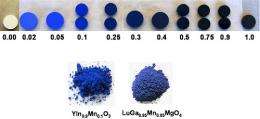
Variations of a new blue pigment were developed by chemists at Oregon State University, based on manganese.

An accidental discovery in a laboratory at Oregon State University has apparently solved a quest that over thousands of years has absorbed the energies of ancient Egyptians, the Han dynasty in China, Mayan cultures and more - the creation of a near-perfect blue pigment.

Through much of recorded human history, people around the world have sought inorganic compounds that could be used to paint things blue, often with limited success. Most had environmental or durability issues. blue, developed in France in the early 1800s, can be carcinogenic. Prussian blue can release cyanide. Other blue pigments are not stable when exposed to heat or acidic conditions.

But chemists at OSU have discovered new compounds based on manganese that should address all of those concerns. They are safer to produce, much more durable, and should lead to more environmentally benign blue pigments than any being used now or in the past. They can survive at extraordinarily high temperatures and don't fade after a week in an acid bath.

The findings were just published in the , and a patent has been applied for on the composition of the compound and the process used to create it. The research was funded by the National Science Foundation.
Accidental discovery produces durable new blue pigment for multiple applications
Enlarge

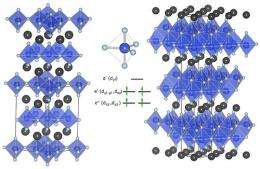
An unusual "trigonal bipyramidal coordination" of manganese compounds was used to create a new blue pigment that is safe to produce, durable and environmentally benign.

"Basically, this was an accidental discovery," said Mas Subramanian, the Milton Harris Professor of Materials Science in the OSU Department of Chemistry. "We were exploring manganese oxides for some interesting they have, something that can be both ferroelectric and ferromagnetic at the same time. Our work had nothing to do with looking for a pigment.

"Then one day a graduate student who is working in the project was taking samples out of a very hot furnace while I was walking by, and it was blue, a very beautiful blue," he said. "I realized immediately that something amazing had happened."

What had happened, the researchers said, was that at about 1,200 degrees centigrade - almost 2,000 degrees Fahrenheit - this otherwise innocuous turned into a vivid blue compound that could be used to make a pigment able to resist heat and acid, be environmentally benign and cheap to produce from a readily available mineral.

The newest - and possibly the best - blue pigment in world history was born, due to manganese ions being structured in an unusual "trigonal bipyramidal coordination" in the presence of extreme heat.

"Ever since the early Egyptians developed some of the first blue pigments, the pigment industry has been struggling to address problems with safety, toxicity and durability," Subramanian said.

The pigment may eventually find uses in everything from inkjet printers to automobiles, fine art or house paint, researchers say.

The scientists said in their journal article that the new compound yields "a surprisingly intense and bright blue color," and they have outlined its structure and characteristics in detail. Collaborating on the work were researchers in the Materials Department at the University of California/Santa Barbara.

"A lot of the most interesting discoveries are not really planned, we've seen that throughout history," Subramanian said. "There is luck involved, but I also teach my students that you have to stay alert to recognize something when it happens, even if it isn't what you were looking for."

"Luck favors the alert mind."

Source: Oregon State University (news : web)

4.5 /5 (33 votes)  

Filter


Move the slider to adjust rank threshold, so that you can hide some of the comments.


Display comments: newest first

Simonsez
Nov 16, 2009

Rank: 2 / 5 (4)
What is this, blue-collar comedy hour?

Pretty sure the Mayans had it down, considering theirs is the only pigment that withstood the test of time... Just because we do not know how to reproduce their pigment does not make it less than "near-perfect" as this one claims to be.
Mungaman
Nov 16, 2009

Rank: 3 / 5 (4)
This guy is pretty full of himself. Luck favors the alert mind? WTF!?! Sounds pretty familiar...

Chance favors the prepared mind -Louis Pasteur
jonnyboy
Nov 17, 2009

Rank: 3 / 5 (2)
Let's see now, funded by the NSF (our money) and they are going to patent it and get rich. WTF is wrong with this picture?
RolfRomeo
Nov 17, 2009

Rank: 2.3 / 5 (3)
Let's see now, funded by the NSF (our money) and they are going to patent it and get rich. WTF is wrong with this picture?

Capitalism ftw!
eurekalogic
Nov 17, 2009

Rank: 4 / 5 (4)
The negativity of the comments I saw is not good. I hope someone noticed that the discovery was more than "blue". Its a blue conductive and magnetic paint. I can think of a thousand uses for this discovery. Be excited for us moving forward and not be full of emotional envy.
SteveL
Nov 20, 2009

Rank: 3.7 / 5 (3)
Quote: "Most had environmental or durability issues. Cobalt blue, developed in France in the early 1800s, can be carcinogenic. Prussian blue can release cyanide. Other blue pigments are not stable when exposed to heat or acidic conditions."

A safe blue that resists fading has always been a challenge. This progress is good - even if it was accidental, and there are a lot worse things for our government to be spending our tax dollars on than studying the properties of materials.
Rank 4.5 /5 (33 votes)
Related Stories
Relevant PhysicsForums posts
  • how to choose a reduced or oxidated form in a redox
    created2 hours ago
  • Mesomeric effect in acids.
    created2 hours ago
  • Looking for a safe endothermic chemical reaction
    createdFeb 07, 2012
  • Anomalies of H20
    createdFeb 07, 2012
  • Orbital Hybridization - Real or Approximation
    createdFeb 07, 2012
  • hybridisation of Mn in MnO4-
    createdFeb 07, 2012
  • More from Physics Forums - Chemistry

More news stories

Carbonized coffee grounds remove foul smells

For coffee lovers, the first cup of the morning is one of life's best aromas. But did you know that the leftover grounds could eliminate one of the worst smells around – sewer gas?

Chemistry / Materials Science

created 5 hours ago | popularity 5 / 5 (1) | comments 2 | with audio podcast

Research provides octagonal window of opportunity for carbon capture

(PhysOrg.com) -- Filtering carbon dioxide, a greenhouse gas, from factory smokestacks is a necessary, but expensive part of many manufacturing processes. However, a collaborative research team from the National ...

Chemistry / Materials Science

created 6 hours ago | popularity 5 / 5 (1) | comments 2 | with audio podcast

Study adds timing capability to living cell sensors

(PhysOrg.com) -- Individual cells modified to act as sensors using fluorescence are already useful tools in biochemistry, but now they can add good timing to their resumé, thanks in part to expertise ...

Chemistry / Biochemistry

created 6 hours ago | popularity not rated yet | comments 0 | with audio podcast

Scientists develop biological computer to encrypt and decipher images

Scientists at The Scripps Research Institute in California and the Technion–Israel Institute of Technology have developed a "biological computer" made entirely from biomolecules that is capable of deciphering ...

Chemistry / Biochemistry

created 22 hours ago | popularity 4.4 / 5 (10) | comments 2 | with audio podcast

'Cell assay on a chip': solid results from simple means

(PhysOrg.com) -- The great artist and inventor Leonardo da Vinci once said that "simplicity is the ultimate sophistication." National Institute of Standards and Technology (NIST) research engineer Javier Atencia ...

Chemistry / Analytical Chemistry

created 5 hours ago | popularity not rated yet | comments 1


Short fasting cycles work as well as chemotherapy in mice

Man may not live by bread alone, but cancer in animals appears less resilient, judging by a study that found chemotherapy drugs work better when combined with cycles of short, severe fasting.

Gene therapy for inherited blindness succeeds in patients' other eye

Gene therapy for congenital blindness has taken another step forward, as researchers further improved vision in three adult patients previously treated in one eye. After receiving the same treatment in their ...

Physicists build highly efficient 'no-waste' laser

A team of University of California, San Diego researchers has built the smallest room-temperature nanolaser to date, as well as an even more startling device: a highly efficient, "thresholdless" laser that ...

Study shows how DNA finds its match

It's been more than 50 years since James Watson and Francis Crick showed that DNA is a double helix of two strands that complement each other. But how does a short piece of DNA find its match, out of the millions ...

Transparent iron? For the first time, an experiment shows that atomic nuclei can become transparent

At the high-brilliance synchrotron light source PETRA III, a team of DESY scientists headed by Dr. Ralf Röhlsberger has succeeded in making atomic nuclei transparent with the help of X-ray light. At the ...

'Explorers,' who embrace the uncertainty of choices, use specific part of cortex

Life shrouds most choices in mystery. Some people inch toward a comfortable enough spot and stick close to that rewarding status quo. Out to dinner, they order the usual. Others consider their options systematically ...