Analyzing structural brain changes in Alzheimer's disease
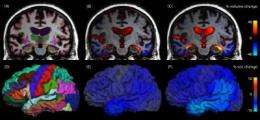
In a study that promises to improve diagnosis and monitoring of Alzheimer's disease, scientists at the University of California, San Diego have developed a fast and accurate method for quantifying subtle, sub-regional brain volume loss using magnetic resonance imaging (MRI). The study will be published the week of November 16 in the Proceedings of the National Academy of Sciences (PNAS).
By applying the techniques to the newly completed dataset of the multi-institution Alzheimer's Disease Neuroimaging Initiative (ADNI), the scientists demonstrated that such sub-regional brain volume measurements outperform available measures for tracking severity of Alzheimer's disease, including widely used cognitive testing and measures of global brain-volume loss.
The general pattern of brain atrophy resulting from Alzheimer's disease has long been known through autopsy studies, but exploiting this knowledge toward accurate diagnosis and monitoring of the disease has only recently been made possible by improvements in computational algorithms that automate identification of brain structures with MRI. The new methods described in the study provide rapid identification of brain sub-regions combined with measures of change in these regions across time. The methods require at least two brain scans to be performed on the same MRI scanner over a period of several months. The new research shows that changes in the brain's memory regions, in particular a region of the temporal lobe called the entorhinal cortex, offer sensitive measures of the early stages of the disease.
"Loss of volume in the hippocampus is a consistent finding when using MRI, and is a reliable predictor of cognitive decline," said Anders M. Dale, PhD, professor of neurosciences and radiology at the UC San Diego School of Medicine, who led the study. "However, we have now developed and validated imaging biomarkers to not only track brain atrophy, but distinguish the early stages of Alzheimer's disease from changes related to normal aging."
The researchers at dozens of sites across the U.S. studied nearly 300 patients with mild cognitive impairment, 169 healthy controls and 129 subjects with AD and then measured rates of sub-regional cerebral volume change for each group. Power calculations were performed to identify regions that would provide the most sensitive outcome measures in clinical trials of disease-modifying agents.
"The technique is extremely powerful, because it allows a researcher to examine exactly how much brain-volume loss has occurred in each region of the brain, including cortical regions, where we know the bad proteins of Alzheimer's disease build up," said study co-author James Brewer, MD, PhD, a neurologist and assistant professor in the Departments of Radiology and Neurosciences at UC San Diego. "We are particularly excited to use the techniques in new clinical trials, but also to reexamine old clinical trial data where global measures of brain shrinkage were applied. These new findings suggest that such global measures are less sensitive than regional measures for detecting the changes specific to Alzheimer's disease - the changes these drugs are targeting."
Source: University of California - San Diego (news : web)


