Freezing: a phenomenon that 'jumps'
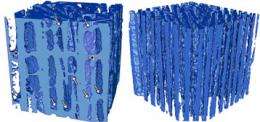
(PhysOrg.com) -- The freezing of suspensions of particles is not always a uniform phenomenon; in certain conditions it leads to a modification of the redistribution of particles and the growth of crystals.
These results have been obtained by researchers at the Laboratoire de Synthčse et Fonctionnalisation des Céramiques and the Laboratoire Matériaux, Ingénierie et Sciences, France, by observing, through X-ray imaging at the European Synchrotron Radiation Facility (ESRF), the movement of particles while they are being frozen. Their work could make it easier not just to develop porous materials with specific properties but also to understand better the mechanisms of soils freezing in winter, which can have a considerable impact on plants, roads and thoroughfares. These results were published on-line in the journal Nature Materials on 8 November 2009.
What is the connection between sea ice formation at the poles, frozen soils in winter, cryopreservation of cells, ice-cream and composite material synthesis? All of these situations involve the propagation of a solidification interface and its encounter with particles, microorganisms or bubbles in suspension in a liquid. Although the phenomenon can be described in just a few words, its mechanism and control remain however extremely complex and still far from being fully understood.
Up until now, studies have simplified the problem by only considering a single particle in front of a flat interface propagating at low velocity. In most situations however, the interface propagates rapidly, is not flat, there are a multitude of particles and the numerous interactions between the particles play a considerable role on the way the system behaves. The behavior of the interface in these conditions, critical in numerous applications, is still poorly understood for the most part and difficult to observe experimentally, since the phenomena take place at small dimensional scales and at high velocity.
Researchers have tackled the problem using X-ray imaging. They benefited from access for several days to the European Synchrotron Radiation Facility (ESRF) in Grenoble, one line of which (ID19) is dedicated to X-ray imaging.
By freezing a concentrated suspension of ceramic particles, the researchers were able to observe in situ the growth of ice crystals and the movement of particles during freezing. They then obtained a three-dimensional image of the ice crystals after freezing by exploiting the differences in X-ray absorption between the ice and the particles. The researchers were then able to demonstrate that, under certain conditions, the interface “jumps”, accelerating in a punctuated manner and modifying the redistribution of particles and the growth of crystals. They explain this result by a systematic return of the interface to equilibrium when it is given enough time to do so, which is extremely interesting to materials science researchers.
The phenomenon of freezing can in fact be used to develop porous materials with specific biomimetic structures, the mechanical properties of which seem to be particularly promising for a wide range of applications in the energy, chemistry and biology fields. Thus, when the interface propagates in an irregular manner, numerous defects appear that weaken the structure, which significantly affect its final properties. These results thus provide the key for working in conditions where such defects are absent and cast new light on natural freezing mechanisms. In fact, the freezing of soils in winter has quite considerable consequences on plants and roads. The formation of sea ice, where salt and microorganisms are expelled between ice crystals, plays an important role in thermal exchanges between the atmosphere and the oceans.
More information: Metastable and Unstable Cellular Solidification of Colloidal Suspensions; S. Deville, E. Maire, G. Bernard-Granger, A. Lasalle, A. Bogner, C. Gauthier, J. Leloup, C. Guizard, Nature Materials, 8 November 2009. doi:10.1038/nmat2571" target="_blank">dx.doi.org/doi:10.1038/nmat2571
Provided by CNRS


