The indefinite self-renewal of specialized cells without the need for stem cell intermediates
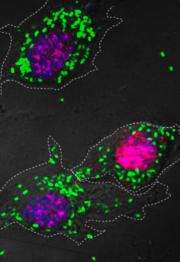
(PhysOrg.com) -- Is the indefinite expansion of adult cells possible without recourse to stem cell intermediates? The team led by Michael Sieweke at the Centre d'immunologie de Marseille Luminy, France has proved that this is the case by achieving the ex vivo regeneration for several months of macrophages, specialized cells in the immune system. Published in Science on November 6, 2009, this discovery could be applied to other cell types.
This research enables a clearer understanding of the mechanisms underlying cell differentiation, but above all raises many hopes for potential therapeutic applications.
The regenerative medicine of the future will be based on replacing damaged cells and repairing deficient organs, notably through the use of stem cells. Indeed, these cells are able not only to proliferate indefinitely but, in theory, to supply all types of cells to the human body. However, the processes that allow the passage from adult (rather than embryonic) cells to stem cells ("reprogramming") are complex and full of risk, as are the processes necessary for the "retransformation" of stem cells into adult cells. The question then arises: might it not be more simple to generate the cells required without passing through the stem cell stage?
The scientists have studied a specific cell type: the macrophages(1). In most cases, when cells have acquired a specialized function (e.g. brain neurons, muscle cells, macrophages for the immune system, etc.) they cease to proliferate and normally remain "blocked" in this state until they die. Thus macrophages, which are key actors in the immune response, are usually incapable of proliferation.
The team of CNRS and INSERM researchers led by Michael Sieweke has nonetheless been able to generate mouse macrophages in vitro thanks to a genetic modification that inactivates the transcription factors (2) called MafB and c-Maf. Furthermore, once reinjected into the animal, these modified cells behave normally: they do not form a tumor and perfectly perform the tasks expected of an adult macrophage, such as ingesting bacteria and secreting the chemical agents capable of killing them.
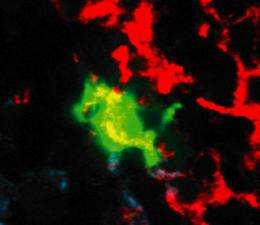
This CNRS and INSERM team in Marseilles has thus found how to re-initiate the division of specialized cells. In addition, they discovered that MafB and cMaf inactivation led to the activation of two of the four transcription factors (c-Myc and KLF4) recently identified as being able to convert almost all adult cells in the body into stem cells. Although this study provides a clearer understanding of the mechanisms of cell differentiation, above all it arouses hopes of the application of this method for the amplification of specialized cells to other cell types. These findings suggest that a passage via stem cells may not be necessary to enable the regeneration of cells and the repair of damaged tissue.
Notes:
(1) Macrophages are large cells that intervene in immune processes by destroying cell debris and microorganisms by means of a process called phagocytosis, an immune defense mechanism that notably allows macrophages to "eat" foreign particles such as bacteria, cell debris, dust particles, etc.
(2) Transcription factors are proteins that regulate the expression of genes by activating or inhibiting them. During embryonic development, cells diversify and specialize into different cell types; this is the process of cell differentiation.
More information: Aziz A, Soucie E, Sarrazin S, Sieweke MH. “MafB/c-Maf deficiency enables self-renewal of differentiated functional macrophages.” Science 326 (Nov. 6, 2009).
Provided by CNRS


