November 17, 2009 feature
Researchers Find Innate Correlations Among Different Power Law Phenomena
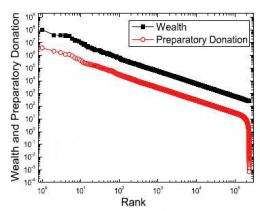
(PhysOrg.com) -- Studying the patterns that emerge in natural and social phenomena is a popular area of research, although usually individual phenomena are studied separately from each other. In a recent study, researchers have found innate correlations among some of these phenomena, showing that the amount of money that individuals in a society donate to a charity can be used to determine the distribution of personal wealth in that society. The connection between these two topics can also be used for exploring the complexity of a society's economic system.
“The greatest significance of this work is showing that power law phenomena in different references may correlate with each other innately,” Yougui Wang of Beijing Normal University told PhysOrg.com. “Thus, this implies that some power law phenomena should be the derivatives of other basic ones.”
The key to using patterns from one data set to infer the patterns of a different set of data is realizing that both sets share a mathematical principle called Zipf’s law, explained Wang, along with coauthors Qinghua Chen and Chao Wang of Beijing Normal University. Although Zipf’s law was originally proposed in the field of linguistics to explain the distribution of words in a language, it has attracted much more attention because it also describes a wide variety of natural and social phenomena. Zipf’s law quantitatively describes how the most common entities of a set (such as the common word “the”) appear with a high frequency that logarithmically tapers off as entities become less common. The same power law holds true for the distribution of population sizes, Internet traffic, and other phenomena. As researchers have previously found, in some cases the law stems from a competition among individuals for a constraint resource.
In the current study, the scientists show that collective donations follow a particular pattern: the upper part (made of the larger monetary donations) follows Zipf’s law, while the lower part (made of smaller donations) exhibits a uniform distribution. The data comes from donations by Chinese to the Chinese Red Cross Foundation after an earthquake of magnitude 8.0 struck Sichuan province in southwest China in May 2008. The data includes more than 230,000 personal donations, with the donation amount ranging from 0.01 RMB to 2.79 million RMB. Significantly, 205,000 donations (87.5%) of the total sample were 100 RMB or more. This part of the data approximately followed Zipf’s law, while the distribution of donations of less than 100 RMB was basically uniform.
So far, the analysis is yet another phenomenon of human behavior that follows the regularity of Zipf’s law. But the researchers also developed a model to explain this pattern, taking into account the previous finding that wealth distribution has also been known to follow Zipf’s law. Their model shows that only a portion of the individuals in a society have a desire to donate, and of these, each individual donates a portion of his or her overall wealth that is random but uniformly distributed. Even though only a small sample of the donators in the case of the Sichuan earthquake was collected and analyzed, the researchers’ model could generate the distribution of personal wealth throughout China, which is consistent with what has been obtained from the data of the richest 500 individuals in China.
As the researchers explain, donation and wealth, like other power law phenomena, seem to coexist in complex systems. By showing that power law phenomena can be related to one another, the researchers’ work could be valuable for exploring the correlations among natural patterns in systems.
“Based on the results of our study, the distribution of wealth could be derived from that of donation,” said Qinghua Chen. “Once the link between two variables involved in a complex system is just like the relation between donation and wealth in our case, we can infer the distribution of one variable from the other.”
More information: Q. Chen, C. Wang, and Y. Wang. “Deformed Zipf’s law in personal donation.” Europhysics Letters, 88 (2009) 38001. doi: 10.1209/0295-5075/88/38001
Copyright 2009 PhysOrg.com.
All rights reserved. This material may not be published, broadcast, rewritten or redistributed in whole or part without the express written permission of PhysOrg.com.


