Small optical force can budge nanoscale objects
November 17, 2009 By Bill Steele
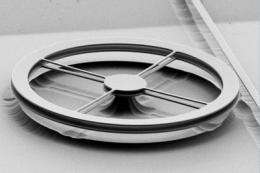
Scanning electron micrograph of two thin, flat rings of silicon nitride, each 190 nanometers thick and mounted a millionth of a meter apart. Light is fed into the ring resonators from the straight waveguide at the right. Under the right conditions optical forces between the two rings are enough to bend the thin spokes and pull the rings toward one another, changing their resonances enough to act as an optical switch. Credit: Cornell Nanophotonics Group
(PhysOrg.com) -- Engineering researchers have used a very tiny beam of light with as little as 1 milliwatt of power to move a silicon structure up to 12 nanometers.
With a bit of leverage, Cornell researchers have used a very tiny beam of light with as little as 1 milliwatt of power to move a silicon structure up to 12 nanometers. That's enough to completely switch the optical properties of the structure from opaque to transparent, they reported.
The technology could have applications in the design of micro-electromechanical systems (MEMS) -- nanoscale devices with moving parts -- and micro-optomechanical systems (MOMS) which combine moving parts with photonic circuits, said Michal Lipson, associate professor of electrical and computer engineering.
The research by postdoctoral researcher Gustavo Wiederhecker, Long Chen, Ph.D. '09, Alexander Gondarenko, Ph.D. '10, and Lipson appears in the online edition of the journal Nature and will appear in a forthcoming print edition.
Light can be thought of as a stream of particles that can exert a force on whatever they strike. The sun doesn't knock you off your feet because the force is very small, but at the nanoscale it can be significant. "The challenge is that large optical forces are required to change the geometry of photonic structures," Lipson explained.
But the researchers were able to reduce the force required by creating two ring resonators -- circular waveguides whose circumference is matched to a multiple of the wavelength of the light used -- and exploiting the coupling between beams of light traveling through the two rings.
A beam of light consists of oscillating electric and magnetic fields, and these fields can pull in nearby objects, a microscopic equivalent of the way static electricity on clothes attracts lint. This phenomenon is exploited in "optical tweezers" used by physicists to trap tiny objects. The forces tend to pull anything at the edge of the beam toward the center.
When light travels through a waveguide whose cross-section is smaller than its wavelength some of the light spills over, and with it the attractive force. So parallel waveguides close together, each carrying a light beam, are drawn even closer, rather like two streams of rainwater on a windowpane that touch and are pulled together by surface tension.
The researchers created a structure consisting of two thin, flat silicon nitride rings about 30 microns (millionths of a meter) in diameter mounted one above the other and connected to a pedestal by thin spokes. Think of two bicycle wheels on a vertical shaft, but each with only four thin, flexible spokes. The ring waveguides are three microns wide and 190 nanometers (nm -- billionths of a meter) thick, and the rings are spaced 1 micron apart.
When light at a resonant frequency of the rings, in this case infrared light at 1533.5 nm, is fed into the rings, the force between the rings is enough to deform the rings by up to 12 nm, which the researchers showed was enough to change other resonances and switch other light beams traveling through the rings on and off. When light in both rings is in phase -- the peaks and valleys of the wave match -- the two rings are pulled together. When it is out of phase they are repelled. The latter phenomenon might be useful in MEMS, where an ongoing problem is that silicon parts tend to stick together, Lipson said.
An application in photonic circuits might be to create a tunable filter to pass one particular optical wavelength, Wiederhecker suggested.
-
A Broadband Light Amplifier on a Photonic Chip
Jul 06, 2006 |
not rated yet |
0
-
Using light to move and trap DNA molecules
Jan 02, 2009 |
not rated yet |
0
-
From electronics to photonics; Modulating light with electricity
May 19, 2005 |
not rated yet |
0
-
Fiber-optic booster on a chip
Feb 20, 2008 |
not rated yet |
0
-
Silicon photonic crystals key to optical cloaking
Jun 25, 2008 |
not rated yet |
0
-
Engineers build first sub-10-nm carbon nanotube transistor
Feb 01, 2012 |
4.9 / 5 (31) |
30
-
Something old, something new: Evolution and the structural divergence of duplicate genes
Jan 31, 2012 |
4.6 / 5 (7) |
1
-
The hidden nanoworld of ice crystals: Revealing the dynamic behavior of quasi-liquid layers
Jan 30, 2012 |
5 / 5 (3) |
1
-
Stock market network reveals investor clustering
Jan 27, 2012 |
3.9 / 5 (23) |
8
-
Of microchemistry and molecules: Electronic microfluidic device synthesizes biocompatible probes
Jan 26, 2012 |
5 / 5 (1) |
0
-
Books To Inspire a Beginnig Physics Student
2 hours ago
-
Pith balls problem
2 hours ago
-
Electrostatics
2 hours ago
-
what is phase constant
2 hours ago
-
Basics In electromagnetic wave
2 hours ago
-
How to calculate theoretical initial velocity?
3 hours ago
- More from Physics Forums - General Physics
More news stories
What lies beneath: Mapping hidden nanostructures
The ability to diagnose and predict the properties of materials is vital, particularly in the expanding field of nanotechnology. Electron and atom-probe microscopy can categorize atoms in thin sheets of material, ...
17 hours ago |
5 / 5 (3) |
1
New kind of solar cell could capture significantly more energy than current cells
New solar cells could increase the maximum efficiency of solar panels by over 25%, according to scientists from the University of Cambridge.
Feb 08, 2012 |
4.5 / 5 (12) |
14
|
Nanoshell whispering galleries improve thin solar panels
Visitors to Statuary Hall in the U.S. Capitol Building may have experienced a curious acoustic feature that allows a person to whisper softly at one side of the cavernous, half-domed room and for another on ...
Nanotechnology / Nanomaterials
Feb 07, 2012 |
4.3 / 5 (6) |
6
|
'Dark plasmons' transmit energy
Microscopic channels of gold nanoparticles have the ability to transmit electromagnetic energy that starts as light and propagates via "dark plasmons," according to researchers at Rice University.
Feb 09, 2012 |
4.8 / 5 (8) |
1
|
Revealing how a battery material works
Since its discovery 15 years ago, lithium iron phosphate (LiFePO4) has become one of the most promising materials for rechargeable batteries because of its stability, durability, safety and ability to deliver ...
Nanotechnology / Nanomaterials
Feb 08, 2012 |
5 / 5 (5) |
0
|
Anonymous knocks CIA website offline (Update)
The website of the Central Intelligence Agency was inaccessible on Friday after the hacker group Anonymous claimed to have knocked it offline.
New error-correcting codes guarantee the fastest possible rate of data transmission
Error-correcting codes are one of the triumphs of the digital age. Theyre a way of encoding information so that it can be transmitted across a communication channel such as an optical fiber o ...
Google users warned of threat to smartphone wallets
Users of Google smartphone wallets were being warned on Friday that there is a way to crack pass codes intended to thwart thieves from going on illicit shopping sprees.
Humans may have helped the decline of African rainforests 3000 years ago
(PhysOrg.com) -- Large areas of rainforests in Central Africa mysteriously disappeared over three thousand years ago, to be replaced by savannas. The prevailing theory has been that the cause was a change ...
New power source discovered
(PhysOrg.com) -- Researchers at the Massachusetts Institute of Technology (MIT) and RMIT University have made a breakthrough in energy storage and power generation.
The power of estrogen -- male snakes attract other males
A new study has shown that boosting the estrogen levels of male garter snakes causes them to secrete the same pheromones that females use to attract suitors, and turned the males into just about the sexiest ...