Ticking stellar time bomb identified (w/ Video)
November 17, 2009
Ticking stellar time bomb identified

Enlarge

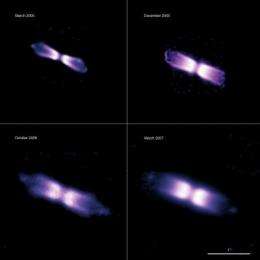
Using the NACO adaptive optics instrument on ESO's Very Large Telescope and its ability to obtain images as sharp as if taken from space, astronomers have made the first time-lapse movie of a bipolar shell ejected by a "vampire star," which underwent an outburst after gulping down part of its companion's matter. This enabled them to determine the distance and intrinsic brightness of the object. It appears that this system is a prime candidate to be one of the long-sought progenitors of the exploding stars known as Type Ia supernovae, critical for the study of dark energy. The images of V445 Puppis cover a time span of two years. The images unambiguously show a bipolar shell, initially with a very narrow waist, with lobes on each side. Two knots are also seen at either extreme end of the shell, which appear to move at about 30 million kilometers per hour. The shell -- unlike any previously observed for a nova -- is itself moving at about 24 million kilometers per hour. A thick disc of dust, which must have been produced during the last outburst, obscures the central couple of stars. Credit: ESO/P.A. Woudt

(PhysOrg.com) -- "One of the major problems in modern astrophysics is the fact that we still do not know exactly what kinds of stellar system explode as a Type Ia supernova," says Patrick Woudt, from the University of Cape Town and lead author of the paper reporting the results. "As these supernovae play a crucial role in showing that the Universe's expansion is currently accelerating, pushed by a mysterious dark energy, it is rather embarrassing."

The astronomers studied the object known as V445 in the constellation of Puppis ("the Stern") in great detail. V445 Puppis is the first, and so far only, nova showing no evidence at all for hydrogen. It provides the first evidence for an outburst on the surface of a white dwarf dominated by helium. "This is critical, as we know that Type Ia supernovae lack hydrogen," says co-author Danny Steeghs, from the University of Warwick, UK, "and the companion star in V445 Pup fits this nicely by also lacking hydrogen, instead dumping mainly helium gas onto the white dwarf."

This video is not supported by your browser at this time.

A supernova is one way that a star can end its life, exploding in a display of grandiose fireworks. One family of supernovae, called Type Ia supernovae, are of particular interest in cosmology as they can be used as standard candles to measure distances in the Universe and so can be used to calibrate the accelerating expansion that is driven by dark energy. One defining characteristic of Type Ia supernovae is the lack of hydrogen in their spectrum. Yet hydrogen is the most common chemical element in the Universe. Such supernovae most likely arise in systems composed of two stars, one of them being the end product of the life of sun-like stars, or white dwarfs. When such white dwarfs, acting as stellar vampires that suck matter from their companion, become heavier than a given limit, they become unstable and explode.

In November 2000, this system underwent a nova outburst, becoming 250 times brighter than before and ejecting a large quantity of matter into space.

The team of astronomers used the NACO adaptive optics instrument on ESO's Very Large Telescope (VLT) to obtain very sharp images of V445 Puppis over a time span of two years. The images show a bipolar shell, initially with a very narrow waist, with lobes on each side. Two knots are also seen at both the extreme ends of the shell, which appear to move at about 30 million kilometres per hour. The shell — unlike any previously observed for a nova — is itself moving at about 24 million kilometres per hour. A thick disc of dust, which must have been produced during the last outburst, obscures the two central stars.

"The incredible detail that we can see on such small scales — about hundred milliarcseconds, which is the apparent size of a one euro coin seen from about forty kilometres — is only possible thanks to the adaptive optics technology available on large ground-based telescopes such as ESO's VLT," says Steeghs.

A supernova is one way that a star can end its life, exploding in a display of grandiose fireworks. One family of supernovae, called Type Ia supernovae, are of particular interest in cosmology as they can be used as "standard candles" to measure distances in the Universe and so can be used to calibrate the accelerating expansion that is driven by .

One defining characteristic of Type Ia supernovae is the lack of hydrogen in their spectrum. Yet hydrogen is the most common chemical element in the Universe. Such supernovae most likely arise in systems composed of two stars, one of them being the end product of the life of sun-like stars, or . When such white dwarfs, acting as stellar vampires that suck matter from their companion, become heavier than a given limit, they become unstable and explode.

The build-up is not a simple process. As the white dwarf cannibalises its prey, matter accumulates on its surface. If this layer becomes too dense, it becomes unstable and erupts as a nova. These controlled, mini-explosions eject part of the accumulated matter back into space. The crucial question is thus to know whether the white dwarf can manage to gain weight despite the outburst, that is, if some of the matter taken from the companion stays on the white dwarf, so that it will eventually become heavy enough to explode as a supernova.

Combining the NACO images with data obtained with several other telescopes the astronomers could determine the distance of the system — about 25 000 light-years from the Sun — and its intrinsic brightness — over 10 000 times brighter than the Sun. This implies that the vampire white dwarf in this system has a high mass that is near its fatal limit and is still simultaneously being fed by its companion at a high rate. "Whether V445 Puppis will eventually explode as a , or if the current nova outburst has pre-empted that pathway by ejecting too much matter back into space is still unclear," says Woudt. "But we have here a pretty good suspect for a future !"

More information: This research was presented in a paper to appear in the 20 November 2009 issue of the Astrophysical Journal, vol. 706, p. 738 ("The expanding bipolar shell of the helium nova V445 Puppis", by P. A. Woudt et al.). http://arxiv.org/abs/0910.1069

Source: ESO (news : web)

4.8 /5 (12 votes)  

Rank 4.8 /5 (12 votes)
Related Stories
Relevant PhysicsForums posts
  • Titan's lack of impact craters
    createdFeb 09, 2012
  • Real pictures of black hole eating a star?
    createdFeb 08, 2012
  • Hypothetical way to travel faster than light, but not technically exceed lightspeed
    createdFeb 06, 2012
  • How do scientists monitor the Sun's activity?
    createdFeb 05, 2012
  • Search patterns in observational studies
    createdFeb 05, 2012
  • Derivation of Pogson's law
    createdFeb 03, 2012
  • More from Physics Forums - General Astronomy

More news stories

Humans may have helped the decline of African rainforests 3000 years ago

(PhysOrg.com) -- Large areas of rainforests in Central Africa mysteriously disappeared over three thousand years ago, to be replaced by savannas. The prevailing theory has been that the cause was a change ...

Space & Earth / Environment

created 10 hours ago | popularity 5 / 5 (4) | comments 10 | with audio podcast report

Could Venus be shifting gear?

(PhysOrg.com) -- ESA’s Venus Express spacecraft has discovered that our cloud-covered neighbour spins a little slower than previously measured. Peering through the dense atmosphere in the infrared, the ...

Space & Earth / Space Exploration

created 6 hours ago | popularity 5 / 5 (5) | comments 7 | with audio podcast

Mars Science Laboratory computer issue resolved

(PhysOrg.com) -- Engineers have found the root cause of a computer reset that occurred two months ago on NASA's Mars Science Laboratory and have determined how to correct it.

Space & Earth / Space Exploration

created 7 hours ago | popularity 5 / 5 (5) | comments 3 | with audio podcast

Clam fields found at deep, low-temperature Mariana vents

(PhysOrg.com) -- Scientists have marveled at the unusual life forms thriving at high temperature hydrothermal vents of the deep ocean.

Space & Earth / Earth Sciences

created 7 hours ago | popularity not rated yet | comments 0 | with audio podcast

Two new moons for Jupiter

Advances in technology have lead to the discovery of new planets outside of our Solar System, and now even new moons in our own backyard.

Space & Earth / Space Exploration

created 6 hours ago | popularity not rated yet | comments 4


Complex wiring of the nervous system may rely on a just a handful of genes and proteins

Researchers at the Salk Institute have discovered a startling feature of early brain development that helps to explain how complex neuron wiring patterns are programmed using just a handful of critical genes. ...

The power of estrogen -- male snakes attract other males

A new study has shown that boosting the estrogen levels of male garter snakes causes them to secrete the same pheromones that females use to attract suitors, and turned the males into just about the sexiest ...

Human cognitive performance suffers following natural disasters, researchers find

Not surprisingly, victims of a natural disaster can experience stress and anxiety, but a new study indicates that it might also cause them to make more errors - some serious - in their daily lives. In their upcoming Human Fa ...

New error-correcting codes guarantee the fastest possible rate of data transmission

Error-correcting codes are one of the triumphs of the digital age. They’re a way of encoding information so that it can be transmitted across a communication channel — such as an optical fiber o ...

Both maternal and paternal age linked to autism

Older maternal and paternal age are jointly associated with having a child with autism, according to a recently published study led by researchers at The University of Texas Health Science Center at Houston (UTHealth).

Curry spice component may help slow prostate tumor growth

Curcumin, an active component of the Indian curry spice turmeric, may help slow down tumor growth in castration-resistant prostate cancer patients on androgen deprivation therapy (ADT), a study from researchers ...