Fossil fuel CO2 emissions up by 29 percent since 2000
November 17, 2009
Human emissions rise 2 percent despite GFC

Enlarge

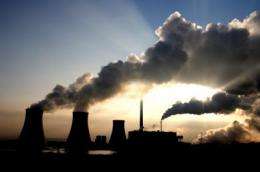
Human emissions rise 2 percent despite the global financial crisis. Credit: CSIRO

The strongest evidence yet that the rise in atmospheric CO2 emissions continues to outstrip the ability of the world's natural 'sinks' to absorb carbon is published this week in the journal Nature Geoscience.

An international team of researchers under the umbrella of the Global Carbon Project reports that over the last 50 years the average fraction of global CO2 that remained in the atmosphere each year was around 43 per cent - the rest was absorbed by the Earth's carbon sinks on land and in the oceans. During this time this fraction has likely increased from 40 per cent to 45 per cent, suggesting a decrease in the efficiency of the natural sinks. The team brings evidence that the sinks are responding to and variability.

The scientists report a 29 per cent increase in global CO2 emissions from fossil fuel between 2000 and 2008 (the latest year for which figures are available), and that in spite of the global emissions increased by 2 per cent during 2008. The use of coal as a fuel has now surpassed oil and developing countries now emit more greenhouse gases than developed countries - with a quarter of their growth in emissions accounted for by increased trade with the West.

Lead author Prof Corinne Le Quéré of the University of East Anglia (UEA) and the British Antarctic Survey said: "The only way to control climate change is through a drastic reduction in global CO2 emissions. The Earth's carbon sinks are complex and there are some gaps in our understanding, particularly in our ability to link human-induced CO2 emissions to atmospheric CO2 concentrations on a year-to-year basis. But, if we can reduce the uncertainty about the carbon sinks, our data could be used to verify the effectiveness of climate mitigations policies."

The main findings of the study include:

  • CO2 emissions from the burning of increased by two per cent from 2007 to 2008, by 29 per cent between 2008 and 2000, and by 41 per cent between 2008 and 1990 - the reference year of the Kyoto Protocol.
  • CO2 emissions from the burning of fossil fuels have increased at an average annual rate of 3.4 per cent between 2000 and 2008, compared with one per cent per year in the 1990s.
  • Emissions from land use change have remained almost constant since 2000, but now account for a significantly smaller proportion of total anthropogenic CO2 emissions (20 per cent in 2000 to 12 per cent in 2008).
  • The fraction of total CO2 emissions remaining in the atmosphere has likely increased from 40 to 45 per cent since 1959, models suggests this is due to the response of the natural CO2 sinks to climate change and variability.
  • Emissions from coal are now the dominant fossil fuel emission source, surpassing 40 years of oil emission prevalence.
  • The financial crisis had a small but discernable impact on emissions growth in 2008 - with a two per cent increase compared with an average 3.6 per cent over the previous seven years. On the basis of projected changes in GDP, emissions for 2009 are expected to fall to their 2007 levels, before increasing again in 2010.
  • Emissions from emerging economies such as China and India have more than doubled since 1990 and developing countries now emit more greenhouse gases than developed countries.
  • A quarter of the growth in CO2 emissions in developing countries can be accounted for by an increase in international trade of goods and services.
The researchers called for more work to be done to improve our understanding of the land and CO2 sinks, so that global action to control climate change can be independently monitored. The sinks have a major influence on climate change and are important in understanding the link between anthropogenic CO2 emissions and atmospheric CO2 concentration. But so far scientists have not been able to calculate the CO2 uptake of the sinks with sufficient accuracy to explain all the annual changes in atmospheric CO2 concentration, which hinders the scientists' ability to monitor the effectiveness of CO2 mitigations policies.

More information: 'Trends in the sources and sinks of carbon dioxide' by Corinne Le Quéré, et at. is published in Nature Geoscience on Tuesday November 17 2009.

Source: University of East Anglia

4.2 /5 (19 votes)  

Filter


Move the slider to adjust rank threshold, so that you can hide some of the comments.


Display comments: newest first

LKD
Nov 17, 2009

Rank: 2.8 / 5 (4)
This article is honest and reasonable. I give them huge credit for implying how the change in percentages is due to developing China, India, and third-world countries that are not concerned with pollution, and do so with little regard. It certainly is not countries like the US who are not building any coal power plants, and enforcing stricter and stricter emissions standards on those operating.

I also appreciate that the honest scientists stated that there is currently no conclusive ability to determine what man made vs natural CO2 has as an effect on our planets CO2 sinks, but that they would like to pursue methods to determine this and find out definitive answers.

Real science! Honest results! I do feel sorry for the scientists involved as they will likely be ostracized for this, but this is such a huge step to dealing with the science as opposed to the political agenda I commend them.
PieRSquare
Nov 17, 2009

Rank: 4.7 / 5 (3)
I give them huge credit for implying how the change in percentages is due to developing China, India, and third-world countries that are not concerned with pollution, and do so with little regard. It certainly is not countries like the US who are not building any coal power plants, and enforcing stricter and stricter emissions standards on those operating.

The article also notes that 25% of the growth in the developing world comes from making more cheap stuff for us. We are outsourcing our dirty work and blaming them, our consumption is the source of this portion counted as their pollution. This is a shared moral responsibility between consumers and producers. Getting everyone on board is critical as the least regulated countries will have the cheapest goods, production will shift toward those countries rewarding those who don't comply while undermining the goals of these agreements.
holoman
Nov 17, 2009

Rank: 2.3 / 5 (3)
I've seen predictions that ~2030 to ~2040 could
be a point of no return if we don't get a
handle on Co2 emissions.
Danie
Nov 17, 2009

Rank: 2 / 5 (3)
Wont make much of a difference. We have little influence in solar events currently happening and causing global warming.

1. The diminishing of the Heliosphere ( down by 25 % in last 10 years )

2. Sun reaching end of 11 year cycle to next polar flip. Which will have one of the worst sun spot periods to date.

The combination of increased solar radiation from the galaxy, due to weakened Heliosphere, and the increase in sun spot activity,as we near solar cycle 24, is the largest cause for increased temperatures by quite a margin.

Yes, it is a good thing to reduce greenhouse gases, but even cows produce more greenhouse gases than man.
Sancho
Nov 18, 2009

Rank: 2.3 / 5 (3)
Headline from this site on 11Nov09:
Study finds increased CO2 emissions absorbed by ecosystems

"(PhysOrg.com) -- New data show that the balance between the airborne and the absorbed fraction of CO2 has stayed approximately constant since 1850, despite emissions of CO2 having risen from about 2 billion tons a year in 1850 to 35 billion tons a year now.
"This suggests that terrestrial ecosystems and the oceans have a much greater capacity to absorb CO2 than had been previously expected.
"The results run contrary to a significant body of recent research which expects that the capacity of terrestrial ecosystems and the oceans to absorb CO2 should start to diminish as CO2 emissions increase, letting greenhouse gas levels skyrocket. Dr Wolfgang Knorr at the University of Bristol found that in fact the trend in the airborne fraction since 1850 has only been 0.7 ± 1.4% per decade, which is essentially zero."
------------------------------------
It's the Sun, stupid.

belteshazzar293
Nov 18, 2009

Rank: 3.5 / 5 (2)
Yes, it is a good thing to reduce greenhouse gases, but even cows produce more greenhouse gases than man.


That's a bit self-serving when the cows are raised by man and for man. Those greenhouse gases are as much man's responsibility as any of our other emissions.
Danie
Nov 18, 2009

Rank: 3.3 / 5 (3)
Yes, it is a good thing to reduce greenhouse gases, but even cows produce more greenhouse gases than man.


That's a bit self-serving when the cows are raised by man and for man. Those greenhouse gases are as much man's responsibility as any of our other emissions.


From what I know, the plains were covered with much larger herbivores before man spread over the globe. Like Mammoths, Bison etc etc.
Rank 4.2 /5 (19 votes)
Relevant PhysicsForums posts
  • Wind Waves in Reservoir ~ Wind run-up and Wind set-up
    createdFeb 08, 2012
  • Balance of oxygen in the atmosphere
    createdFeb 01, 2012
  • The case for a methanol-based economy
    createdJan 30, 2012
  • Weather in a rotating cylinder
    createdJan 25, 2012
  • Importance of difference between SVP over ice and water?
    createdJan 19, 2012
  • Ozone and atmosphere sampling
    createdJan 16, 2012
  • More from Physics Forums - Earth

More news stories

Astronomy team discovers nearby dwarf galaxy

(PhysOrg.com) -- A team led by UCLA research astronomer Michael Rich has used a unique telescope to discover a previously unknown companion to the nearby galaxy NGC 4449, which is some 12.5 million light years ...

Space & Earth / Astronomy

created 12 hours ago | popularity 4.3 / 5 (4) | comments 5 | with audio podcast

Amasia: As next supercontinent forms, Arctic Ocean, Caribbean will vanish first

(PhysOrg.com) -- Geologists at Yale University have proposed a new theory to describe the formation of supercontinents, the epic process by which Earth’s major continental blocks combine into a single ...

Space & Earth / Earth Sciences

created 13 hours ago | popularity 4.1 / 5 (11) | comments 4 | with audio podcast

In scientific coup, Russians reach Antarctic lake

After more than two decades of drilling in Antarctica, Russian scientists have reached a gigantic freshwater lake hidden under miles of ice for some 20 million years - a pristine body of water that may hold ...

Space & Earth / Earth Sciences

created 13 hours ago | popularity 4.8 / 5 (6) | comments 6

Chandra finds Milky Way's black hole grazing on asteroids

(PhysOrg.com) -- The giant black hole at the center of the Milky Way may be vaporizing and devouring asteroids, which could explain the frequent flares observed, according to astronomers using data from NASA's ...

Space & Earth / Astronomy

created 13 hours ago | popularity 5 / 5 (5) | comments 5 | with audio podcast

Study shows global glaciers, ice caps, shedding billions of tons of mass annually

Earth's glaciers and ice caps outside of the regions of Greenland and Antarctica are shedding roughly 150 billion tons of ice annually, according to a new study led by the University of Colorado Boulder.

Space & Earth / Earth Sciences

created 16 hours ago | popularity 5 / 5 (5) | comments 5 | with audio podcast


Amazing skin gives sharks a push

Shark skin has long been known to improve the fish's swimming performance by reducing drag, but now George Lauder and Johannes Oeffner from Harvard University show that in addition, the skin generates thrust, giving the fish ...

Fruit flies drawn to the sweet smell of youth

Aging takes its toll on sex appeal and now an international team of researchers led by Baylor College of Medicine and the University of Michigan find that in fruit flies, at least, it even diminishes the come-hither ...

Life in Antarctic lake? It's everywhere else

If scientists find microbes in a frigid lake two miles beneath the thick ice of Antarctica, it will illustrate once again that somehow life finds a way to survive in the strangest and harshest places.

New study shows high cost of defensive medicine

Vanderbilt University Medical Center researchers estimate that U.S. orthopaedic surgeons create approximately $2 billion per year in unnecessary health care costs associated with orthopaedic care due to the practice of defensive ...

Continental mosquito with 'vector' potential found breeding in UK after 60 year absence

A species of mosquito has been discovered breeding in the UK that has not been seen in the country since 1945. Populations of the mosquito, found across mainland Europe and known only by its Latin name Culex modestus, were r ...

Presdisposition to common heart disease 'passed on from father to son'

A common heart disease which kills thousands each year may be passed genetically from father to son, according to a study led by the University of Leicester.