Cyclone Anja hits wind shear, weakens drastically
November 17, 2009
Cyclone Anja hits wind shear, weakens drastically

Enlarge

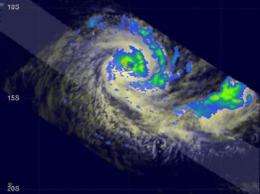
The Tropical Rainfall Measuring Mission satellite passed over Anja on November 15 at 0904 UTC. Anja had a well defined eye and was increasing in strength from a category 2 to 3 tropical cyclone. Credit: NASA/SSAI, Hal Pierce

This morning, Cyclone Anja was a powerful Category 4 cyclone on the Saffir-Simpson scale. Wind shear has now giving Anja a strong "punch in the gut" as the storm has weakened to a Category 1 cyclone.

At 1500 UTC (10 a.m. ET) on November 17, Anja's were sustained at 75 knots (86 mph). Anja's center was located 715 miles east-northeast of La Reunion Island, near 18.3 South and 66.5 East. Anja is moving south-southwest at 12 mph. The storm seems to be spreading out as its weakening, as tropical storm force winds now extend out to 115 miles from the center (earlier today, they only extended 75 miles out from the center).

When tropical cyclone Anja formed on November 14, it was the first tropical cyclone in the southwestern . That signaled the tapering off of tropical cyclone activity and the start of tropical cyclone formation in the southern hemisphere. The Atlantic Ocean officially ends at the end of November while the southwest Indian Ocean tropical cyclone season starts on November 1 and ends on April 30.

When the Tropical Rainfall Measuring Mission (TRMM) satellite passed over Anja on November 15 at 0904 UTC it had a well-defined eye and was increasing in strength from a category 2 tropical cyclone (on the Saffir-Simpson scale) to a powerful category 3 tropical cyclone later that day. TRMM is a joint mission between NASA and the Japanese space agency JAXA.
Cyclone Anja hits wind shear, weakens drastically
Enlarge

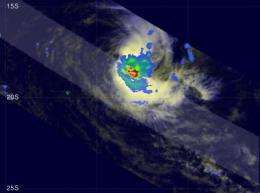
The Tropical Rainfall Measuring Mission, or TRMM satellite passed over Anja again on November 17 at 0850 UTC showing some heavy rain around the center. TRMM data made it clear that upper level wind shear had caused Anja to weaken greatly. Credit: NASA/SSAI, Hal Pierce

The TRMM satellite passed over Anja again on November 17 at 0850 UTC. The data from TRMM made it clear that upper level wind shear (winds blowing at different directions in the atmosphere that can tear a storm apart) had caused Anja to weaken greatly from its earlier maximum category 4 intensity. Anja no longer had a well defined eye but the TRMM derived rainfall analysis showed there was still very heavy rainfall in an area near Anja's center.

Anja is predicted to continue weakening and move harmlessly toward the southeast over the open waters of the south Indian Ocean.

Source: JPL/NASA (news : web)


Rank not rated yet
Relevant PhysicsForums posts
  • Discrepancy between oxygen and carbon-dioxide levels
    created11 hours ago
  • where gems are found in the world
    created14 hours ago
  • Wind Waves in Reservoir ~ Wind run-up and Wind set-up
    createdFeb 08, 2012
  • Balance of oxygen in the atmosphere
    createdFeb 01, 2012
  • The case for a methanol-based economy
    createdJan 30, 2012
  • Weather in a rotating cylinder
    createdJan 25, 2012
  • More from Physics Forums - Earth

More news stories

Clam fields found at deep, low-temperature Mariana vents

(PhysOrg.com) -- Scientists have marveled at the unusual life forms thriving at high temperature hydrothermal vents of the deep ocean.

Space & Earth / Earth Sciences

created 48 minutes ago | popularity not rated yet | comments 0 | with audio podcast

Could Venus be shifting gear?

(PhysOrg.com) -- ESA’s Venus Express spacecraft has discovered that our cloud-covered neighbour spins a little slower than previously measured. Peering through the dense atmosphere in the infrared, the ...

Space & Earth / Space Exploration

created 16 minutes ago | popularity 5 / 5 (1) | comments 0 | with audio podcast

Streams need trees to withstand climate change

(PhysOrg.com) -- More than twenty years of biological monitoring have confirmed the importance of vegetation for protecting Australia's freshwater streams and rivers against the ravages of drought and climate ...

Space & Earth / Environment

created 57 minutes ago | popularity not rated yet | comments 0

The turbulent birth of super star clusters in galaxy mergers

By combining two of the most advanced telescopes in the world -- the new Atacama Large Millimeter Array (ALMA) and the Very Large Telescope (VLT) of ESO -- a team of French astronomers from the Institut d'astrophysique ...

Space & Earth / Astronomy

created 39 minutes ago | popularity not rated yet | comments 0

What does a nebula sound like?

What do things sound like out in the cosmos? Of course, sound waves can’t travel through the vacuum of space; however, electromagnetic waves can. These electromagnetic waves can be recorded by devices called spectrographs ...

Space & Earth / Space Exploration

created 23 minutes ago | popularity 5 / 5 (1) | comments 0


Seeing colors in music, tasting flavors in shapes may happen in life's early months

Famed violinist Itzhak Perlman sees a deep forest green whenever he plays a B-flat on his Stradivarius' G string. The A on the E string is red.

Is that sleepiness during pregnancy normal or a sign of sleep apnea?

(Medical Xpress) -- Most pregnant women complain of being tired. Some of them however, could be suffering more than normal fatigue associated with their pregnancy; they may have developed obstructive sleep apnea (OSA), a ...

Engineering images bring life to submerged city

(PhysOrg.com) -- Photo-realistic 3D mapping and digital reconstruction of an ancient underwater city in Greece have earned a team from the University of Sydney's Faculty of Engineering and Information Technologies ...

Numeracy: The educational gift that keeps on giving?

(Medical Xpress) -- Cancer risks. Investment alternatives. Calories. Numbers are everywhere in daily life, and they figure into all sorts of decisions. A new article published in Current Directions in Psychological Science, a journal of the Association for Psychological Science, examin ...

New power source discovered

(PhysOrg.com) -- Researchers at the Massachusetts Institute of Technology (MIT) and RMIT University have made a breakthrough in energy storage and power generation.

Measurements from high-energy collisions lead to better understanding of why meson particles disappear

For several years, physicists at the Relativistic Heavy Ion Collider (RHIC) at Brookhaven National Laboratory (BNL), USA, have studied an unusual state of matter called the quark–gluon plasma, which they ...