Heart disease found in Egyptian mummies
November 17, 2009
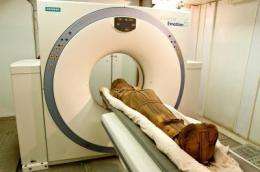
This image shows the mummy of Esankh, male, Third Intermediate Period (1070-712 BCE), undergoing CT scanning. Credit: Dr. Michael Miyamoto / UC San Diego
Hardening of the arteries has been detected in Egyptian mummies, some as old as 3,500 years, suggesting that the factors causing heart attack and stroke are not only modern ones; they afflicted ancient people, too.
Study results are appearing in the Nov. 18 issue of the Journal of the American Medical Association (JAMA) and are being presented Nov. 17 at the Scientific Session of the American Heart Association at Orlando, Fla.
"Atherosclerosis is ubiquitous among modern day humans and, despite differences in ancient and modern lifestyles, we found that it was rather common in ancient Egyptians of high socioeconomic status living as much as three millennia ago," says UC Irvine clinical professor of cardiology Dr. Gregory Thomas, a co-principal investigator on the study. "The findings suggest that we may have to look beyond modern risk factors to fully understand the disease."
The nameplate of the Pharaoh Merenptah (c. 1213-1203 BC) in the Museum of Egyptian Antiquities reads that, when he died at approximately age 60, he was afflicted with atherosclerosis, arthritis, and dental decay. Intrigued that atherosclerosis may have been widespread among ancient Egyptians, Thomas and a team of U.S. and Egyptian cardiologists, joined by experts in Egyptology and preservation, selected 20 mummies on display and in the basement of the Museum of Egyptian Antiquities for scanning on a Siemens 6 slice CT scanner during the week of Feb. 8, 2009.
The mummies underwent whole body scanning with special attention to the cardiovascular system. The researchers found that 9 of the 16 mummies who had identifiable arteries or hearts left in their bodies after the mummification process had calcification either clearly seen in the wall of the artery or in the path were the artery should have been. Some mummies had calcification in up to 6 different arteries.
Using skeletal analysis, the Egyptology and preservationist team was able to estimate the age at death for all the mummies and the names and occupations in the majority. Of the mummies who had died when they were older than 45, 7 of 8 had calcification and thus atherosclerosis while only 2 of 8 of those dying at an earlier age had calcification. Atherosclerosis did not spare women; vascular calcifications were observed in both male and female mummies.
The most ancient Egyptian afflicted with atherosclerosis was Lady Rai, who lived to an estimated age of 30 to 40 years around 1530 BC and had been the nursemaid to Queen Ahmose Nefertiri. To put this in context, Lady Rai lived about 300 years prior to the time of Moses and 200 prior to King Tutankhamun (Tut).
In those mummies whose identities could be determined, all were of high socioeconomic status, generally serving in the court of the Pharaoh or as priests or priestess. While the diet of any one mummy could not be determined, eating meat in the form of cattle, ducks and geese was not uncommon during these times.
"While we do not know whether atherosclerosis caused the demise of any of the mummies in the study, we can confirm that the disease was present in many," Thomas says.
Source: University of California - Irvine
-
Low risk for heart attack? Could an ultrasound hold the answer?
Nov 11, 2008 |
not rated yet |
0
-
High-fat diets inflame fat tissue around blood vessels, contribute to heart disease
Feb 18, 2009 |
not rated yet |
0
-
High phosphorus linked to coronary calcification in chronic kidney disease
Dec 10, 2008 |
not rated yet |
0
-
New study finds coronary arterial calcium scans help detect overall death risk in the elderly
Jul 02, 2008 |
not rated yet |
0
-
PET imaging detects early, 'silent heart' stage of disease in asymptomatic diabetic patients
Jun 16, 2008 |
not rated yet |
0
-
Engineers build first sub-10-nm carbon nanotube transistor
Feb 01, 2012 |
4.9 / 5 (31) |
30
-
Something old, something new: Evolution and the structural divergence of duplicate genes
Jan 31, 2012 |
4.6 / 5 (7) |
1
-
The hidden nanoworld of ice crystals: Revealing the dynamic behavior of quasi-liquid layers
Jan 30, 2012 |
5 / 5 (3) |
1
-
Stock market network reveals investor clustering
Jan 27, 2012 |
3.9 / 5 (23) |
8
-
Of microchemistry and molecules: Electronic microfluidic device synthesizes biocompatible probes
Jan 26, 2012 |
5 / 5 (1) |
0
-
Mitosis
8 hours ago
-
Stem cell question.
9 hours ago
-
Protease cleavage
16 hours ago
-
Pertubance in a model
22 hours ago
-
Cancer drugs and Alzheimer's, Oh my!
Feb 09, 2012
-
Squishing cells
Feb 09, 2012
- More from Physics Forums - Biology
More news stories
A frank discussion of the power law and linking correlation to causation
(PhysOrg.com) -- Michael Stumpf a mathematics professor at Imperial College in London, and Mason Porter a lecturer at Oxford have teamed together to write and publish a perspective piece in Science regarding the in ...
Employers feel no love for unscrupulous practice of 'service sweethearting'
A new study led by two Florida State University marketing professors finds that some frontline service employees who are rewarded for hikes in customer loyalty and satisfaction also may engage in "service ...
Other Sciences / Economics & Business
16 hours ago |
4 / 5 (1) |
7
The question of life in the ancient world
Theres a general feeling that we dont get the Greeks ancient or modern. Many, including heads of state like Angela Merkel, visibly shake their head in exasperation, rightly or wrongly, at ...
Other Sciences / Archaeology & Fossils
22 hours ago |
1.3 / 5 (3) |
4
Sonic Cradle lands spot in TED exhibition
A Simon Fraser University graduate student project that melds music, meditation and modern technology has landed a rare spot as an exhibit at TEDActive 2012 in Palm Springs, California this month.
18 hours ago |
not rated yet |
0
US workers are 'giving away the store,' costing firms billions
Nearly 70 percent of the nation's service employees give away free goods and services from hamburgers to cable TV costing companies billions of dollars a year, according to a groundbreaking study.
Other Sciences / Economics & Business
Feb 09, 2012 |
3.3 / 5 (3) |
10
Anonymous knocks CIA website offline (Update)
The website of the Central Intelligence Agency was inaccessible on Friday after the hacker group Anonymous claimed to have knocked it offline.
New error-correcting codes guarantee the fastest possible rate of data transmission
Error-correcting codes are one of the triumphs of the digital age. Theyre a way of encoding information so that it can be transmitted across a communication channel such as an optical fiber o ...
Small modular reactor design could be a 'SUPERSTAR'
(PhysOrg.com) -- Though most of today's nuclear reactors are cooled by water, we've long known that there are alternatives; in fact, the world's first nuclear-powered electricity in 1951 came from a reactor ...
New power source discovered
(PhysOrg.com) -- Researchers at the Massachusetts Institute of Technology (MIT) and RMIT University have made a breakthrough in energy storage and power generation.
The power of estrogen -- male snakes attract other males
A new study has shown that boosting the estrogen levels of male garter snakes causes them to secrete the same pheromones that females use to attract suitors, and turned the males into just about the sexiest ...
Advanced power-grid model finds low-cost, low-carbon future in West
(PhysOrg.com) -- The least expensive way for the Western U.S. to reduce greenhouse gas emissions enough to help prevent the worst consequences of global warming is to replace coal with renewable and other ...