Fungi May Hold Key to Reducing Grapefruit Juice Interactions with Medications
November 17, 2009 By Sharon Durham
Fungi May Hold Key to Reducing Grapefruit Juice Interactions with Medications

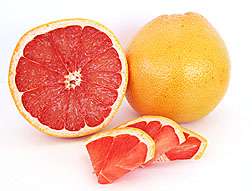
ARS scientists have found that certain fungi can prevent compounds in grapefruits from interfering with some prescription medicines. Photo courtesy of Florida Department of Citrus.

(PhysOrg.com) -- A fungus may help solve a problem of a grapefruit compound that interacts negatively with certain prescription drugs, according to studies by Agricultural Research Service (ARS) scientists.

Grapefruit contains furanocomarins (FCs), which inhibit the responsible for metabolizing certain prescribed medications and allowing more of the medication to enter the bloodstream. FCs are phytochemicals commonly found in plants. Two well-known phytochemicals are Vitamins C and E.

Grapefruit juice can interfere with the metabolism of certain medications used to treat a wide range of conditions such as allergies, , depression, hypertension, infections, heart disease, and high . The grapefruit industry may have lost customers who no longer drink grapefruit juice due to their medications.

ARS chemists Kyung Myung and John Manthey and microbiologist Jan Narciso at the ARS Citrus and Subtropical Products Laboratory in Winter Haven, Fla., began the study using a fungus—Aspergillus niger—to bind and break down FCs in grapefruit juice.

Grapefruit juice contains three main FCs. Myung found that A. niger either bound these FCs or enzymatically broke them down into other products. Enzymatic inactivation of these compounds may be a means of eliminating them from commercial grapefruit juice, and work to identify these enzymes in A. niger is in progress. A. niger is one of the most common species of the genus Aspergillus that can cause black mold on certain fruits and vegetables but often doesn’t cause human disease.

Myung and his team decided to also test edible fungi, or mushrooms. In studies, they found that edible mushrooms such as morels, oyster and button mushrooms—when dried, pulverized and added to —also removed FCs. That provides researchers with evidence that fungal proteins could be responsible for removing the FCs from the .

This research was published in the Journal of Applied Microbiology and Biotechnology and the Journal of Agricultural and Food Chemistry.

Provided by USDA Agricultural Research Service

Filter


Move the slider to adjust rank threshold, so that you can hide some of the comments.


Display comments: newest first

pres68y
Nov 17, 2009

Rank: not rated yet
Gee, using a $0.20 grapefruit to reduce the consumption of an additional $20.00 pill would negatively affect the pharmco profit!

We cannot permit that to happen.
(I own Pfizer stock :)
Don't do any testing that might reduce costs
- just outlaw grapefruit!
Rank 5 /5 (1 vote)
Relevant PhysicsForums posts
  • How to determine zinc in a plant.
    createdFeb 11, 2012
  • Stoichiometry
    createdFeb 10, 2012
  • Boiling and melting point of impure substances
    createdFeb 10, 2012
  • Safe nitrogen compound to decompose a 500 deg C in a furnace?
    createdFeb 09, 2012
  • [ask]electron inside drinking water
    createdFeb 08, 2012
  • How to avoid formation of Lithium Chromate ???
    createdFeb 08, 2012
  • More from Physics Forums - Chemistry

More news stories

Scientists discover molecular secrets of 2,000-year-old Chinese herbal remedy

For roughly two thousand years, Chinese herbalists have treated Malaria using a root extract, commonly known as Chang Shan, from a type of hydrangea that grows in Tibet and Nepal. More recent studies suggest that halofuginone, ...

Chemistry / Biochemistry

created 4 hours ago | popularity 5 / 5 (11) | comments 4 | with audio podcast

New method to examine batteries -- MRI from the inside

There is an ever-increasing need for advanced batteries for portable electronics, such as phones, cameras, and music players, but also to power electric vehicles and to facilitate the distribution and storage of energy derived ...

Chemistry / Analytical Chemistry

created 4 hours ago | popularity 5 / 5 (4) | comments 0 | with audio podcast

Hydrogen from acidic water: Researchers develop potential low cost alternative to platinum for splitting water

A technique for creating a new molecule that structurally and chemically replicates the active part of the widely used industrial catalyst molybdenite has been developed by researchers with the Lawrence Berkeley ...

Chemistry / Materials Science

created Feb 09, 2012 | popularity 4.8 / 5 (16) | comments 21 | with audio podcast

Fool's gold may prove an unlikely alternative to overexploited catalytic materials

Catalytic materials, which lower the energy barriers for chemical reactions, are used in everything from the commercial production of chemicals to catalytic converters in car engines. However, with current catalytic materials ...

Chemistry / Materials Science

created Feb 10, 2012 | popularity 4.4 / 5 (8) | comments 8 | with audio podcast

Research provides octagonal window of opportunity for carbon capture

(PhysOrg.com) -- Filtering carbon dioxide, a greenhouse gas, from factory smokestacks is a necessary, but expensive part of many manufacturing processes. However, a collaborative research team from the National ...

Chemistry / Materials Science

created Feb 08, 2012 | popularity 5 / 5 (2) | comments 5 | with audio podcast


Overeating may double risk of memory loss

New research suggests that consuming between 2,100 and 6,000 calories per day may double the risk of memory loss, or mild cognitive impairment (MCI), among people age 70 and older. The study was released today and will be ...

Google might launch Drive for cloud storage soon

(PhysOrg.com) -- Google's next big move, according to the Wall Street Journal, is a cloud storage service called Drive. Hardly first to the plate, Google is simply catching up to introducing its cloud reposi ...

Lab study raises questions over nano-particle impact

Tests involving chickens have raised questions about the impact on health from engineered nano-particles, the ultra-fine grains commonly used in drugs and processed foods, scientists said on Sunday.

Injured boomers beware: Know when to see doctor

(AP) -- It happened to nurse Jane Byron years after an in-line skating fall, business owner Haralee Weintraub while doing "men's" push-ups, and avid cyclist Gene Wilberg while lifting a heavy box.

A mitosis mystery solved: How chromosomes align perfectly in a dividing cell

Although the process of mitotic cell division has been studied intensely for more than 50 years, Whitehead Institute researchers have only now solved the mystery of how cells correctly align their chromosomes during symmetric ...

Starve a virus, feed a cure? Findings show how some cells protect themselves against HIV

A protein that protects some of our immune cells from the most common and virulent form of HIV works by starving the virus of the molecular building blocks that it needs to replicate, according to research published online ...