Extinct moa rewrites New Zealand's history
November 18, 2009
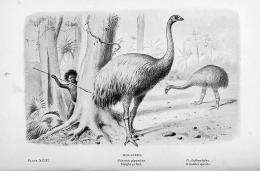
Moa birds. Dinornis giganteus, Height 12 feet. D. (Pachyornis) elephantopus, a smaller species.". Hunting Moa birds from Extinct Monsters: A popular account of some of the larger forms of ancient animal life 1892. Image credit: Wikimedia Commons
(PhysOrg.com) -- The evolutionary history of New Zealand's many extinct flightless moa has been re-written in the first comprehensive study of more than 260 sub-fossil specimens to combine all known genetic, anatomical, geological and ecological information about the unique bird lineage.
That lineage ended only about 600 years ago after a journey through time that most likely began about 80 million years earlier on the prehistoric supercontinent of Gondwana, according to the study published in Proceedings of the National Academy of Sciences by an international team of researchers.
Found on the south and north islands of New Zealand, the evolutionary history and relationships between the moa species has long been subject to scientific debate, with past studies suggesting that up to 64 species existed with as many as 20 generic groups.
The new study found that moas should be grouped into only three families, six genera and it reduced the number of species to nine. The most recent species were relatively modern, evolving in the South Island only after the uplift of the Southern Alps between 5 and 8.5 million years ago.
Periodical land bridges, created by geological events and sea-level changes, allowed some of these species to cross over to the North Island.
The many species of moa are thought to have descended from a common ancestor of other large living flightless birds that evolved on separate southern landmasses when Gondwana broke up: the ostrich in Africa; the emu and cassowary in Australia; the rhea in South America; and New Zealand's kiwi. Another presumed relative was the extinct giant elephant bird in Madagascar.
New Zealand broke away from Gondwana at least 60 million years ago and a wide variety of moas subsequently evolved there, ranging in size from a large turkey to the three-metre tall Dinornis, which weighed up to 300 kg.
Maori people are known to have killed large numbers of birds for their meat, eggs and feathers - moa is a Polynesian word for chicken - after they arrived on the islands about 1,000 years ago. All the nine living species were gone within a few centuries.
The study also presents an important new geological/paleogeographical model, which suggests that land-dwelling animals on the North and South Island landmasses were isolated for most of the past 20-30 million years.
"The prolonged geographic isolation of New Zealand and the paucity of terrestrial mammals created a unique ecosystem dominated by an estimated 245 species of birds, providing an unparalleled opportunity to observe evolutionary processes," says Dr Trevor Worthy, a palaeontologist from the UNSW School of Biological, Earth and Environmental Sciences, who was one of the 11 members of study team.
"Our study reveals that the patterns of genetic diversity within and between different moa groups reflect a complex history following a major drowning of the New Zealand landmass in the Oligocene [23 to 34 million years ago]. Their history was then affected by a series of marine barriers, tectonic activity and glacial cycles.
"We were surprised to discover just how recently many of the moa species - and probably many of the iconic New Zealand animals and plants - evolved in the South Island after the uplift of the Alps. The Alps brought rain and allowed wet rainforests to develop in the west and generated a drier, warmer climate to the east, creating a mix of upland and lowland environments, wet and dry habitats and a variety of forest, shrubland, and grasslands."
More information: The evolutionary history of the extinct ratite moa and New Zealand Neogene paleogeography, PNAS.
-
Scientists 'rebuild' giant moa using ancient DNA
Jul 01, 2009 |
not rated yet |
0
-
Tiny bones rewrite textbooks
Dec 13, 2006 |
not rated yet |
0
-
Trees evolved camouflage defense against long extinct predator: First evidence of camouflage defense in plants
Jul 22, 2009 |
not rated yet |
0
-
Extinct New Zealand eagle may have eaten humans
Sep 11, 2009 |
not rated yet |
0
-
Giant bird feces records pre-human New Zealand
Jan 12, 2009 |
not rated yet |
0
-
Engineers build first sub-10-nm carbon nanotube transistor
Feb 01, 2012 |
4.9 / 5 (30) |
30
-
Something old, something new: Evolution and the structural divergence of duplicate genes
Jan 31, 2012 |
4.6 / 5 (7) |
1
-
The hidden nanoworld of ice crystals: Revealing the dynamic behavior of quasi-liquid layers
Jan 30, 2012 |
5 / 5 (3) |
1
-
Stock market network reveals investor clustering
Jan 27, 2012 |
3.9 / 5 (23) |
8
-
Of microchemistry and molecules: Electronic microfluidic device synthesizes biocompatible probes
Jan 26, 2012 |
5 / 5 (1) |
0
-
Cancer drugs and Alzheimer's, Oh my!
6 hours ago
-
Squishing cells
7 hours ago
-
Any books/articles for evolutionary stable strategy models in humans?
18 hours ago
-
Science behind the bore feeling?
Feb 09, 2012
-
Homo Sapien vs. Chimpanzee - Divergence Timeline
Feb 09, 2012
-
a single mRNA strand is attached to sevaral ribosomes?
Feb 08, 2012
- More from Physics Forums - Biology
More news stories
US workers are 'giving away the store,' costing firms billions
Nearly 70 percent of the nation's service employees give away free goods and services from hamburgers to cable TV costing companies billions of dollars a year, according to a groundbreaking study.
Other Sciences / Economics & Business
16 hours ago |
5 / 5 (1) |
8
Storm warning: Financial tsunami heading this way
In today's global village, national coffers are more interconnected than ever before. And as the current economic crisis has proven, a downturn in one country can travel in a wave across the globe, like a financial tsunami. ...
Other Sciences / Economics & Business
17 hours ago |
3 / 5 (2) |
7
Kids show cultural gender bias
(PhysOrg.com) -- Talk about gender confusion! A recent study by University of Alberta researchers Elena Nicoladis and Cassandra Foursha-Stevenson in the Journal of Cross-Cultural Psychology into whether speaki ...
Other Sciences / Social Sciences
22 hours ago |
1.5 / 5 (2) |
2
Prague gets hold of modern genetics founder Mendel's papers
Germany has handed to the Czech Republic a manuscript of Johann Gregor Mendel, founder of modern genetics, on his plant hybridization experiments, the Czech foreign minister said Thursday.
13 hours ago |
5 / 5 (1) |
1
'Flipped classroom' teaching model gains an online community
Researchers at Harvard University have launched the Peer Instruction (PI) Network, a new global social network for users of interactive teaching methods.
Other Sciences / Social Sciences
17 hours ago |
5 / 5 (2) |
0
Humans may have helped the decline of African rainforests 3000 years ago
(PhysOrg.com) -- Large areas of rainforests in Central Africa mysteriously disappeared over three thousand years ago, to be replaced by savannas. The prevailing theory has been that the cause was a change ...
Protein libraries in a snap
(PhysOrg.com) -- A Rice University undergraduate will depart with not only a degree but also a possible patent for his invention of an efficient way to create protein libraries, an important component of biomolecular ...
Sleep breathing machine shows clear benefits in children with sleep apnea
Children and adolescents with obstructive sleep apnea had substantial improvements in attention, anxiety and quality of life after treatment with positive airway pressure (PAP)a nighttime therapy in which a machine ...
Neurologic improvement detected in rats receiving stem cell transplant
In a study to be presented today at the Society for Maternal-Fetal Medicine's annual meeting, The Pregnancy Meeting, in Dallas, Texas, researchers will report that early transplantation of human placenta-derived mesenchymal ...
Miami battling invasion of giant African snails
No one knows how they got there. But an invasion of African giant snails has southern Florida in a panic over potential crop damage, disease and general yuckiness surrounding the slimy gastropods.
NASA budget will axe Mars deal with Europe: scientists
US President Barack Obama's budget proposal to be submitted next week for 2013 will cut NASA's budget by 20 percent and eliminate a major partnership with Europe on Mars exploration, scientists said Thursday.
Nov 18, 2009
Rank: not rated yet