Novel connector uses magnets for leak-free microfluidic devices
November 18, 2009 Novel connector uses magnets for leak-free microfluidic devices

Enlarge

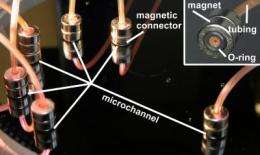
This photograph shows the use of the NIST magnetic connectors with a microfluidic device designed to generate liposomes. The microchip has five inlets and one outlet, all linked to tubing via the magnetic connectors. The inset at upper right shows the setup of the tube-magnet combination. Credit: G. Cooksey, NIST

Like other users of microfluidic systems, National Institute of Standards and Technology researcher Javier Atencia was faced with an annoying engineering problem: how to simply, reliably and most of all, tightly, connect his tiny devices to the external pumps and reservoirs delivering liquids into the system. While pondering this one day, he randomly picked up two magnets and began playing with them. As the magnets pulled apart and then snapped back together, Atencia realized that he had his solution.

In a paper recently published online in Lab on a Chip, Atencia and colleagues describe the result of that brainstorm: a new, inexpensive, reusable and highly efficient microfluidic connector. The NIST connector employs a ring magnet with a O-ring gasket on its bottom and a tube in its center set directly atop the inlet or outlet port of a microfluidic channel embedded in a glass chip. A disc magnet on the underside of the chip holds the first magnet—and its tubing—securely in place.

Unlike traditional approaches to connectors—such as gluing the tubing directly to the chip or mounting a male/female connection with the tubing attached to the male portion—the NIST magnetic connector is reusable; can be positioned anywhere on the chip; and eliminates any possibility of broken bonds that leak, chips cracked during heat curing of the glue, or microfluidic devices turned useless by excess glue entering the channels. Additionally, the reliability, flexibility and fast assembly of the NIST connector compares favorably to a recently developed press-fit system (where springs produce the sealing force) but the magnetic connectors cost hundreds of dollars less to build and operate.

As reported in their paper, the NIST researchers demonstrated the viability of their magnetic connector in a microfluidic device designed to generate liposomes (tiny bubble-shaped membranes that can be used to transport drugs throughout the body), a fairly port-intensive task. A solution of lipids suspended in isopropyl alcohol is pumped at a high rate into a microchannel through one inlet and hit with a buffer solution pumped in through four other ports. The convection and diffusion that occurs as the liquid streams mix produces liposomes that exit the microfluidic device through an outlet port. Magnetic connectors at the five inlets and one outlet were removed and reseated numerous times without any visible leakage.

The NIST researchers state that their magnetic connector is suitable for most microfluidic applications except those dealing with iron-containing (ferro) fluids, superparamagnetic particles (particles so small that their magnetic properties decrease with time and fluctuations in temperature), cells tagged with magnetic particles, or high-temperatures (greater than 80 degrees Celsius).

More information: J. Atencia, G. Cooksey, A. Jahn, J. Zook, W. Vreeland and L. Locascio. Magnetic connectors for microfluidic applications. Lab on a Chip. Published online Nov. 16, 2009.

Source: National Institute of Standards and Technology (news : web)


Rate this story - 4.8 /5 (4 votes)


November 18, 2009 all stories

Comments: 0

4.8 /5 (4 votes)

  • hide
  • Related Stories

  • 'Microfluidic Palette' May Paint Clearer Picture of Biological Processes
    created Jul 28, 2009 | popularity not rated yet | comments 0
  • Magnetic Computer Sensors May Help Study Biomolecules
    created May 10, 2007 | popularity not rated yet | comments 0
  • Make your own microfluidic device with new kit from U-M
    created Jul 24, 2008 | popularity not rated yet | comments 0
  • Magnetic nanoparticles assembled into long chains
    created Oct 20, 2005 | popularity not rated yet | comments 0
  • 'NMR on a chip' features magnetic mini-sensor
    created Feb 19, 2008 | popularity not rated yet | comments 0


  • hide
  • Relevant PhysicsForums posts

  • How to find static friction
    created 5 hours ago
  • Calculating decible increases
    created 12 hours ago
  • Coefficients of friction
    created 12 hours ago
  • Deduction of centripetal force
    created 13 hours ago
  • More from Physics Forums - General Physics

Other News

Extra large carbon

Extra large carbon

Physics / General Physics

created 12 hours ago | popularity 4.7 / 5 (12) | comments 7 | with audio podcast

An exotic form of carbon has been found to have an extra large nucleus, dwarfing even the nuclei of much heavier elements like copper and zinc, in experiments performed in a particle accelerator in Japan. ...


Scientist explore future of high-energy physics

Scientist explore future of high-energy physics

Physics / General Physics

created 18 hours ago | popularity 4.9 / 5 (12) | comments 8 | with audio podcast

In a 1954 speech to the American Physical Society, the University of Chicago's Enrico Fermi fancifully envisioned a particle accelerator that encircled the globe. Such would be the ultimate theoretical outcome, ...


Leaf veins inspire a new model for distribution networks (w/ Video)

Physics / General Physics

created 15 hours ago | popularity 5 / 5 (3) | comments 0 | with audio podcast

(PhysOrg.com) -- Following the straight and narrow may be good moral advice, but it’s not a great design principle for a distribution network. In new research, a team of biophysicists describe a complex netting of interconnected ...


New magnetic tuning method enhances data storage

New magnetic tuning method enhances data storage

Physics / General Physics

created 18 hours ago | popularity 4.2 / 5 (5) | comments 0 | with audio podcast

Researchers in Chicago and London have developed a method for controlling the properties of magnets that could be used to improve the storage capacity of next-generation computer hard drives.


High-performance microring resonator developed by INRS researchers

Physics / Optics & Photonics

created 10 hours ago | popularity 1.5 / 5 (2) | comments 0

A new, more efficient low-cost microring resonator for high speed telecommunications systems has been developed and tested by Professor Roberto Morandotti's INRS team in collaboration with Canadian, American, and Australian ...