NGC 4710 galaxy: Baffling boxy bulge (w/ Video)
November 18, 2009 Baffling boxy bulge

Enlarge

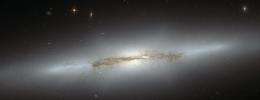
Still an astrophysical mystery, the evolution of the bulges in spiral galaxies led astronomers to the edge-on galaxy NGC 4710. When staring directly at the centre of the galaxy, one can detect a faint, ethereal "X"-shaped structure. Such a feature, which astronomers call a "boxy" or "peanut-shaped" bulge, is due to the vertical motions of the stars in the galaxy's bar and is only evident when the galaxy is seen edge-on. This curiously shaped puff is often observed in spiral galaxies with small bulges and open arms, but is less common in spirals with arms tightly wrapped around a more prominent bulge, such as NGC 4710. Credit: NASA & ESA

(PhysOrg.com) -- Just as many people are surprised to find themselves packing on unexplained weight around the middle, astronomers find the evolution of bulges in the centres of spiral galaxies puzzling. A recent NASA/ESA Hubble Space Telescope image of NGC 4710 is part of a survey that astronomers have conducted to learn more about the formation of bulges, which are a substantial component of most spiral galaxies.

When targeting bulges, astronomers often seek edge-on galaxies, as their bulges are more easily distinguishable from the disc. This exceptionally detailed edge-on view of NGC 4710 taken by the Advanced Camera for Surveys (ACS) aboard Hubble reveals the galaxy's bulge in the brightly coloured centre. The luminous, elongated white plane that runs through the bulge is the galaxy disc. The disc and bulge are surrounded by eerie-looking dust lanes.

You need Flash installed to watch this ideo

Zooming in on NGC 4710, an edge-on galaxy, located in the constellation of Coma Berenices (Berenice’s Hair). The galaxy’s bulge is located in the brightly coloured centre. When staring directly at the centre of the galaxy, one can detect a faint, ethereal “X”-shaped structure. Such a feature, which astronomers call a “boxy” or “peanut-shaped” bulge, is due to the vertical motions of the stars in the galaxy’s bar and is only evident when the galaxy is seen edge-on. This curiously shaped puff is often observed in spiral galaxies with small bulges and open arms, but is less common in spirals with arms tightly wrapped around a more prominent bulge, such as NGC 4710. Credit: ESA/Hubble

When staring directly at the centre of the galaxy, one can detect a faint, ethereal "X"-shaped structure. Such a feature, which astronomers call a "boxy" or "peanut-shaped" bulge, is due to the vertical motions of the stars in the galaxy's bar and is only evident when the galaxy is seen edge-on. This curiously shaped puff is often observed in spiral galaxies with small bulges and open arms, but is less common in spirals with arms tightly wrapped around a more prominent bulge, such as NGC 4710.

NGC 4710 is a member of the giant Virgo Cluster of galaxies and lies in the northern constellation of Coma Berenices (the Hair of Queen Berenice). It is not one of the brightest members of the cluster, but can easily be seen as a dim elongated smudge on a dark night with a medium-sized . In the 1780s, William Herschel discovered the galaxy and noted it simply as a "faint nebula". It lies about 60 million light-years from the Earth and is an example of a lenticular or S0-type galaxy - a type that seems to have some characteristics of both spiral and elliptical galaxies.

Astronomers are scrutinising these systems to determine how many globular clusters they host. Globular clusters are thought to represent an indication of the processes that can build bulges. Two quite different processes are believed to be at play regarding the formation of bulges in spiral : either they formed rather rapidly in the early Universe, before the spiral disc and arms formed; or they built up from material accumulating from the disc during a slow and long evolution. In this case of NGC 4710, researchers have spotted very few globular clusters associated with the bulge, indicating that its assembly mainly involved relatively slow processes.

Source: European Space Agency (news : web)


Rate this story - 4.4 /5 (14 votes)


November 18, 2009 all stories

Comments: 0

4.4 /5 (14 votes)

  • hide
  • Related Stories

  • Hubble Sees Galaxy on Edge
    created Jun 08, 2006 | popularity not rated yet | comments 0
  • Hubble's sweeping view of the Coma Galaxy Cluster
    created Jun 10, 2008 | popularity not rated yet | comments 0
  • Dramatically backlit dust in giant galaxy
    created Apr 07, 2009 | popularity not rated yet | comments 0
  • Stars forced to relocate near the Southern Fish
    created Mar 03, 2009 | popularity not rated yet | comments 0
  • Hubble photographs grand spiral galaxy Messier 81
    created May 29, 2007 | popularity not rated yet | comments 0


  • hide
  • Relevant PhysicsForums posts

  • Spreading Life in the Universe
    created 12 hours ago
  • Force of Gravity in terms of Density
    created Feb 08, 2010
  • what is the relation between gravity and light?
    created Feb 08, 2010
  • Does the Thermoelectric effect apply in sun?
    created Feb 07, 2010
  • More from Physics Forums - General Astronomy

Other News

Space shuttle Endeavour pulls in at space station (AP)

Space shuttle Endeavour pulls in at space station

Space & Earth / Space Exploration

created 1hour ago | popularity not rated yet | comments 0

(AP) -- Shuttle Endeavour arrived to a warm welcome at the International Space Station early Wednesday, delivering a new room and observation deck that will come close to completing construction 200 miles ...


Rho Ophiuchus cloud

Professor: We have a 'moral obligation' to seed universe with life

Space & Earth / Astronomy

created 23 hours ago | popularity 3.1 / 5 (27) | comments 54 | with audio podcast report

(PhysOrg.com) -- Eventually, the day will come when life on Earth ends. Whether that’s tomorrow or five billion years from now, whether by nuclear war, climate change, or the Sun burning up its fuel, the last ...


Climate 'Tipping Points' May Arrive Without Warning, Says Top Forecaster

Space & Earth / Environment

created 11 hours ago | popularity 3 / 5 (8) | comments 8 | with audio podcast

(PhysOrg.com) -- A new University of California, Davis, study by a top ecological forecaster says it is harder than experts thought to predict when sudden shifts in Earth's natural systems will occur -- a worrisome finding ...


38 percent of world's surface in danger of desertification

38 percent of world's surface in danger of desertification

Space & Earth / Environment

created 8 hours ago | popularity 2.3 / 5 (3) | comments 5

A team of Spanish researchers has measured the degradation of the planet's soil using the Life Cycle Assessment (LCA), a scientific methodology that analyses the environmental impact of human activities, and ...


A new 3-D map of the interstellar gas within 300 parsecs from the sun

A new 3D map of the interstellar gas within 300 parsecs from the Sun

Space & Earth / Astronomy

created 14 hours ago | popularity 5 / 5 (5) | comments 0 | with audio podcast

(PhysOrg.com) -- Astronomy & Astrophysics is publishing new 3D maps of the interstellar gas in the local area around our Sun. A French-American team of astronomers presents new absorption measurements toward ...