Unique Uranium Source in Naturally Bioreduced Sediment
November 18, 2009
Unique Uranium Source in Naturally Bioreduced Sediment

Enlarge

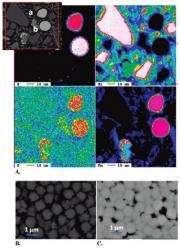
Scanning electron microscope backscattered image of two framboidal pyrites found in the <53-micron-size fraction of the naturally bioreduced sediment. Top framboid (left) is weathered and bottom right framboid is unweathered (right). The EMPA elemental maps show the distribution of iron, sulfur, uranium, and silicon in the region depicted in the SEM micrograph. Clearly, uranium is concentrated on framboidal pyrite surfaces.

(PhysOrg.com) -- A recently published Pacific Northwest National Laboratory study of a naturally bioreduced sediment sample from a former uranium mill tailings site reveals insights that enhance understanding of the long-term persistence of uranium in groundwater. The study provides the first-ever evidence of a useful pyrite mineral formation within the sample.

This mineral form is called "framboidal" because its surface resembles a framboise (French for raspberry). The study presents data showing that framboidal pyrite has an affinity for , decreasing its transport via . The sample originated from a U.S. Department of Integrated Field Research Challenge site at Rifle, Colorado.

This new understanding will help in developing strategies for keeping the contaminant out of aquifers and away from humans, animals and crops.

"We are trying to determine what kind of minerals in soil have a higher affinity for uranium; that is, what it will stick to," said Dr. Nikolla Qafoku, a PNNL geochemist, who with Dr. Ravi Kukkadapu, an EMSL chemist, is lead author of the paper, which appears in Environmental Science & Technology. EMSL is the Environmental Molecular Sciences Laboratory, a national scientific user facility sponsored by DOE and located at PNNL.

Past research on pyrite crystals was done on synthesized pyrite made in the lab. These studies demonstrated that uranium adsorption and partial reduction occur on the surfaces on both unweathered and weathered (oxidized) pyrites. However, no such studies have been done with naturally occurring pyrite. High concentrations of uranium in pyrite, including framboidal pyrite in naturally bioreduced alluvial—or silty—sediments, have not been previously reported.

Naturally bioreduced makes up 10% of an alluvial aquifer adjacent to the Colorado River, within the Rifle site. Past and ongoing research has demonstrated that bioreduced sediment has higher amounts of uranium, Fe(II), organic carbon and sulfides.

The researchers used a series of wet chemical extraction methods and microscopic and spectroscopic techniques on the Rifle sediment sample to determine its mineralogy and the affinity of uranium for different minerals. At EMSL, they used X-ray diffraction, scanning electron microscopy, transmission electron microscopy and Mössbauer spectroscopy to characterize the iron in the sediment. The results initially showed that the iron sulfide in the form of framboidal pyrite is abundant in the fine-grained fraction of this sediment. Electron microprobe analysis produced elemental mappings showing that uranium was associated with framboidal pyrite.

"The results were really exciting," said Qafoku, "because this was the first time that uranium was found to be associated with naturally occurring framboidal pyrites in alluvial sediments." X-ray spectroscopic analyses conducted at the Advanced Photon Source at Argonne National Laboratory confirmed that framboidal pyrite uranium occurred in both oxidized and reduced forms. This is important because the mobility of contaminant uranium depends strongly on its valence state: reduced uranium is usually much less mobile.

This research showed that framboidal pyrite may initially serve as a "sink" for uranium, where the contaminant may be sequestered under reducing conditions. Framboidal pyrites may also serve as long-term sources of contaminant uranium under conditions of slow oxidation. More studies are planned to better understand the reduction and the oxidation processes in the naturally bioreduced sediment. Clearly not all pyrites, framboidal or otherwise, contain high uranium, so understanding what controls uranium uptake in pyrite is a crucial next step.

More information: Qafoku N, RK Kukkadapu, JP McKinley, BW Arey, SD Kelly, CM Wang, CT Resch, and PE Long. 2009. "Uranium in framboidal pyrite from a naturally bioreduced alluvial sediment." Environmental Science & Technology 43(22):8528-8534; doi:10.1021/es9017333

Provided by Pacific Northwest National Laboratory (news : web)

4.2 /5 (5 votes)  

Rank 4.2 /5 (5 votes)
Related Stories
Relevant PhysicsForums posts
  • Discrepancy between oxygen and carbon-dioxide levels
    created16 hours ago
  • where gems are found in the world
    created19 hours ago
  • Wind Waves in Reservoir ~ Wind run-up and Wind set-up
    createdFeb 08, 2012
  • Balance of oxygen in the atmosphere
    createdFeb 01, 2012
  • The case for a methanol-based economy
    createdJan 30, 2012
  • Weather in a rotating cylinder
    createdJan 25, 2012
  • More from Physics Forums - Earth

More news stories

Could Venus be shifting gear?

(PhysOrg.com) -- ESA’s Venus Express spacecraft has discovered that our cloud-covered neighbour spins a little slower than previously measured. Peering through the dense atmosphere in the infrared, the ...

Space & Earth / Space Exploration

created 4 hours ago | popularity 5 / 5 (5) | comments 7 | with audio podcast

Humans may have helped the decline of African rainforests 3000 years ago

(PhysOrg.com) -- Large areas of rainforests in Central Africa mysteriously disappeared over three thousand years ago, to be replaced by savannas. The prevailing theory has been that the cause was a change ...

Space & Earth / Environment

created 8 hours ago | popularity 5 / 5 (3) | comments 8 | with audio podcast report

Mars Science Laboratory computer issue resolved

(PhysOrg.com) -- Engineers have found the root cause of a computer reset that occurred two months ago on NASA's Mars Science Laboratory and have determined how to correct it.

Space & Earth / Space Exploration

created 5 hours ago | popularity 5 / 5 (5) | comments 3 | with audio podcast

Clam fields found at deep, low-temperature Mariana vents

(PhysOrg.com) -- Scientists have marveled at the unusual life forms thriving at high temperature hydrothermal vents of the deep ocean.

Space & Earth / Earth Sciences

created 5 hours ago | popularity not rated yet | comments 0 | with audio podcast

Two new moons for Jupiter

Advances in technology have lead to the discovery of new planets outside of our Solar System, and now even new moons in our own backyard.

Space & Earth / Space Exploration

created 4 hours ago | popularity not rated yet | comments 2


Putting the squeeze on planets outside our solar system

(PhysOrg.com) -- Using high-powered lasers, scientists at Lawrence Livermore National Laboratory and collaborators discovered that molten magnesium silicate undergoes a phase change in the liquid state, abruptly ...

India probes Google over 'forex transactions'

Indian authorities are probing whether online giant Google broke domestic foreign-exchange transactions rules while shifting funds abroad, the Press Trust of India reported on Friday.

Germany freezes signing of disputed Internet pact

Germany on Friday halted the signing of a controversial international accord billed as a way to beat online piracy that has sparked angry protests, saying it needed more time to consider it.

Health experts, scientists to discuss bird flu studies

The World Health Organization said Friday it will meet next week to determine whether scientists can publish research on a bird flu virus that may be easily passed among humans.

Employers feel no love for unscrupulous practice of 'service sweethearting'

A new study led by two Florida State University marketing professors finds that some frontline service employees who are rewarded for hikes in customer loyalty and satisfaction also may engage in "service ...

Obama forges compromise birth control plan

US President Barack Obama Friday announced a compromise to defuse a row over access to birth control which prompted election-year Republican critics to claim he was waging a war on religion.