Studying Fertilizers to Cut Greenhouse Gases
November 18, 2009 By Dennis O'Brien Studying Fertilizers to Cut Greenhouse Gases

Enlarge

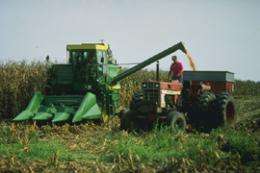
ARS scientists have found that using alternative types of fertilizers can cut back on greenhouse gas emissions from crop production, at least in one part of the country.

(PhysOrg.com) -- Agricultural Research Service (ARS) scientists have found that using alternative types of fertilizers can cut back on greenhouse gas emissions, at least in one part of the country. They are currently examining whether the alternatives offer similar benefits nationwide.

Nitrogen fertilizers are often a necessity for ensuring sufficient crop yields, but their use leads to release of nitrous oxide, a major greenhouse gas, into the atmosphere. use is one reason an estimated 78 percent of the nation's nitrous oxide emissions come from agriculture, according to Ardell Halvorson, a scientist at the ARS Soil Plant Nutrient Research Laboratory in Fort Collins, Colo.

Halvorson compared nitrous oxide emissions from corn fields treated with either a conventional (urea) or either of two specially formulated urea fertilizers—one with "controlled release" polymer-coated pellets, and the other with inhibitors added to "stabilize" the urea to keep more of it in the soil as ammonium for a longer period.

In a two-year experiment at Fort Collins, he collected the emissions using static vented chambers, similar to small "pillbox" structures placed over the soil. He chose a no-till cropping system because it's known to reduce carbon dioxide emissions. He found that the controlled-release fertilizer cut nitrous oxide emissions by a third, and that the stabilized fertilizer cut them almost in half.

Halvorson's results are so far limited to the irrigated fields and cool, semi-arid conditions in and around Fort Collins. But releases are the result of a complex interplay of conditions that vary from one area to the next, such as soil water content, soil temperatures, soil types, microbial activity, climactic conditions and rainfall patterns. So Halvorson is expanding the study, with support from the fertilizer industry and cooperation of other ARS locations, to see how the fertilizers respond at seven sites around the United States.

Read more about ARS climate change research in the November/December 2009 issue of Agricultural Research magazine.

Provided by USDA Agricultural Research Service


Rate this story - 1 /5 (1 vote)


November 18, 2009 all stories

Comments: 0

1 /5 (1 vote)

  • hide
  • Related Stories


  • hide
  • Relevant PhysicsForums posts

Other News

Great tits: birds with character

Great tits: birds with character

Biology / Plants & Animals

created 9 hours ago | popularity 5 / 5 (3) | comments 3 | with audio podcast

(PhysOrg.com) -- In humans and animals alike, individuals differ in sets of traits that we usually refer to as personality. An important part of the individual difference in personality is due to variation ...


Cells can read damaged DNA without missing a beat

Biology / Cell & Microbiology

created 8 hours ago | popularity 5 / 5 (1) | comments 0 | with audio podcast

Scientists have shown that cells' DNA-reading machinery can skim through certain kinds of damaged DNA without skipping any letters in the genetic "text." The studies, performed in bacteria, suggest a new mechanism that can ...


Study carried out into biological risks of eating reptiles

Study carried out into biological risks of eating reptiles

Biology / Cell & Microbiology

created 11 hours ago | popularity 3 / 5 (2) | comments 4

Reptiles are bred in captivity primarily for their skins, but some restaurants and population groups also want them for their meat. A study shows that eating these animals can have side effects that call into ...


Researchers find genes that 'tune' flower fragrances

Biology / Biotechnology

created 12 hours ago | popularity 5 / 5 (1) | comments 0 | with audio podcast

(PhysOrg.com) -- Shakespeare famously wrote, "That which we call a rose by any other name would smell as sweet." With all due respect to the Bard, University of Florida researchers may have to disagree: no matter what you ...


Researchers map all the fragile sites of the yeast Saccharomyces cerevisiae's genome

Biology / Cell & Microbiology

created 12 hours ago | popularity not rated yet | comments 0 | with audio podcast

The research group of Dr. François Robert, a researcher at the Institut de recherches cliniques de Montréal (IRCM), in collaboration with the team of Dr. Daniel Durocher (Samuel Lunenfeld Research Institute and University ...